
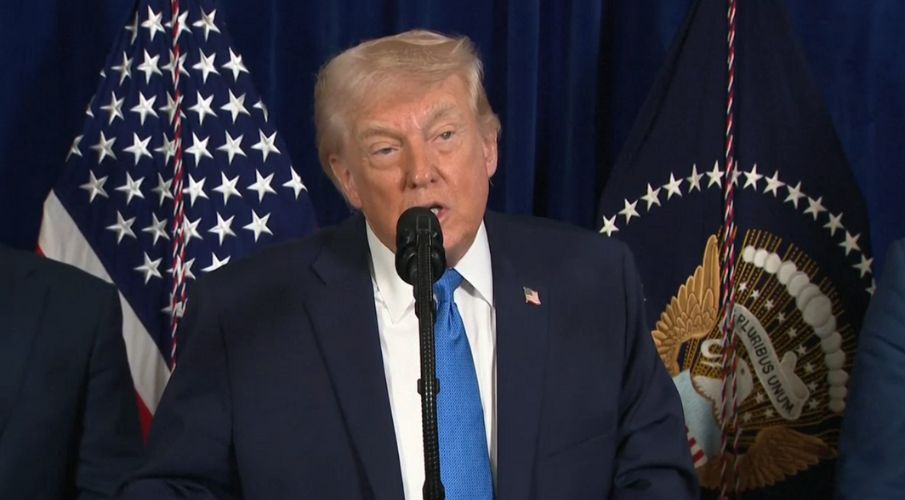
In the night leading into Saturday, the United States overthrew Venezuelan President Nicolas Maduro. US special forces entered his government residence at the Fuerte Tiuna military base, arrested him and his wife Cilia Flores, and flew both out of the country. As early as August 11, 2025, we had issued an urgent warning about this escalation. Excerpt: “The international community bears responsibility to break its silence. Defending the sovereignty of Latin America is not only a question of regional stability, but a test of the validity of international legal norms in the 21st century. In a world in which power increasingly triumphs over law, Latin America’s resistance to renewed intervention could become a test case for the future of the international order. Venezuela has long been a thorn in Trump’s side, and sooner or later he will reach out for it.”
The military operation, which President Donald Trump described as “brilliant,” ended Maduro’s twelve-year rule with an unprecedented act of violence that triggered fierce international reactions.
US attack in Venezuela - The number of dead is still unknown
Trump announced the success of the mission on his platform Truth Social and spoke of “large-scale attacks on Venezuela” carried out jointly with US security agencies. In a brief telephone interview, the president expressed satisfaction: “A lot of good planning and great troops. It was a brilliant operation.” When asked about the constitutional basis and Venezuela’s future.

The arrest of Maduro is the dramatic culmination of a campaign that the Trump administration had pushed forward for months with growing intensity. What began as threats and economic sanctions escalated over weeks into a military campaign that destabilized the entire region and now puts international law to a severe test. The Venezuelan government reported explosions and airstrikes on military facilities in Caracas and the surrounding states of Miranda, Aragua, and La Guaira. The La Carlota air force base in the capital was particularly hard hit, where burned-out military vehicles were visible hours after the attacks. The Communications Ministry in Caracas declared a state of emergency and condemned the US “military aggression.” “Venezuela rejects, condemns, and denounces this imperialist attack,” a statement said. The government called on all social and political forces to activate mobilization plans.
US attack in Venezuela - The number of dead is still unknown
How many Venezuelans were killed or injured in the attacks initially remained unclear. Attorney General Tarek William Saab said in a televised address that there were “innocent victims who were fatally wounded or killed by this criminal terrorist attack.” He urged the population to take to the streets “with calm and vigilance.” A US government official confirmed that there were no American fatalities, but declined to comment on Venezuelan casualties.
PRESIDENT TRUMP said on the program “FOX & Friends Weekend” that Maduro and his wife were initially brought aboard the USS Iwo Jima: “They are on a ship, and they are being brought to New York … They flew by helicopter, a beautiful flight. I’m sure they enjoyed it.”
Trump later said on Fox News that a helicopter had been hit and that “a few people were injured.” “A few were hit, but they came back and are supposed to be in pretty good shape,” he said. No American aircraft had been lost. “We got everything back. One of them was hit pretty hard, a helicopter, but we got it back. We had to do it, because it’s a war.” The president said he followed the operation via video transmission from Mar-a-Lago. He described how special forces breached steel doors “in seconds.” “I’ve never seen anything like it,” Trump said. According to a member of the Venezuelan ruling party, Maduro and his wife were in their residence within the Fuerte Tiuna military complex when the attacks began. “That’s where they bombed,” said party official Nahum Fernández. “And that’s where they carried out what we can call an abduction of the president and the first lady of the country.”
CIA conducted months-long surveillance
Behind the successful seizure was a sophisticated intelligence operation. As early as October 16, 2025, we had pointed to and questioned this measure based on our own research. At the time, reactions were conspicuously muted. Today, by contrast, this very step is being taken up everywhere - as if it had suddenly emerged out of nowhere, like a rabbit pulled from a hat. According to people familiar with the operation, the CIA had recruited a source in Maduro’s immediate circle who relayed his whereabouts both in the days leading up to and in the decisive moments before the arrest. The surveillance was supported by a fleet of stealth drones that circled Venezuela almost continuously and generated precise movement profiles. How the CIA managed to recruit the Venezuelan source is unknown. Former intelligence officials pointed, however, to the 50 million dollar reward the US government had offered for information leading to Maduro’s arrest. That money is now likely to be divided. A person familiar with the events described the arrest as the “product of a deep partnership between the agency and the military” and spoke of “months of meticulous planning.” Investigations have repeatedly shown that Maduro’s location was known with precision at all times.
CIA Director John Ratcliffe had promised during his confirmation hearing last year to lead a more aggressive agency willing to conduct covert operations both to gather intelligence and to enforce American policy. Last fall, Trump authorized more aggressive measures for the CIA and in November approved planning and preparation for a series of operations in Venezuela. At the end of December, the CIA used an armed drone to strike a port that US authorities believed was being used by a Venezuelan gang to load drugs. Although the CIA played a decisive role in planning and execution, the mission was formally a law enforcement operation by military special units and was not carried out under the agency’s own authority - a legal technicality that carries little weight given the scale of the operation.
Maduro on the way to New York
Trump said on Fox News that Maduro and his wife had been taken to the warship USS Iwo Jima, which has been cruising the Caribbean for weeks. Survivors of the controversial boat attacks, in which US forces killed at least 115 people in recent months, had already been brought to the same ship. From there, the couple is to be transferred to New York.
Attorney General Pam Bondi announced that both would be tried in New York. “Nicolas Maduro and his wife Cilia Flores have been charged in New York,” she wrote on X. “They will soon feel the full force of American justice on American soil in American courts.” Maduro had already been indicted in March 2020 in the Southern District of New York - on charges of terrorism related to drugs, conspiracy to import cocaine, and possession and conspiracy to possess machine guns. His wife was not listed in the original indictment, indicating that prosecutors have prepared an expanded charging document.

The 2020 indictment accused Maduro of leading a drug trafficking organization called the Cartel de los Soles, the Cartel of the Suns. The name is an ironic reference to the sun insignia on the shoulder boards of Venezuelan military officers. Under Maduro’s leadership, the organization allegedly not only enriched its members and expanded its power, but also sought to “flood” the United States with cocaine and “inflict the harmful and addictive effects of the drug on consumers in this country.” The indictment claimed that Maduro and others had “prioritized cocaine as a weapon against America.”
The term “Cartel de los Soles” is primarily used as a collective label to describe alleged links between high-ranking Venezuelan military and political officials and drug trafficking. Unlike classic drug cartels, however, neither a clearly defined organizational structure nor a formal existence of this “cartel” established by a court has been proven. The term therefore serves more as a political and analytical description than as the designation of a clearly documented criminal organization.
Secretary of State Marco Rubio, who had been a driving force behind the campaign against Maduro, repeatedly referred to the Venezuelan leader as “a fugitive from American justice.” The Southern District prosecutor’s office had had Maduro in its sights for years. The investigations were led by Emil Bove III, a former criminal defense lawyer for Trump. One of the prosecutors in the 2020 case was Amanda Houle, who now heads the office’s criminal division.
Senator Mike Lee of Utah said Rubio had informed him that Maduro had been “arrested by US personnel to be brought before courts in the United States on criminal charges.” Rubio also told Lee that he expected “no further actions in Venezuela now that Maduro is in US custody.” Christopher Landau, deputy secretary of state, wrote on X that the action marked “a new morning for Venezuela.” “The tyrant is gone. He will finally be held accountable for his crimes.”

In Venezuela itself, it initially remained unclear who was now running the government. Vice President Delcy Rodríguez, who under Venezuelan law would have to assume succession, appeared on state television and demanded that Trump provide proof that Maduro was alive. She called on the population and the armed forces to defend Venezuela and described the US action as “military aggression” that violated the country’s sovereignty. Rumors that she had been in Russia at the time of the attacks were not officially confirmed. Rodríguez, who was partly educated in France, had led a market-friendly economic reform that had given Venezuela a measure of stability after a long economic collapse, prior to the US military campaign against Maduro. Her older brother Jorge Rodríguez, president of the National Assembly and Maduro’s chief political strategist, shared via Telegram a statement by his sister describing the move as an attempt to seize Venezuela’s oil reserves.
Other senior Maduro confidants also appeared in the hours after the attacks. Defense Minister Vladimir Padrino López, who has been in office for eleven years and is considered a survivor of political upheavals, called the attacks an act of “criminal military aggression” on state television. Interior Minister Diosdado Cabello, a retired military officer and hardliner with a biting political style, urged Venezuelans to support Maduro’s government. Cabello, who stands at the head of Venezuela’s repression apparatus, had gained public profile in recent weeks as the United States intensified its campaign. Although allied with Maduro, he is also regarded as an internal rival within Venezuela’s power structures. The survival of these key figures suggests that Venezuela’s government continues to function, at least for now, albeit shakily. A war game conducted during Trump’s first term had predicted chaotic power struggles between military units, rival political factions, and guerrilla groups if Maduro were toppled.
In the province of Sucre, about 500 kilometers east of Caracas, Governor Jhoanna Carrillo called party members to gather in the town square. Together with Mayor Pedro Figueroa, she demonstrated loyalty to the president. “We demand that the entire world speak out against the threat and chaos they have tried to sow in our homeland,” Carrillo said. In Caracas, armed civilians began patrolling the streets. Several men in civilian clothing were seen shortly after dawn guarding the General Francisco de Miranda air force base outside Caracas. Two pickup trucks loaded with men in vests and civilian clothing carrying gas canisters as well as long and short firearms were unloaded in front of a shopping center near the base. Venezuela’s government has long used armed civilians, so called colectivos, to crack down on protesters.
Caracas Mayor Carmen Meléndez joined a pro-Maduro demonstration in which the crowd demanded his immediate return. “Maduro, hold on, the people are rising up,” demonstrators chanted. “We are here, Nicolas Maduro. If you can hear us, we are here.” Elsewhere in the city, residents reacted with mixed feelings. “How do I feel? Afraid, like everyone else,” said Caracas resident Noris Prada, sitting on an empty street and looking at his phone. “Venezuelans woke up afraid, many families couldn’t sleep. I was on the road, just came back from Maracay, everything is blocked, everything is bad, very bad.” Electrician Alfonso Valdez said of the US government: “They enforce the law. They are the police of the world… they are murderers.”
The Venezuelan opposition initially remained silent. A spokeswoman for María Corina Machado, the opposition leader and 2025 Nobel Peace Prize laureate, declined to comment, later releasing a letter. Machado last appeared publicly in December, when she traveled to Norway after eleven months in hiding to receive the Nobel Prize. Edmundo González, a retired diplomat widely regarded as the rightful winner of the 2024 presidential election, also did not comment. After the election, which Maduro claimed for himself, González had been forced to flee to Spain.

Venezuelans,
the HOUR OF FREEDOM has arrived!As of today, Nicolas Maduro is facing international justice for the cruel crimes he committed against the Venezuelan people and against citizens of many other nations. After refusing to accept a negotiated way out, the government of the United States has fulfilled its promise to enforce the law. The hour has come in which popular sovereignty and national sovereignty will revive in our country. We will restore order, free political prisoners, build an extraordinary country, and bring our children home.
We fought for years, we gave everything - and it was worth it. What had to happen is happening now. This is the hour of the citizens. Of those who risked everything for democracy on July 28. Of those who elected Edmundo González Urrutia as the legitimate president of Venezuela, who must immediately assume his constitutional mandate and be recognized as commander in chief by all officers and soldiers of the National Armed Forces.
Today we are ready to enforce our mandate and take power. Let us remain vigilant, active, and organized until the democratic transition is completed. A transition that needs ALL of us. To Venezuelans in the country: be ready to carry out what we will very soon communicate to you through our official channels. To Venezuelans abroad: we need you mobilized - activate the governments and citizens of the world and involve them from now on in the great task of rebuilding a new Venezuela. In these decisive hours, receive all my strength, my trust, and my affection. Let us all remain vigilant and in contact.
VENEZUELA WILL BE FREE!
Let us walk hand in hand with God - until the end.María Corina Machado
January 3, 2026
Trump showed restraint in supporting Machado. “Well, we have to look at that now,” he said on Fox News when asked whether he would support her. “They have a vice president, as you know. I mean, I don’t know what kind of election that was, but Maduro’s election was a disgrace.” The president also made clear that the United States would decide what happens next in Venezuela. “We will be very strongly involved,” Trump said, in who governs the country. “We can’t risk letting someone else take over and just take over what he left behind.”
Trump also warned senior Venezuelan officials: “If they stay loyal, the future is really bad, really bad for them. I would say most of them have converted.” Vice President JD Vance defended the operation in a statement on X: “The president offered multiple exit options, but was very clear throughout the process: drug trafficking must stop, and the stolen oil must be returned to the United States. Maduro is the latest person to find out that President Trump means what he says. Praise to our brave special forces who carried out a truly impressive operation.”
The arrest of Maduro is the provisional climax of a campaign the Trump administration pursued with three objectives: weakening Maduro, using military force against drug cartels, and securing access to Venezuela’s vast oil reserves for US companies. Since late August, the Pentagon had assembled about a dozen ships with more than 15,000 troops in the Caribbean - the largest naval buildup in the region since the Cuban Missile Crisis of 1962. C-17 transport aircraft, primarily used to move military personnel and equipment, carried out at least 16 flights from US military bases to Puerto Rico in December.

The boat attacks began in the summer. On July 25, Trump signed a secret order authorizing military action against cartels that envisioned maritime strikes. Government officials referred to the boat attacks as “Phase One,” with SEAL Team 6 taking the lead. At the time, policymakers also discussed a vague “Phase Two,” in which Army Delta Force units might carry out operations on land. In a total of 35 known attacks on boats in the Caribbean and eastern Pacific, at least 115 people were killed. Many, possibly most, of the suspected drug traffickers were Venezuelan citizens, but people from Colombia, Ecuador, and Trinidad were also on the targeted boats. Unlike traditional counternarcotics operations that target high-level cartel leaders, the boat attacks focused on low-level actors in the illegal drug trade. Numerous legal experts described the strikes as unlawful extrajudicial killings. The Trump administration, however, claimed they were consistent with the laws of war because the United States was in an armed conflict with drug cartels.

Trump had repeatedly threatened to carry out strikes on Venezuelan soil. In October, he abandoned efforts to reach a diplomatic agreement with Maduro after the Venezuelan leader refused to step down voluntarily and government officials continued to insist they had no role in drug trafficking. Maduro had appealed for peace just two days before his arrest in an interview with Spanish journalist Ignacio Ramonet. “The American people should know that we have peaceful, friendly people here, and also a friendly government,” he said to the camera. “They should know that our message is very clear: No war. Yes peace.” He handed the journalist a red cap in the style of the “Make America Great Again” hat with the words “No War. Yes Peace.”
In the same interview, Maduro said he was ready to work with the United States to avoid conflict. “If they want to have a serious conversation about a counternarcotics agreement, we are ready. If they want Venezuelan oil, Venezuela is ready for US investments - like Chevron - anytime, anywhere, and however they want. People in the United States should know that Venezuela is right here if they want comprehensive economic development agreements.” Trump declined. “I didn’t want to negotiate,” he later said on Fox News. “I said: No, we have to go through with it.”
That the United States is facing a veritable fentanyl catastrophe is beyond question. More than 100,000 deaths per year are a tragedy. But the militarization of drug policy carries the risk of fighting an enemy that may not even exist in that form. Even if TdA cells in US cities are dismantled - whether through police work or military force - the demand for drugs remains, and other cartels will fill the gaps.

In the United States people all too readily close their eyes to the homegrown causes of the crisis and shift the blame to foreign states. The truth is: As long as Washington clings to an outdated social system and pursues policies that neglect prevention, health care, and drug treatment, the fentanyl epidemic will continue to escalate. Thousands of illegal drug labs exist in the United States itself - a fact that is hardly mentioned in the public debate. Against this backdrop, the "drug wars" against Venezuela propagated by Trump appear less like a security concept and more like a political distraction maneuver that obscures the real structural problems at home.
Our investigations reveal that the administration is willing to turn an internal crisis - ongoing violence and the drug epidemic - into a foreign policy project. It wants to project toughness, demonstrate military strength, and present a tangible enemy. Mexican President Claudia Sheinbaum put it succinctly in June: “The US government must take responsibility for the opioid crisis.” But instead of confronting its own failures, Trump is now projecting the problem onto Venezuela - a politically useful scapegoat with oil. Is Venezuela really flooding the United States with drugs - or is security policy being staged as theater? Anyone who looks at sober data instead of headlines sees a different picture. Venezuela is not a significant producer of cocaine. It is primarily a transit country - a corridor fed by the porous, thousand kilometer border with Colombia, the world’s largest producer. US government estimates in 2020 placed around 200 to 250 tons of cocaine transiting Venezuela annually - roughly one tenth of global volume. That is substantial, but it is not the epicenter. Other routes move far more product. In 2023, according to our research, about 1,700 tons passed through Guatemala. Geography of logistics is also decisive: the main flow to North America runs through the Pacific. From 2019 to 2023, roughly three quarters of all shipments were recorded via the Pacific corridor, mainly from Colombia and Ecuador. The Caribbean was the smaller, though more visible, stage. And with fentanyl - the real killer of the US opioid crisis - Venezuela is little more than a rhetorical lightning rod. The synthetic drug is produced almost entirely in Mexico, from precursor substances often originating in China. It is documented that cocaine in the United States is cut with fentanyl - but the cutting happens in Mexico or on US soil in thousands of small labs, not in Caracas.
The truth is bitter: Trump’s “solution” of redirecting the fentanyl crisis toward Venezuela is nothing more than a media effective diversion. He needs enemy images to distract from decades of failed domestic policy, to divert attention from the real crisis, because the major boom in the United States began in 2018, during Trump’s first term - a crisis that is now deeply rooted in American society. In a country where the health care and social systems are chronically underfunded, where Robert Kennedy Jr. has been installed as health secretary acting like a butcher, where mental illnesses often go untreated, where economic insecurity and lack of prospects drive millions into addiction, drug consumption remains high - regardless of which drug currently dominates.
As the boat attacks continued in the fall, Trump, Rubio, and Stephen Miller, a senior White House adviser on immigration policy, moved on to the next phase of the campaign against Maduro: seizing oil tankers to deprive Venezuela of revenue. They insisted that Maduro must return oil and other assets that the United States claimed had been “stolen” before they would lift what Trump called a blockade. In the first weeks, the tactic shook Venezuela’s economy by paralyzing the oil industry. Critics called it gunboat diplomacy or, as Maduro put it, “a warmongering and colonialist presumption.”

The United States seized a sanctioned tanker transporting oil from Venezuela to Asia. It intercepted another oil tanker that was not under US sanctions. And the US Coast Guard attempted to board a third tanker en route to Venezuela to pick up cargo. Chevron, the largest private oil producer in Venezuela, declined on Saturday morning to comment on the status of its operations in the country. “Chevron continues to focus on the safety and well being of our employees and the integrity of our facilities,” a spokesperson said.
Celebrations in Florida, outrage around the world
In South Florida, where about 40 percent of Doral’s residents are of Venezuelan origin, celebrations broke out before sunrise. Venezuelans and Venezuelan Americans blasted loud music, honked car horns, and danced to celebrate Maduro’s arrest. “Long live free Venezuela,” shouted a man waving a Venezuelan flag as he drove past El Arepazo, a Venezuelan arepa shop at a gas station where Venezuelans often gather for political or sporting events. South Florida is home to the largest Venezuelan community in the United States, and the overwhelming majority opposes Maduro. Millions have left Venezuela in recent years amid economic chaos and political repression. Some immigrated here more than two decades ago. Others are more recent arrivals. Many of them watched anxiously in recent months as Trump escalated his threats and boat attacks against Venezuela.
At one point, a few hundred people stood in the middle of the gas station, which was closed and guarded by police, singing traditional Venezuelan songs as well as the Venezuelan and American national anthems. The arepa shop was still closed, so some people slipped into the neighboring supermarket to grab coffee or the occasional celebratory beer. Several people said they were worried about what would come next after Maduro was no longer in power, although all said they were optimistic. “I don’t know what will happen,” said Tibisay Mejía, 51, who immigrated in 2015. “But this is the beginning.” Several Republican lawmakers representing districts in South Florida with large Venezuelan American communities celebrated the arrest. “Today’s decisive action is the equivalent in this hemisphere of the fall of the Berlin Wall,” Representative Carlos Gimenez wrote on X. Representative Mario Díaz-Balart praised Trump’s “decisive leadership,” and Representative Maria Salazar said it was time for “the rightful leaders of Venezuela to restore freedom and rebuild the nation.” Representative Don Bacon of Nebraska cautioned, however, that while the mission was “great for the future of Venezuelans and the region,” it could give authoritarian powers justification for aggression elsewhere. “My main concern now is that Russia will use this to justify their illegal and barbaric military actions against Ukraine, or China to justify an invasion of Taiwan,” he wrote.
International outrage
The international community reacted largely with concern and criticism. UN Secretary General António Guterres expressed alarm over the events in Venezuela and warned that the US military action would have far-reaching implications for the region. “Regardless of the situation in Venezuela, these developments represent a dangerous precedent,” he said, calling for adherence to international law. UN spokesperson Stéphane Dujarric added that the United Nations was “deeply concerned” about the US attacks and the reported arrest of Maduro. The organization expressed concern that the escalation could constitute a violation of international law. “These developments represent a dangerous precedent,” Dujarric said in a statement. He voiced concern about broader effects on Latin America and the Caribbean and urged “all actors in Venezuela” to respect human rights and the rule of law.
Russia’s Foreign Ministry called the US action “an act of armed aggression” and “extremely alarming.” “Venezuela must be guaranteed the right to determine its own fate without any destructive, let alone military, interference from outside,” a statement published on Telegram said. The ministry called for dialogue to prevent further escalation and reaffirmed its “solidarity” with the Venezuelan people and government. Foreign Minister Sergei Lavrov spoke by phone with Vice President Rodríguez and expressed “resolute solidarity with the Venezuelan people in the face of armed aggression.” Moscow would continue to support the government, according to a summary of the call released by the ministry. Russia supports calls for an emergency meeting of the UN Security Council.
China sharply condemned the US attack. The Foreign Ministry said the government in Beijing was “deeply shocked” and firmly opposed the operation. “Such hegemonic actions by the United States seriously violate international law and Venezuela’s sovereignty and threaten peace and security in Latin America and the Caribbean,” it said. China urged the United States to comply with international law and the principles of the UN Charter and not to violate the sovereignty and security of other nations.
Ecuador’s President Daniel Noboa appeared to support Maduro’s arrest and wrote on X: “All narco chavista criminals, your time is coming,” expressing his support for Venezuelan opposition leaders María Corina Machado and Edmundo González.
Colombia’s President Gustavo Petro, one of Trump’s sharpest critics, said the Colombian government convened a national security meeting before dawn and sent security forces to the border to prepare for a possible “mass influx of refugees” from neighboring Venezuela. He announced he would ask the UN Security Council to examine “the aggression against the sovereignty of Venezuela and Latin America.” “Without sovereignty, there is no nation,” Petro wrote.
Germany’s federal government said it was observing developments “with the greatest concern.” The government’s crisis unit was meeting at the Foreign Office to discuss the situation. “We are monitoring the situation in Venezuela very closely,” a statement said. The Foreign Office was in close contact with the embassy in Caracas. The situation remained unclear in parts. “We are coordinating closely with our partners.”
EU foreign policy chief Kaja Kallas called for restraint after a phone call with Secretary Rubio. “The EU has repeatedly stated that Mr Maduro lacks legitimacy and has advocated a peaceful transition,” she wrote on X. “Under all circumstances, the principles of international law and the Charter of the United Nations must be respected. We call for restraint.” She added that the safety of EU citizens in Venezuela was the EU’s top priority, without directly criticizing the United States. Kallas’s statement raises serious questions about the EU’s capacity to act.
European Council President António Costa expressed concern over the attacks. “The European Union calls for de escalation and for a solution in full respect of international law and the principles enshrined in the Charter of the United Nations,” Costa wrote on X. The EU would continue to work for a peaceful, democratic, and inclusive solution in Venezuela.
Spanish Prime Minister Pedro Sánchez, who had previously criticized Trump’s military actions in Venezuela, struck a more cautious tone. “We call on everyone to de escalate and act responsibly. International law and the principles of the UN Charter must be respected,” he wrote on X. Spain’s Foreign Ministry offered mediation and called for “de escalation and restraint.” It declared itself “ready to help in the search for a democratic, negotiated, and peaceful solution for the country.”
British Prime Minister Keir Starmer said the United Kingdom had not been involved in the US operation in Venezuela and that he would seek further information from Trump. Without condemning the US action, Starmer said he always believed international law should be upheld. “But I think at this point, in this fast moving situation, we should establish the facts and proceed from there,” he said.
Constitutional debate in Washington
In the United States, the operation triggered a heated constitutional debate. Trump had not sought explicit authorization from Congress for the military action, even though a bipartisan group in the Senate had been working for months on legislation to restrict his authority to act militarily in Venezuela. The ranking Democrat on the House Intelligence Committee, Jim Himes of Connecticut, sharply criticized the move. While calling Maduro an “illegitimate ruler,” he said there was no evidence that Maduro posed a threat justifying military intervention. “Secretary Rubio has repeatedly denied to Congress that the administration intends to force regime change in Venezuela,” Himes said. “The administration must immediately brief Congress on its plan to ensure stability in the region and its legal justification for this decision.”
Trump wies die Kritik schroff zurück. Er nannte seine demokratischen Kritiker „schwache, dumme Leute“ und machte seine politischen Gegner für die Inflation in den USA verantwortlich. Die Operation in Venezuela sei „wirklich genial“ gewesen. „Alles, was sie tun, ist sich beschweren. Sie sollten sagen: Großartige Arbeit. Sie sollten nicht sagen: Oh Gott, vielleicht ist es nicht verfassungsgemäß. Wissen Sie, das gleiche alte Zeug, das wir seit Jahren und Jahren und Jahren hören.“ Als er gefragt wurde, ob er die Zustimmung des Kongresses für die Operation eingeholt habe, sagte Trump, er werde diese Fragen während der Pressekonferenz in Mar-a-Lago beantworten.
The Republican Senate majority leader, John Thune, called Maduro’s arrest “an important first step toward bringing him to justice for the drug crimes for which he has been charged in the United States.” He described the operation as “decisive action” by President Trump.
Trump also hinted that similar actions against Mexico could follow. The operation in Venezuela was not intended as a message to Mexico, he said, but then added that he had suggested to Mexican President Claudia Sheinbaum that the United States could “take out” the cartels in her country. “We have a friendly relationship with her, she’s a good woman. But the cartels run Mexico. She doesn’t run Mexico. The cartels run Mexico,” Trump said. He said he had repeatedly asked Sheinbaum, “Do you want us to take out the cartels?” but she had declined. “Something has to be done with Mexico,” Trump said.
The Federal Aviation Administration imposed a temporary airspace restriction for Puerto Rico’s international airport and surrounding regions. Luis Muñoz Marín International Airport in San Juan said on X that the restriction was imposed due to the “security situation associated with military activities” in Venezuela. As a result, most commercial airline flights to and from the airport operated by US carriers were suspended or could be canceled. Foreign airlines and military aircraft were not affected by the restriction. “Passengers are strongly urged to check the status of their flight directly with their airline before traveling to the airport.”
The State Department issued a new travel advisory early Saturday morning urging Americans in Venezuela to “shelter in place.” “The US Embassy in Bogotá is aware of reports of explosions in and around Caracas, Venezuela,” it said without further elaboration. “The US Embassy in Bogotá, Colombia, warns US citizens against travel to Venezuela. US citizens in Venezuela should shelter in place.” The embassy in Bogotá has been closed since March 2019 but operates remotely.
Attention is now focused on how the Venezuelan military will respond to the US attacks. US forces appeared not to have encountered significant resistance from Venezuelan air defense systems or ground troops, despite Venezuela’s claims to possess an arsenal capable of confronting, if not repelling, such an incursion.
In Venezuela, the future is uncertain. Reactions in Caracas to the US attacks and Maduro’s arrest were mixed. At a pro Maduro protest in the capital, Mayor Carmen Meléndez joined a crowd demanding Maduro’s immediate return. Elsewhere, residents were still processing events. “They enforce the law,” electrician Alfonso Valdez said of the US government. “They are the police of the world… they are murderers.”
The operation raises fundamental questions about international law, American foreign policy, and Venezuela’s future - questions that will require answers in the days and weeks ahead. The press conference only completes the picture. Here, the breach of international law is framed as a deployment of the DEA and the Department of Justice, which can only be described as detached from reality.

The press conference felt less like a sober briefing than like the public proclamation of a power play. Donald Trump presented the arrest of Nicolas Maduro as a military demonstration of unprecedented strength - an operation from “air, land, and sea,” so massive that he compared it to operations of the Second World War. He spoke of overwhelming power, of total control, of an action only the United States could carry out. At the same time, he appeared overtired, erratic, driven.
At the center, Trump made unmistakably clear that this was not a limited arrest operation but a regime change. The United States would “for a certain time” run Venezuela itself. Who exactly would govern the country remained vague - Trump spoke of a “group,” gestured to his advisers behind him, and named the defense secretary, the secretary of state, and the chairman of the Joint Chiefs. A time frame? None. A legal basis? None either. He repeatedly emphasized that the United States would determine when and how Venezuela would be “handed over” again.
Strikingly, Trump quickly shifted from military details to oil. Barely asked about Venezuela’s future, he spoke about destroyed energy infrastructure, about American oil companies rebuilding it - for payment. Venezuela would make a lot of money, he said, adding that previous governments had “stolen our oil.” At that point at the latest, it became clear that economic interests were a central part of the narrative.
Secretary of State Marco Rubio attempted to frame the operation as a kind of law enforcement action, as a necessary operation without prior notification to Congress. Trump openly interrupted him: Congress tends to leak, he said - and then added that they had known anyway that the United States was coming. Asked about previous failed US interventions in Latin America, Trump brushed off any criticism: not under him, he said. His record was “perfect.”

Militarily, the generals delivered the details: hundreds of aircraft, disabled air defenses, multiple helicopter waves, fire during evacuation, an operation lasting about two hours. Everything sounded precise, routine - like a familiar script from other wars. At the same time, statements about possible damage and risks contradicted each other. Trump at one point spoke of no losses, then again of hits on US equipment.
Politically, however, the situation was far less clear than Trump portrayed it. In Venezuela, the defense minister, attorney general, and governors appeared on camera, declared the US action illegal, and insisted they still controlled the country. State media showed rallies speaking of abduction and calling for international condemnation. There were no indications of an actual US presence in the country. Particularly explosive was Trump’s open threat to Venezuela’s leadership: what happened to Maduro could happen to any of them. At the same time, he justified the operation with alleged ties between Maduro and criminal gangs - even though his own intelligence community had previously qualified that claim. The new indictment, it was acknowledged, did not support all the allegations Trump was now making publicly.
In the end, the picture was one of great force but great uncertainty: a president openly speaking of occupation, of control over a foreign country, of oil and order - without a plan, without limits, without a discernible exit strategy. What was sold as an arrest turned out to be a takeover with an open ending. And with the question left hanging in the air: how long can such a claim be sustained without becoming exactly what Trump once promised to fight. Fact is: this entire story began with a lie - and it ends with a lie. The civilian population in Venezuela, whom he claims to protect and save, is being deported by him day after day, often under degrading and sometimes life threatening conditions. This is not theory. It is a reality we observe, document, and experience every day.
Updates – Kaizen News Brief
All current curated daily updates can be found in the Kaizen News Brief.
To the Kaizen News Brief In English


Danke für diesen umfangreichen Bericht mit all den Details.
Für mich ist es eine kriegerische Handlung mit Entführung.
Nicht einmal der IStGh kidnappt einfach Menschen um sie dann persönlich in Den Haag vors Gericht zu stellen.
Trump aber schnappt sich einfach einen Regierungschef und verschleppt ihn in die USA.
Ein Geschmäckle bleibt auch im Hinblick auf die Lobeshymne von Machado auf Trump.
Und dann tönt Trump, „die USA werden vorerst Venezuela selber führen“
Die USA wollen also Venezuela faktisch annektieren?
Und den Hinweis auf Mexiko finde ich extrem beunruhigend.
Und die Reaktionen von Europa etc finde ich beschämend.
Tanzen wieder auf Zehenspitzen um Trump.
Sind besorgt, sind empört, werden es genau beobachten …. was für Weicheier.
Anders kann man es nicht mehr sagen.
Trump kommt damit durch.
Sein Versagen in all anderen Bereichen rücken in den Hintergrund.
Die Epstein Files? Redet keiner mehr davon.
Und das das Drogenproblem hausgemacht ist, wird gar bicht erwähnt.
Weil es nie um Drogen ging.
Sondern um Macht und Bodenschätze.
Und was Trump vormacht, werden andere nachmachen.
Die Legitimation in Land einzufallen und einen unliebsamen Regierungschef verschleppen.
Es gilt das Recht des Stärkeren, nicht mehr der Gesetze.
Ich sehe Putins Hand schon über ganz Europa.
Xis Hand über Asien
Trumps Hand über den ganzen Kontinent… und Grönland.
Es sieht gerade arg hoffnungslos aus.
vielen dank, ja, es sind wirklich zeiten, wo viele doch wegschauen, bis es knallt. das problem ist tatsächlich, es gibt kaum noch internationale investigative journalisten, das ist ein großes problem, nicht weil wir das sind. wir hatten im august, wie du ja weisst davor gewarnt, im oktober haben wir schon auf die CIA Pläne hingewiesen, aber du hast kein netzwerk in diesem bereich mehr, weil die meisten aufgehört haben, weil sie kaum unterstützt wurden, oder bis zur entgültigen pleite gekämpft haben. agenturjournalismus will die tiefe nicht und dadurch fällt eine ganz grosse bastion, die guten widerstand, aufklärung, hilfe zusammenbringen kann, wo auch politiker nicht mehr wegschauen können. uns haben alle für verrückt schon fast erklärt, als wir das project kaizen auf den weg gebracht haben, aber wir sind hart im nehmen und ziehen das durch…. denn man muss in der heutigen zeit etws machen, nur so geht das … die fetten jahre sind schon lange vorbei, und das muss man einsehen und sich gegen das kommende wehren, dann kann es wieder besser werden. bis dahin, viel good luck