
The courtroom in Greenbelt, Maryland, filled with tension, mistrust, and an unusually candid judge. Kilmar Abrego Garcia is allowed to remain free. Not because his case is simple, but because it is the opposite. The presiding federal judge, Paula Xinis, has decided to keep the existing protective order in place. This means that the U.S. immigration authority Immigration and Customs Enforcement is, for the time being, barred from taking Kilmar Abrego Garcia back into deportation custody or carrying out his removal – at least through the holidays.
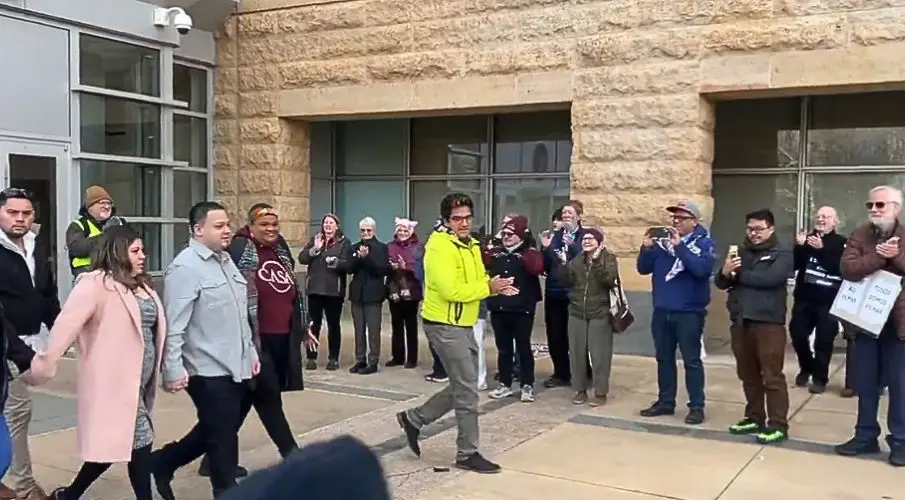
This morning – Kilmar on his way to the court in Greenbelt, Maryland
The judge’s tone left no doubt about how deeply the court’s trust in the government’s statements has eroded. Kilmar had already been deported once without a legal basis, Xinis noted. The explanations offered by government representatives in court had pushed her to the end of her patience. Why, she asked openly, should she grant the government any further benefit of the doubt on this matter. The question hung in the room like a heavy accusation – unanswered.
The Abrego Garcia case stands as an example of the distortions of current U.S. immigration policy. In March, the man from El Salvador was mistakenly deported and imprisoned in his home country, even though a court order was meant to protect him from exactly that. We have reported extensively on this since March 2025, were ourselves in El Salvador, and were actively involved in this case. Only after significant investigative work, political and legal pressure, up to and including the involvement of the Supreme Court, did he return to the United States in June. Hardly back, he again faced state action: an arrest warrant in Tennessee over alleged smuggling accusations and attempts by immigration authorities to remove him from the country once more. Just last Friday, another final deportation order arrived at the Garcia household, legally hardly defensible, the reasoning nonsense that only shows that the Department of Justice has long since abandoned law and order. Nevertheless, the Garcia family has decided to move to Costa Rica.
Bondi’s fantasy world already continued on December 12 – Kilmar is accused of soliciting nude photos from a minor and killing rivals. Who exactly is the U.S. justice system protecting here? (That her claims will also have criminal consequences is something she has long failed to realize – editor’s note)
On December 11, Judge Xinis ordered his release from deportation custody. The reasoning was clear: the government had presented no realistic plan for where Abrego was supposed to be deported. One day later, an interim order followed that prohibited ICE from immediately detaining him again. The hearing on Monday was meant to determine whether this order should be lifted. The judge’s answer was clear: not for now.
What unfolded in the courtroom was more than a formal hearing. Xinis tried to bring order to proceedings that were increasingly defying logic. She wanted to know whether any concrete removal proceedings were even planned. The government attorney’s answers remained vague. No arguments, only false claims. What was supposed to happen next, the government could not or would not say. For the judge, that was unacceptable. The protective order would remain in place, she declared, while she reviewed the unresolved questions. The situation was highly unusual and extraordinary.
Outside the courthouse, this legal confrontation was accompanied by loud support. Supporters greeted Kilmar, his wife, and his legal team with singing, drums, and chants. Inside, Kilmar sat among several defense attorneys, opposite them a single representative of the government – an image that reflected the balance of forces on that day. Particularly significant for the court was the conduct of the authorities in recent months. Since August, Kilmar had been in deportation custody. During that time, the government named a series of destination countries: Uganda, Eswatini, Ghana, most recently Liberia. None of these countries had agreed to accept him. At the same time, the authorities consistently ignored the only country that would accept Abrego and had even offered him protection: Costa Rica. Judge Xinis accused the government of deliberately misleading the court by claiming that Costa Rica was not an option. The refusal to acknowledge this offer, the threats of deportation to African states without consent, and the portrayal of Liberia as the supposedly only possibility showed, in the judge’s view, that the detention did not serve the purpose of timely removal, something our investigations had also established.
Kilmar’s attorneys made it clear in court once again that their client was ready at any time to go to Costa Rica – immediately, if allowed. One of his lawyers said after the hearing that it was obvious the government had no plan, but merely wanted to punish and please Trump. Whoever was currently keeping Kilmar in the United States, he said, was not the court but the state itself. He had finished with America, and as a free man, he had the right to decide his place of life himself.
Kilmar has lived in Maryland for years, is married to a U.S. citizen, and has a child. As a teenager, he came to the United States from El Salvador without papers. In 2019, an immigration judge granted him protection from being returned to his home country because he faced concrete danger there from a gang that had targeted his family. Despite this protection, the Department of Homeland Security insists that Kilmar Abrego Garcia may not remain in the United States and must be deported to a third country. At the same time, criminal proceedings are ongoing in Tennessee. There, his attorneys recently requested sanctions after a senior border protection official publicly disparaged their client in national media. In this matter as well, a court had already ordered officials to refrain from public statements that could prejudice Kilmar’s right to a fair trial. The evidence against Kilmar is so thin that it can easily be described as fabricated. Our investigations have clearly shown this as well.
Thus, Kilmar Abrego Garcia now stands between the fronts of a system that contradicts itself, delays, and gets lost. Judge Xinis’s decision is not an acquittal, not a final solution. It is a stop sign. A clear signal that a court is not prepared to tolerate further errors, evasions, and distortions of facts. For Kilmar, it means freedom for now. For the government, it means an uncomfortable task: finally explaining what it actually intends to do – and on what legal basis.
All of this is a consequence of right-wing populism. Anyone in Germany who believes this does not concern them is mistaken – profoundly so. Björn Höcke did not formulate this direction vaguely, but openly. In the spring of 2025, the AfD parliamentary leader in Thuringia declared that Erfurt-Weimar Airport should in future serve as a central site for deportations. People without residency status were to be gathered there and deported from there. The proposal was part of an official motion by the AfD parliamentary group in the state legislature. Höcke spoke of bundling and accelerating deportations. Lawyers and refugee organizations warned that this would effectively create a sealed-off collection site where people would be held without regular detention. A clear distancing did not follow. The plan remained on the table. CDU and CSU are also increasingly showing tendencies to find favor with such practices.
The case of Kilmar Abrego Garcia shows how crucial concrete help and support from people who know the pathways and know what needs to be done truly are. Hardly any such case can be resolved without investigation. This is also what the Trump regime relies on: people who have little money, few resources, and little legal knowledge of their own. Pushing back means working with lawyers and organizations that fight pro bono or for minimal fees. The effort is enormous. But every case won matters. Every case lost is taken up again. In a time when so much of this seems to play out only on social media, reality is elsewhere: on the streets, in deportation facilities, in countries where human rights offer no protection. That is exactly where our work and the work of many great organizations, lawyers, and people begins.
Der Fall Kilmar Abrego Garcia zeigt, wie sehr es auf konkrete Hilfe und Unterstützung von Menschen ankommt, die die Wege kennen, wissen, was zu tun ist. Kaum ein solcher Fall lässt sich ohne Recherche aufklären. Darauf baut auch das Trump-Regime: auf Menschen, die kaum Geld haben, kaum Mittel, kaum eigenes Rechtswissen. Dagegenhalten heißt, mit Anwälten und Organisationen zu arbeiten, die pro Bono oder zu minimalen Sätzen kämpfen. Der Aufwand ist enorm. Aber jeder gewonnene Fall zählt. Jeder verlorene wird wieder aufgenommen. In einer Zeit, in der sich vieles darüber nur noch in sozialen Netzwerken abspielt, ist die Realität woanders: auf den Straßen, in Abschiebeeinrichtungen, in Ländern, in denen Menschenrechte keinen Schutz bieten. Genau dort setzt auch unsere Arbeit und die vieler tollen Organisationen, Anwälten und Menschen an.
Updates – Kaizen News Brief
All current curated daily updates can be found in the Kaizen News Brief.
To the Kaizen News Brief In English


