
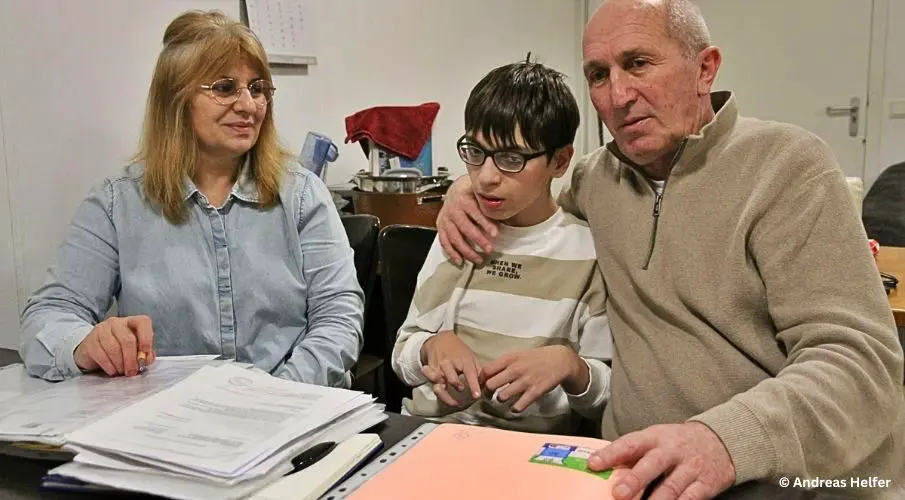
Nani Ninua does not hold back her tears. "For my son, deportation means death," she says. Fourteen-year-old Bagrat lies in his bed at the shelter in Lohmar-Birk. Three years ago, his parents came to Germany from Georgia because they saw no future for their severely disabled son. Now the immigration authority of the Rhein-Sieg district is demanding their departure - voluntarily, as it is put, otherwise deportation will follow. Bagrat suffers from a severe, life-threatening bladder disorder. His brain does not properly control bladder emptying. In Bonn, he receives medication through a special catheter that calms the organ. Without this therapy, kidney failure threatens. That is stated in a medical certificate from the Clinic and Polyclinic for Urology and Pediatric Urology at Bonn University Hospital. His mother fears a nighttime deportation, removal without warning, transport to the airport. "Deported," she says in Russian.
The boy has been seriously ill multiple times. Encephalopathy, spastic cerebral palsy, combined developmental disorder, epilepsy, blindness. Consequences of a brain hemorrhage after a premature birth. He is not cognitively impaired. In Georgia, he initially attended a primary school, without success, later a school for the blind. But there was no support for his motor impairments. As his condition worsened, his parents decided to leave the country. In Germany, Bagrat attends the LVR special education school at Königsforst in Rösrath with a focus on physical and motor development. He has learned German, sings in the choir, and his mother speaks of a "beautiful voice." Doctors have stabilized his bladder problems using the catheter method. "There is nothing like that in Georgia," says Nani Ninua.
An emergency motion against deportation was rejected by the Administrative Court of Cologne. The reasoning: treatment is available in Georgia, albeit not via catheter but with tablets and a liquid medication. Private clinics could also be consulted. The family counters that they lack the funds for private treatment and that tablets are not an option due to side effects. The catheter method is safer. The Lohmar-Siegburg refugee initiative, represented by Christa Feld, has intervened. It is calling for the right to remain. There are too many uncertainties that could worsen the boy’s health after deportation to the point that his life would be endangered. Feld refers to the European Convention on Human Rights. Deportation is impermissible if adequate medical care is not guaranteed in the country of origin or if an existential emergency threatens.
The district administration remains firm. All legal bases have been reviewed, it says. The illnesses were taken into account by the Federal Office for Migration and Refugees, the courts, and the immigration authority. Continued treatment of the underlying condition is possible in Georgia "with the necessary medications at the standard typical for the country." Dialysis treatment is also available there. The family will be provided with contacts, a medical handover will be organized, and a supply of medication for the transition period will be given. From the perspective of Bonn University Hospital, it reads differently. Incorrect therapy could lead to febrile urinary tract infections and acutely to urosepsis and death. Nani Ninua holds this medical certificate in her hands.
Support is coming from Lohmar City Hall. The former mayor Claudia Wieja of the Green Party publicly spoke out in favor of the family and said this is not about paragraphs but about humanity. Her successor Matthias Schmitz of the CDU announced talks with the immigration authority and raised the question of what lever must be moved to find the best possible solution, especially for the child. Political asylum was hopeless from the beginning, as Georgia is considered a safe country of origin. Nevertheless, the hardship commission of the state of North Rhine-Westphalia requested a right to remain, without success. Nani Ninua was preparing for a German language exam and signed an employment contract with a cleaning company starting April 1. Her husband Merab Sharia, a trained electrician of retirement age, offered volunteer work.
Now everything is once again on the brink. An administrative decision against a temporary suspension has been issued. The district administration considers the risk of kidney failure hypothetical, since treatment in Georgia is possible. The family reads the medical warnings differently. For Bagrat, Germany is more than a place of residence. It is school, therapy, choir, medical care that stabilizes his condition. For his mother, the question is not a legal one. It is existential.
Updates – Kaizen News Brief
All current curated daily updates can be found in the Kaizen News Brief.
To the Kaizen News Brief In English


Wie zynisch: „ Eine Weiterbehandlung der Grunderkrankung sei in Georgien „mit den notwendigen Medikamenten auf landestypischem Niveau möglich“.“