
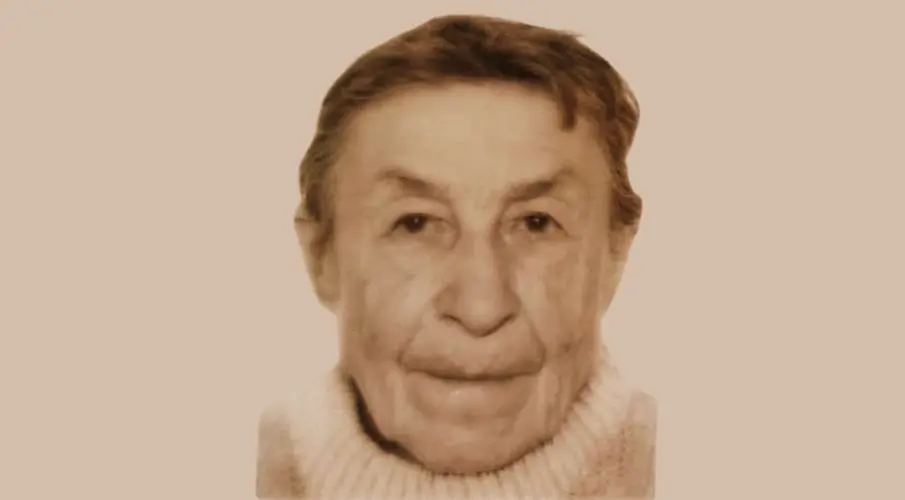
Yevgenia Mykhailivna Bezfamilna was 88 years old. As a child, she survived the Holocaust. She then died alone in her apartment in the historic center of Kyiv, a European capital under constant bombardment. Her surname came from an orphanage after the war. Bezfamilna means "without family." No one knew who she had been before everything was erased. No documents. No relatives. No traceable origin.

She belonged to those Jewish children who made it through a regime of extermination and then spent an entire lifetime living with that survival. Neighbors described her as reserved, cautious, withdrawn. She had learned early that trust at the wrong moment could be fatal. No one was allowed to simply enter her apartment. She had no children, no relatives. Only the nearby synagogue was a place where she felt among her own. People brought soup, food, hygiene supplies, small tokens of care. They looked after her. But she rarely opened the door. Those who survive war as children by remaining invisible often forget how to ask for help.

Two weeks before her death, the pipes in her apartment burst. During those days, the temperature in Kyiv dropped to below -24 degrees Celsius at times. Entire districts were repeatedly left without stable heat, water, and electricity. For many, that meant hardship. For the very old, it meant mortal danger. Some initially believed she had frozen to death. Officially, the cause of death is listed as heart failure due to chronic ischemic heart disease. Police stated that the apartment was largely dry, with water only in the kitchen following the pipe burst. Media outlets were urged not to speculate.

Her heart may have failed. She may not have frozen to death. And yet her death belongs to this war. Russia has been deliberately targeting civilian infrastructure for months. Power plants, pipelines, grids. With the declared intention of leaving cities without heat and turning winter into a weapon. When electricity fails, when heating systems stop working, when pipes burst under pressure, that is part of a strategy.

An 88-year-old Holocaust survivor in an unheated apartment, in a city under constant attack, officially dies of heart failure. But a weakened body gives out faster under such conditions. That is not an isolated medical event. Yevgenia Bezfamilna was living for the second time in her life in a country under attack. The knowledge that had saved her as a child became a trap in old age. The Holocaust had taught her to keep doors closed and trust no one. Those rules had preserved her life. They never left her. When Russia invaded Ukraine, no soldier needed to knock on her door. The war arrived through cold. Through blackouts. Through damaged infrastructure.
She was not the only one. In Kherson, 84-year-old doctor Alexander Bonder, also a member of the Jewish community, recently died from injuries sustained as a result of Russian shelling. Under the pretext of so-called "denazification," drones and missiles are launched, civilian infrastructure is destroyed, and elderly people are pushed into conditions they can scarcely endure. Wars do not kill only with projectiles. They take away shelter. They weaken the systems on which the elderly depend. Those who are old, ill, alone, need functioning services. When these are deliberately damaged, the burden on body and mind increases. The funeral for Yevgenia Mikhailovna took place on February 1, 2026 at the Jewish cemetery in Barakhty.

Her name was Yevgenia Bezfamilna. A name given to her because nothing else remained. She survived one war by becoming someone without an origin. She entered the second carrying that absence. Authorities will record a cause of death. What cannot be recorded is a life without a family name of her own, without a protected space, without the ability to ask for help. She died in a winter shaped by deliberate destruction. In Europe. Now.
Baruch Dayan HaEmet. May her memory be a blessing.
Updates – Kaizen News Brief
All current curated daily updates can be found in the Kaizen News Brief.
To the Kaizen News Brief In English


Und trotzdem hetzen Deutsche über die Hilfen in der Ukraine. Sie nehmen diese Tode in Kauf, damit sie den rechten Schergen gefallen und weil diese ihnen gefallen.
Uns geht es sehr gut hier, trotzdem will man nichts abgeben oder dem Schutzschild gegen Putin helfen.
..leider gibt es immer diese menschen, aber es gibt auch ganz viele tolle menschen in deutschland die unterstützen. es sind keine guten zeiten, und klar, ein ganz grosser zusammenhalt würde natürlich noch mehr helfen
https://s.w.org/images/core/emoji/17.0.2/svg/1f61e.svg https://s.w.org/images/core/emoji/17.0.2/svg/1f61e.svg https://s.w.org/images/core/emoji/17.0.2/svg/1f61e.svg
Danke, dass Ihr sie sichtbar gemacht habt.
Eine Frau, die ihr Leben in Unsichtbarkeit letter.
Keine Familie hatte, wahrscheinlich aus Angst, dass sie etwas geliebtes verlieren könnte.
So versagte sie sich, aufgrund des furchtbaren Holocaust, selber ein Leben mit Liebe.
Und Russland, mit seiner dummen Begründung „Denazifizierung“ bringt solche Menschen um.
Sie starben nicht durch Nazis in der Ukraine, sondern durch den menschenrechtswidrigen Angriffskrieg Russlands.
… wir fanden das einfach wichtig