
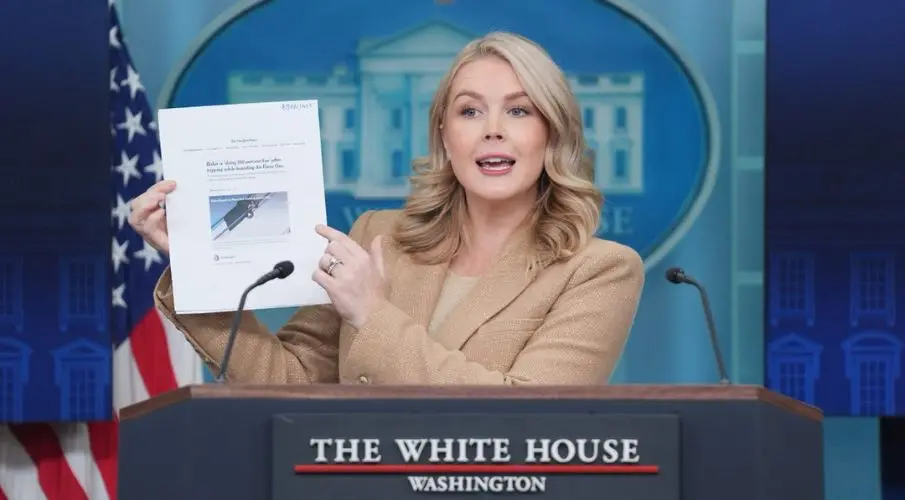
The White House presents itself as determined. A Navy admiral acted “within his authority and the applicable laws” when he ordered a second strike against an alleged drug boat on September 2. This is how the government presented it on Monday – yet the doubts are not subsiding. Too many contradictions, too many dead, too many open questions. Pressure has been growing in Congress for weeks, and unlike usual, the objections this time come from both parties. Because what is on the table is an allegation that tears apart any political defense: if the second strike actually hit survivors, it would be a violation of international law.
While the White House press secretary, Karoline Leavitt, tries to organize the events, one sentence from her briefing moves into particular focus. She does not dispute that after the first hit there were people who could no longer fight. Nevertheless, she maintains that the commanding admiral had “eliminated” the threat and the operation had been fully lawful. Thus she does not explicitly contradict the newspaper report that set everything in motion – she simply declares it irrelevant. That the president said the day before that he would not have wanted a second strike does not make the matter any easier.
In the Capitol, Democrats and Republicans show a rare degree of unity in these hours. Tim Kaine of Virginia says openly that the allegation, if confirmed, crosses the threshold into a war crime. Mike Turner of Ohio, a Republican with close ties to the defense community, describes a targeted strike on survivors as clearly illegal. Both point to the ongoing investigations in the Senate and House. In Washington’s political language, that is an unusual signal: the committees want to see documents, hear witness statements, reconstruct every decision. The government has no direct influence over that.
Rep. Mike Turner on the double strike to comply with Hegseth's alleged order: “If that occurred, that would be very serious and I agree that it would be an illegal act … This is completely outside of anything that has been discussed with Congress, and there is an ongoing investigation.”
John Thune, the Republican Senate Majority Leader, welcomes the fact that the Armed Services Committees are reviewing the incidents. He avoids evaluating Hegseth directly, but says that all particulars about the strikes on alleged drug boats are needed. The committees must determine which orders were given and when. Thune warns against drawing premature conclusions before all facts are on the table. This position shows how Republican leadership is attempting a balancing act: they do not want to appear as if they are covering up violations of the law of war, but they also do not want to sacrifice a secretary they themselves supported without certainty.

Trump, meanwhile, positions himself protectively in front of his Defense Secretary. Pete had never ordered the death of the two men, he says, adding that he believes him. It is the same mixture of loyalty and distance that Trump often uses when a situation could slip out of his control politically. Hegseth himself reacts on X with sharp attacks on the press. He speaks of fabricated stories and attempts to discredit soldiers. A pattern that runs through his entire tenure: criticism should be framed as an attack before it is even examined.
But even if the government presents the events as clearly lawful, the facts do not change. Since the summer, the U.S. military has conducted a series of lethal operations in the Caribbean and eastern Pacific. More than eighty people have been killed, many of them in small boats allegedly working for drug cartels. Washington claims that a portion of these groups is controlled by Venezuela’s President Maduro. This is why the government is already considering strikes against targets on the Venezuelan mainland. It is an escalation that goes far beyond the initial approach of disrupting maritime smuggling routes.

Trump has now confirmed, as we already reported on November 29, that he recently spoke with Maduro. What was said in that conversation remains unclear. But the political situation speaks more directly. The National Assembly in Caracas has now launched its own investigation into the lethal strikes. For the first time, a Maduro ally publicly confirms that Venezuelans are among the dead. The president of the assembly, Jorge Rodríguez, announced that lawmakers would investigate “the events that led to the deaths of Venezuelan citizens in the waters of the Caribbean Sea.”
This gives the conflict a new dimension. It is no longer just about whether the second strike was lawful. It is about an entire complex of operations now on the table: international responsibility, political intent, military limits, and the question of how far a president may go when he claims to be protecting the country. The September strike was only one point on the map. Now it becomes clear that the waves it sets in motion are reaching Washington and Caracas at the same time – and writing a story that begins with questions of responsibility, violations of international law, and political guilt.
Investigative journalism requires courage – and your support.
Support our work against right-wing populism, disinformation, and violations of human and environmental rights. Every contribution goes directly into our daily reporting – we operate without advertising, without subscriptions, without corporations, without political parties. Our journalism is meant to remain freely accessible. For everyone.
Independent – Critical – For Everyone
Thank you for making our independent work possible.
Updates – Kaizen News Brief
All current curated daily updates can be found in the Kaizen News Brief.
To the Kaizen News Brief In English


Ich frage mich, was das mit den Soldaten macht, die diese Befehle ausführen. Sind sie „handverlesen“, also selbst „Trump-indoktriniert“, oder ist es der selbe Befehlsautomatismus, mit dem sich deutsche im zweiten Weltkrieg herausgeredet haben? Zumindest die Vorgesetzten der Ausführenden müssten Gewissen und Wissen zeigen.
sehr gute frage
Was mir auffällt, dass jetzt ein Admiral inden Fokus gerückt wird.
„Der die Gefahr erkannt und mit einem zweiten Schlag eliminiert hat“
Geschickt.
Nun ist es der Admiral, nicht mehr Hegseth.
Schon hat man ein Bauernofer, sofetn nötig.
Und Hegseth kann weiter machen.
…trump und heseth sind die grössten feiglinge auf der politischen landkarte