
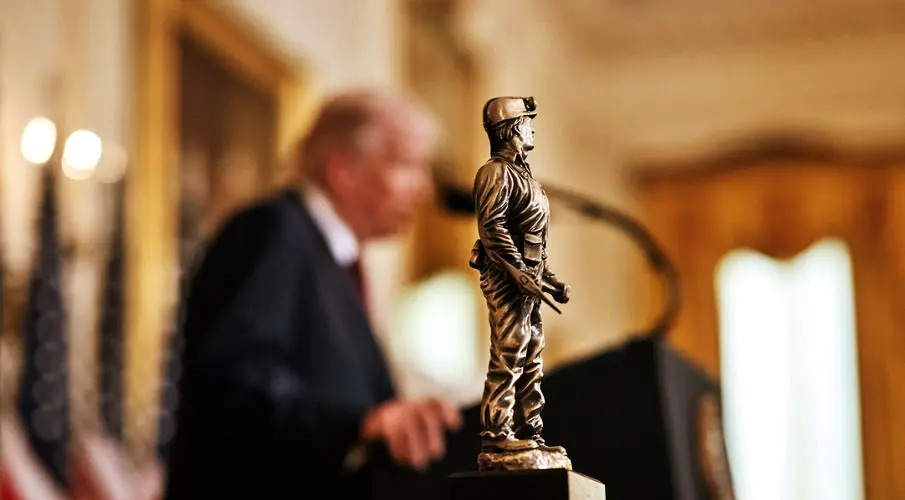
In the Roosevelt Room of the White House, the president basked in applause and announced that the Environmental Protection Agency would no longer regulate greenhouse gases. What sounds technical is politically a frontal assault on the foundation of nearly all American climate protections. The Environmental Protection Agency has rescinded the so called Endangerment Finding of 2009 - the scientific determination that carbon dioxide and other greenhouse gases endanger public health and welfare. Without it, the foundation of almost all climate regulations under the Clean Air Act collapses: for cars and trucks, for power plants, for oil and gas facilities.
A signature with far reaching consequences - we, too, will join the lawsuit against this decision.
With the stroke of a pen, the administration has eliminated the scientific basis on which nearly all American climate regulations rest. The Environmental Protection Agency has revoked the so called Endangerment Finding of 2009 - the determination that carbon dioxide and other greenhouse gases threaten public health and welfare. This puts the foundation of emission standards for vehicles, power plants, and oil and gas facilities at risk. Anyone who removes this danger assessment is not merely attacking administrative rules, but the right of people to life, health, and a secure future.
Climate protection is a human right. Internationally, the right to a clean, healthy, and sustainable environment is recognized. In the United States, the legal obligation arises from existing federal law. The Clean Air Act, 42 U.S.C. § 7401 ff., requires the Environmental Protection Agency to protect public health and welfare. Since the Supreme Court’s 2007 decision in Massachusetts v. EPA, it has been clear that greenhouse gases may be regulated as air pollutants - and, once a danger has been determined, must be regulated. The Endangerment Finding was precisely this statutorily grounded determination of danger.
Anyone who now rescinds it must scientifically demonstrate that greenhouse gases suddenly no longer pose a threat. Given the overwhelming body of data on rising temperatures, extreme weather, droughts, flooding, and wildfires, such a reversal is hardly sustainable. This is exactly where the Administrative Procedure Act, 5 U.S.C. § 706, comes into play. Agency decisions can be set aside by courts if they are arbitrary, capricious, an abuse of discretion, or otherwise not in accordance with law. A rescission without credible new findings would not meet that standard.
Therefore, we will join the lawsuit and are preparing additional legal action, grounded in the Clean Air Act and the Administrative Procedure Act, as well as established case law. The state cannot evade its duty of protection by redefining scientific facts. If a government declares that a demonstrable danger does not exist, even though it is measurable, it is the role of the courts to enforce the law.
This dispute is not a political gesture. It is a legal necessity. The responsibility toward the people whose health, livelihoods, and future are affected leaves no room for inaction. We will keep you informed both about this lawsuit and about our filed complaint before the International Court of Human Rights .
This determination arose after a 2007 Supreme Court ruling. At that time, in Massachusetts v. EPA, the Court held that greenhouse gases may be regulated as air pollutants. The Obama administration drew the consequence and in 2009 determined that these emissions endanger the population. On that basis, emission standards for vehicles were introduced, power plants were limited, and regulatory thresholds were tightened. Now this legal backbone is being removed.
Lee Zeldin, appointed by Trump as head of the EPA and a former member of Congress from New York, had already internally advocated for a reassessment. He argued that the Court had not required the agency to act, but merely granted it the authority to do so. The president went further. In a cabinet meeting, he spoke of wanting to reduce the EPA workforce by about 65 percent. Many were “just blockers,” he said. At the same time, on his first day in office, he had issued an executive order demanding a review of the legality and applicability of the Endangerment Finding.

Open approval is coming from within the administration’s circle. Longtime Trump adviser Steve Milloy, who disputes mainstream climate science, described the determination as the “linchpin” of all climate regulations. Remove it, in his logic, and everything the EPA does on climate disappears. Myron Ebell, also previously active in Trump’s transition team, likewise called it a major step against economically harmful CO2 rules.
On the other side, lawyers and scientists warn of massive consequences. Ann Carlson, an environmental law professor in Los Angeles, says the rescission will create more chaos than many other deregulations of this administration. David Doniger of the Natural Resources Defense Council considers the attempt unlikely to succeed. Given the overwhelming scientific evidence, it is hard to imagine that an opposite determination would survive in court. Courts have repeatedly affirmed that the EPA is authorized to regulate greenhouse gases under the Clean Air Act.
No Turning Back - How the 1.5 Degree Limit Falls and the Climate System Tips

(Our article of February 9, 2026)
The 1.5 degree mark was never a symbolic number. It was a red line. Enshrined in Paris in 2015, at the urging of those states that already knew they would pay first - with land, with harvests, with human lives. Ten years later, that line has effectively been crossed. For the first time, a three year period through 2025 has breached the threshold of 1.5 degrees Celsius above preindustrial levels. And as the data tightens, the political will to truly cut emissions is fading. Robert Watson, former chair of the Intergovernmental Panel on Climate Change, puts it without softening the blow: “Climate policy has failed. The landmark 2015 Paris Agreement is dead.” What sounds clinical describes a turning point. The 1.5 degrees were meant as a shield - against extreme weather, against runaway warming, against irreversible tipping points in the Earth system. Today, many researchers openly say those tipping points are closer than long assumed.
The debate is not merely legal. It collides with a reality in which heat records, droughts, flooding, stronger hurricanes, and devastating wildfires are increasing. In 2015 in Paris, the global community agreed on the goal of limiting global warming to as close as possible to 1.5 degrees Celsius. According to many researchers, that threshold has effectively already been exceeded. Climate scientist Michael Mann speaks of a new form of denial: no longer denying that the climate is changing, but claiming it is not a threat. Michael Oppenheimer of Princeton calls the notion that greenhouse gases do not endanger public health absurd. The consequences are already tangible and will continue to alter life as it was known in the past century.
The step gains additional explosiveness through the political environment. In conservative reform papers such as Project 2025, a reassessment of the Endangerment Finding is explicitly recommended. For critics, this is no coincidence, but part of a comprehensive strategy to dismantle core environmental standards. The administration itself speaks of excessive rules and an alleged “climate performance” that burdens the economy and jobs.
Storm Warning from Washington - How Trump's Allies Want to Destroy America's Weather Services and Project 2025 Provides the Blueprint

(Our article of July 6, 2025)
What is more dangerous - a hurricane over the Gulf of Mexico or a strategy document from the White House? If the planners of the "2025 Presidential Transition Project" are to be believed, the answer is: the state itself. More precisely: NOAA - the federal agency that for decades has been responsible for weather warnings, satellite data, climate research, hurricane forecasting, and fisheries protection. It is to be dismantled. And with it, the idea that public safety is a public good.
If the rescission stands, all emission standards for cars and trucks would immediately be vulnerable. Regulations for stationary sources such as power plants or refineries could also fall. Experts expect a wave of lawsuits. The outcome is open, but the signal is clear: the United States is calling into question the scientific foundation of its own climate law. What is happening here is more than an administrative correction. It is an attempt to remove a legally and scientifically grounded danger assessment from the statute. Whether courts will stop this step remains to be seen. What is already clear: the dispute over American climate law is entering a new, darker phase.
Updates – Kaizen News Brief
All current curated daily updates can be found in the Kaizen News Brief.
To the Kaizen News Brief In English


Ein rabenschwarzer Tag für unsere Erde….. Aber wie gut, dass wir noch die Erde 2.0 in petto haben (Achtung: Satire!)….
Klagen werden bereits vorbereitet, denke bis mitte der nächsten woche sind sie eingereicht …
wenn man bedenkt das China,Indien, Pakistsn und zahlreiche weitere BRICS Staaten das hohe Lied regenerativer Energie singen, muss die Frage erlaubt sein warum wollen und unterstützen Amerikaner mehrheitlich einen solchen Präsidenten? Die Wirkung des Treibhauseffektes ist wissenschaftlich belegt und belegt ist auch das Polemik die Physik überhaupt nicht beeinflusst. Wann kommt der Wechsel in den USA die dabei sind immer näher an die Position der Unbedeutung zu manövrieren.
Da kommt die leider doch sehr mangelnde Bildung und das fehlende Interesse an wissenschaftlichen Fakten, sowie die Bibeltreue ins Spiel.
Gott macht alles, Gott macht keine Fehler, wenn es schief läuft ist es eben eine Prüfung und man betet.
Ein Dekret und Zack gibt es keine schädliche CO2 Emission mehr.
Warum ist denn noch Niemand vor ihm auf diese geniale Idee gekommen?
Weil er der genialste Präsident aller Zeiten ist. (Satire).
Da freuen sich die blaunen hier auch.
Und Orban.
Endlich hat einer das schädliche CO2 abgeschafft, mit nur einem Federstrich 🙈
Da fragt man sich, ob die Alle zu nah am Auspuff gelebt haben.
Das der stark beschleunigte Klimawandel menschengemacht ist, belegen zig hunderte Studien und evidenzbasierte Daten.
Aber das ist ja alles woke Spinnerei.
Wahrscheinlich schafft er demnächst noch das Unterrichtsfach Physik ab.
Gefolgt von Chemie.
Man, man, man….was für ein rabenschwarzer Tag für die Menschheit und die Erde.
Ich hoffe, dass die Klagen Erfolg haben und der Marionetten Supreme Court Trump bicht wieder einen gefallen tut.
Was ist bis dahin?
Das kann sich Jahre hinziehen.
Hoffentlich verfügt ein Richter eine Aussetzung des Dekretes, wegen der Brisanz und Reichweite der Folgen.
Danke, dass Ihr Euch auch beteiligt.
… natürlich, nein, das kann sehr schnell gehen, mit den windrädern hat man auch recht schnell durchbekommen