
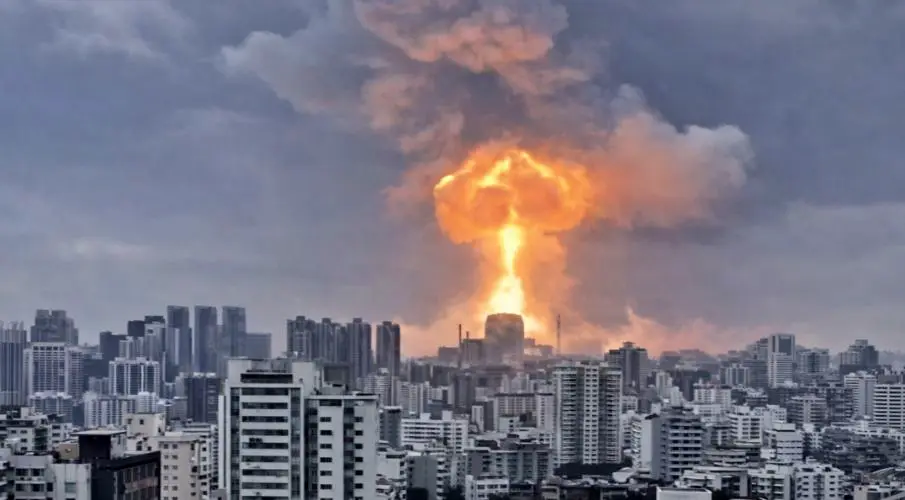
Ayatollah Ali Khamenei is dead. Killed in a targeted Israeli airstrike on his leadership compound in central Tehran. President Donald Trump announced his death overnight on social media. Shortly afterward, the Israeli military confirmed the “precise large scale operation.” What seemed unthinkable for decades has happened: the Supreme Leader of the Islamic Republic, 86 years old, in office for more than three decades, was eliminated by a military strike. The consequences have been unfolding by the hour ever since.
On Sunday, Iran launched waves of ballistic missiles and drones at Israel as well as at American allies in the Persian Gulf. In Tel Aviv, a woman was killed after an Iranian missile broke through air defenses and struck a residential building in the city center. More than twenty people were injured. Sirens wailed nationwide, and people sought shelter. Even Jerusalem reported its first drone alert. The Gulf states were not spared. In Bahrain, home to the US Fifth Fleet, dozens of missiles and drones were intercepted. A hotel in Manama was damaged. In Dubai, debris from downed drones fell into residential courtyards, injuring several people. In Abu Dhabi, falling fragments struck the facade of the Etihad Towers, where the Israeli embassy is located. In Qatar, 18 ballistic missiles were intercepted, with at least 16 people injured. In Kuwait, a drone struck the airport. Oman, which only days ago had sought to mediate between Washington and Tehran, reported attacks on the port of Duqm. Even an oil tanker near the Strait of Hormuz was hit, and its crew evacuated.
The Strait of Hormuz is effectively blocked. Shipping companies are avoiding the passage through which normally about one fifth of the world’s oil supply flows. Major airports such as Dubai International temporarily halted operations. Airspace over large parts of the region is closed. Oil could rise sharply when trading opens. Analysts speak of a five to ten dollar increase per barrel, and some consider triple digit prices possible again. OPEC Plus announced a production increase of 206,000 barrels per day starting in April, but compared with more than 100 million barrels of global daily production, that remains a limited buffer.
In Tehran itself, gray plumes of smoke are rising. The Israeli military says it continues to bombard “the heart of Tehran.” More than 200 people are believed to have been killed in Iran since the beginning of the strikes. The human rights organization HRANA reports at least 133 civilian deaths and 200 injuries, figures that have not yet been independently verified. At the same time, reports are circulating of children killed at a girls’ school near a naval base.
In addition to Khamenei, several leading officials have been confirmed killed: General Mohammad Pakpour, commander of the Revolutionary Guards. Defense Minister Aziz Nasirzadeh. Chief of Staff Sayyid Abdolrahim Mousavi. Admiral Ali Shamkhani, close adviser to Khamenei and head of a newly created National Defense Council. Not only a head of state was struck, but a significant portion of the military leadership. Ali Larijani, Iran’s top security official, said a transitional council would assume leadership until the Assembly of Experts appoints a new Supreme Leader. The president, the head of the judiciary and a member of the Guardian Council are to govern temporarily. Larijani announced retaliation “with a force they have never experienced.” At the same time, the leadership sought to project continuity. Mass rallies in Tehran and Isfahan showed mourning supporters, while videos from Shiraz circulated of jubilant crowds honking car horns and celebrating the Ayatollah’s death.
Many people of the Iranian population celebrated in the streets of Tehran
The other side: “As mourners gathered to grieve Ayatollah Khamenei, they shouted ‘Allahu Akbar’ when they heard the sound of an explosion.”
Internationally, the fronts are hardening. Vladimir Putin spoke of a “cynical violation of all norms of international law” and praised Khamenei as a statesman who strengthened the Russian Iranian partnership. Putin’s opinion, given his own trampling of international law, is superfluous. No one needs it. China condemned the killing as a serious violation of Iranian sovereignty. Kaja Kallas, the EU’s foreign policy chief, called the event a turning point and spoke of a possible opening for a different Iran. Britain’s defense secretary John Healey said no one would mourn Khamenei, but demanded a legal justification for the action.
The CIA reportedly played a central role in target identification. According to individuals familiar with the operation, it had analyzed Khamenei’s locations and movement patterns for months and ultimately identified a gathering of top leadership. Once it became clear that the Supreme Leader would be personally present, the strike was carried out. Israel’s defense minister Israel Katz speaks of a turning point and of creating conditions for regime change. The Israeli military estimates that Iran’s arsenal at the start of the conflict included about 2,500 surface to surface missiles. President Trump announced that the strikes would continue “all week or as long as necessary” to achieve “peace in the Middle East and the world.”
But while political statements are still being drafted, the casualty numbers continue to rise. In Beit Shemesh, west of Jerusalem, Israel’s emergency services reported six dead after an Iranian missile attack - the deadliest incident on the Israeli side since the fighting began. Four people are in critical condition, dozens more were injured. In Kuwait, the Defense Ministry reported 97 ballistic missiles and 283 drones fired at the country. One person was killed there, and more than 30 were injured. The US State Department instructed diplomats in several countries to seek shelter and urged American citizens in the region to move to safety. Egypt’s president Abdel Fattah el Sisi, in a conversation with Oman’s Sultan Haitham bin Tariq, warned of the Middle East sliding into chaos and called for dialogue and political solutions.
What is taking shape, however, is no quick victory. It is an open conflict with an uncertain end. The Gulf states, which built their economic model on stability and security, are witnessing missiles over their skylines. In Pakistan, eight demonstrators were killed during a storming of the US consulate in Karachi. In Kashmir, thousands took to the streets. The conflict radiates far beyond Tehran and Tel Aviv. With the death of Ali Khamenei, an era has ended. Whether a new chapter begins or a long phase of escalation, no one knows. What is certain is that the threshold has been crossed. And it cannot simply be restored.
Updates – Kaizen News Brief
All current curated daily updates can be found in the Kaizen News Brief.
To the Kaizen News Brief In English


Man könnte auch sagen, Trump hat die Büchse der Pandora geöffnet.
Wie sich der Konflikt auf (derzeit noch?) Verbündete in der arabischen Welt auswirkt, kann Niemand vorher sehen.
Jeder hat eigene Interessen.
Wirtschaftlich, Religiös und Sicherheit.
Wenn dieser Krieg weiter um sich greift und Bürger der Anreiner getötet oder verletzt werden, kann sich das Blatt schneller wenden, als gedacht.
Durch US Basen stehen viele Anreiner auf der Zielliste des Iran.
Zu wem werden die Anreiner stehen?
Zu Israel (einem „Dauerfeind“) und den USA (nicht beliebt in der islamischen Welt)?
Oder dann doch zu den arabischen Ländern?
Was passiert, wenn Trump einen NATO Fall deklariert, wenn Menschen in US Konsulaten sterben?
Die Amis sind immer wieder gut im Erschaffen von Unordnung.
Statt aus den Fehlern der Vergangenheit zu lernen – und hier gerade im Gebiet: Iran, Irak, Afghanistan, Pakistan, mischen sich die USA mal wieder ein.
Schmeißen Bomben, töten wer ihnen im Weg steht. Richten Chaos an – und haben dann keine Lösung wenn es nicht so läuft wie sie dachten.
Genau durch dieses Vorgehen ist der Zustand entstanden, den wir als Chaos und ständiger Konflikte sehen.
Ländergrenzen wurden willkürlich gezogen, Völker und Völkerstämme zerrissen – das schaffte böses Blut und wirkt bis heute nach.
Oder, wie Falle Husseins:
Hier sind die wichtigsten Punkte zum Verhältnis zwischen Saddam Hussein und den USA:
Zusammenfassend lässt sich sagen: Die USA haben den Weg für Saddams Baath-Partei geebnet und ihn später in seinem Krieg gegen den Iran massiv gestützt, um eigene geostrategische Interessen (Realpolitik) zu verfolgen, was ihn als Diktator festigte
Und Jahre später dann die Kehrtwende – weil der USA ihre Marionette nicht mehr passte:
Saddam Hussein, der ehemalige irakische Diktator, wurde am 30. Dezember 2006 durch den Strang hingerichtet, nachdem er von einem irakischen Sondergericht wegen Verbrechen gegen die Menschlichkeit zum Tode verurteilt worden war. Er wurde zuvor am 13. Dezember 2003 von US-Soldaten gefasst, nachdem er sich nach dem Einmarsch der USA im März 2003 versteckt hatte.
Wichtige Details:
Zuvor, im Jahr 2003, wurden bereits seine Söhne Udai und Qusai bei einem Gefecht mit US-Soldaten getötet.
…… zum „Vergleich“ – über Russland regen wir aber auf!
Warum verurteilen wir die USA nicht?
Weil wir meinten die USA sein ein Freund? Die USA seinen freundlicher als ein Russland?
Weil wir meinten, die USA achten Menschenrechte? Sind modern und agieren sozial?
Wie geschrieben: Es soll nur ein anschauliches Beispiel sein – und zum Nachdenken anregen. Bewerten muss es jeder für sich.