
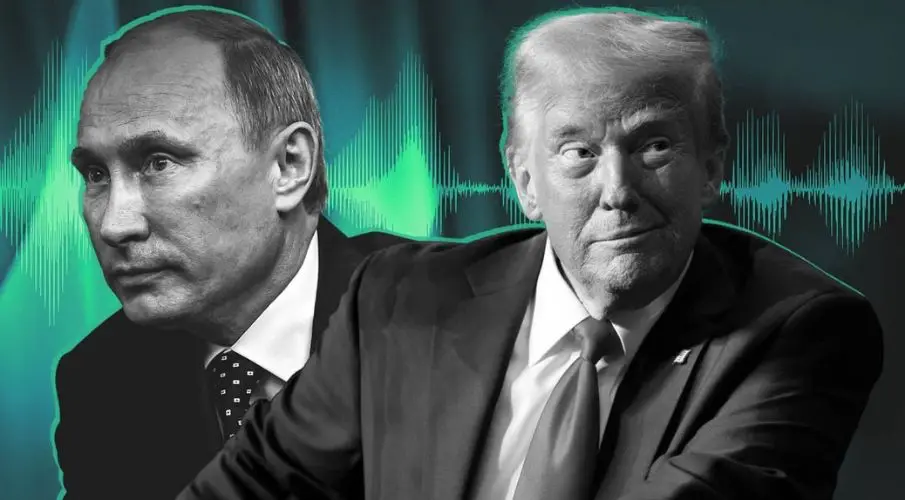
It was not a performance. It was a calculated moment for the cameras. Donald Trump spoke, and something in the room shifted. He did not talk about strategies or timelines. He talked about the dead. Twenty five thousand soldiers in a single month. No looking back, no relativization. A number placed there like an accusation. Then came the sentence that lingered. You keep playing your games, he said. And while you do that, World War Three is drawing closer. That was not language for negotiations. That was language for pressure. For fear. For submission.
„Allein im letzten Monat sind 25.000 Soldaten gestorben. Ihr spielt weiter diese Spiele … und der Dritte Weltkrieg kommt.“
What followed was directed clearly at Europe. Five percent of gross domestic product for defense. Not sometime, but now. Billions that continue to flow into American factories. Weapons, equipment, ammunition. And in the end body bags. Trump did not present this connection as something to debate. He stated it as a fact. He said it without emotion. No hesitation. No attempt to soften the words. That was precisely what made them so heavy. Because someone who speaks like that is no longer expecting contradiction. He expects obedience or consequences. The war, according to Trump, is not winding down. It is growing. Becoming more confusing. More brutal. Europe, he did not say it explicitly, but clearly enough, is sleepwalking in that direction. Not because it wants to, but because it does not stop. What is unsettling about that moment is not only the threat. It is the matter of fact way in which it was delivered. As if escalation were no longer a risk, but a tool. As if war were not a failure, but a development. No one in the room objected. Perhaps because no one knew how. Perhaps because people have long grown accustomed to hearing such sentences. That is exactly where the danger lies. History rarely fails because of a lack of warnings. It fails because people accept them. Trump did not call it a recommendation. He did not call it a debate. He framed it as a last opportunity. Listen or pay. Not politically. Humanly. With lives.
Almost simultaneously, almost like a second scene of the same play, a sentence came out of Moscow that pointed in a completely different direction and yet landed in the same moment. Vladimir Putin addressed the citizens of Western countries directly and said they were being systematically led to believe that their current problems were the result of hostile actions by an allegedly malevolent Russia. They were being told they must pay out of their own pockets for the fight against an invented Russian threat. All of that, Putin said, was a lie. The real causes lay in the decisions of their own elites, in years of mistakes, short sightedness and ambition. Those elites, he said, were not thinking about how to improve people’s lives. They were fixated on their own interests and excessive profits.
“I want the ordinary citizens of Western countries to listen to me. You are being constantly told that all your current difficulties are the result of hostile actions by a vicious Russia and that you must pay out of your own pockets for the fight against an alleged Russian threat. All of this is a lie. The truth is that the problems you are now facing are the result of years of decisions by the ruling elites of your own countries - their mistakes, their short sightedness and their ambition. They do not think about how to improve your lives. They are obsessed with their own selfish interests and excessive profits”
Two voices, two more than questionable presidents, two narratives. And yet they meet at one point. Neither speaks of hope, neither of ways out, but of blame. For the people living between these fronts, one thing above all becomes tangible - that they are being talked about, rarely talked with.
Europe is facing decisions, and Germany is facing decisions that can no longer be postponed. This is not a moment for vanity, not for endless infighting, not for staging one’s own righteousness. Society has to close ranks, and that begins in how we treat one another, in tone, in the willingness not to immediately see the other as an enemy. As far from ideal as the choice of Merz and some ministers may appear to many, and as much as one cannot ignore right wing tendencies there either, now is not the time to question everything. Now is the time to support a government where it is justifiable, critically, but not deaf, because instability in times like these is the wrong path. Merz is not wrong on one point, and that point is uncomfortable, but not unrealistic. If Ukraine falls, Putin will not stop. History has rarely known final endpoints.
Now is also the time to stop further inflating the AfD. Not through constant reactions, not by amplifying every minor statement. Those who see themselves as enlighteners should ask whether they carry responsibility, or whether they stubbornly continue without noticing that it is counterproductive. Strangely enough, with these people one thing is almost never found - the current weekly party polling numbers, because they would only confirm that the train of this kind of enlightenment has already left the station. The AfD is playing a malicious game, and that game lives off attention. Ignoring is not looking away, it is withdrawal.
In the United States sits a man who turns madness into policy, in Moscow a president, a warmonger and war criminal. In between are societies losing themselves in trivialities, as if time were infinite. In moments like these, issues one would normally argue about must take a back seat. Not because they are unimportant, but because they can wait. Responsibility does not mean negotiating everything at once. The media also carry responsibility here. Too often the impression arises that what drives them is not the desire to inform, but the lure of attention. Sensational headlines over thin substance generate reach, but explain nothing. War is good for clicks, yes. Artificial and false portrayals of AfD trips to the United States, yes. But those who write about it that way have never experienced war and have not understood politics. Anyone who has experienced war knows that one speaks differently afterward. When language is used like this, it changes more than moods. It prepares the ground for wrong paths. And then it is usually too late to pretend one did not see it coming.
Investigative journalism requires courage – and your support.
Investigative journalism is important because it researches where others no longer go and thereby ensures that what is decisive for the understanding of reality becomes public. - for that we need your support.
Independent – Critical – For Everyone
Thank you for making our independent work possible.
Updates – Kaizen News Brief
All current curated daily updates can be found in the Kaizen News Brief.
To the Kaizen News Brief In English


👍🏼
Einer eurer besten Artikel, danke!
Auf den Punkt gebracht.
Trump der sich als Retter darstellen will.
Wenn das nicht klappt, sollen gefälligst und ohne Widerworte, die europäischen Staaten 5% in die Verteidigung investieren.
Nicht in irgendeine Verteidigung, sondern in die Waffen aus den USA.
Menschen, Staaten… alles egal. Hauptsache der/die Deal(s) stehen und das Geld fließt in Trumps Taschen.
Blutin auf der anderen Seite kommt mit seiner Propaganda, die schon leider tausendfach Einzug in den Köpfen gehalten hat (insbesondere bei den ehemaligen DDR Bürgern…. 40 Jahre Gehirnwäsche haben immer noch Wirkung), Russland ist unschuldig, der Westen ist Schuld am Krieg und der Westen verbreitet Russophobie.
Und die AfD hüpft auf Putins Propaganda, nutzt Trumps Wahnsinn und tönt gegen alles, was nicht deutsch scheint.
Damit bedienen sie leider ein riesen Klientel.
Ein Klientel aus Holköpfen. Wir haben hier nicht mal den MAGA Kult, aber trotzdem rennen der AfD zu viele Menschen blindlings nach.
Europa hat lange geschlafen.
Nein, Europa schläft immer noch.
Europa hat sich meist auf Kkein-Klein konzentriert. Irgendwelche absurden Regulierungen (ich denke da nur an die Bananen).
Aber die großen Probleme hat man vertagt oder mit zig Ausschüssen tot diskutiert (erinnert mich stark an „wie man ein totes Pferd reitet).
Für solch unsinnige Politik ist keine Zeit.
Unsere Demokratie und Freiheit stehen auf dem Spiel.
Wer das nicht begreift ist naiv und dumm.
Wenn Europa sich jetzt nicht besinnt und Stärke zeigt, ist es zu spät.
Wenn Putin erstmal seine eiskalte Hand, über die Ukraine hinaus, ins Herz von Europa steckt, ist es zu spät.
Sehr beängstigend das alles und leider, was ich seit Jahren sage, aber keiner hört auf mich. Ich sagte auch, dass es jetzt nicht die Zeit ist, sich in kleinlichen parteipolitischen Streitereien zu verlieren. Die einzige Partei, die der AfD (NOCH!) Paroli bieten kann, ist die CDU/CSU. Leider haben viele in meinem Umfeld auch bei der letzten Wahl nicht auf meine Bitten gehört, nicht aus Überzeugung, sondern um EINDEUTIG Front gegen die Rechtsradikalen zu machen, gemeinsam eine starke CDU/CSU wählen. Stattdessen gibt nun wieder permanent kleinliche Streitereien, die SPD blockiert, was in dieser Lage wahrscheinlich geboten wäre und die anderen sind sowieso aus Prinzip dagegen. Und die AfD wächst. Ähnlich war es doch schon am Ende der Weimarer Republik. Lernt denn keiner aus der Geschichte??? Und derweil treiben uns die zwei antisozialen Soziopathen, die wir doch eigentlich nur Frieden wollen, einem dritten Weltkrieg entgegen. Es ist zum Heulen.