
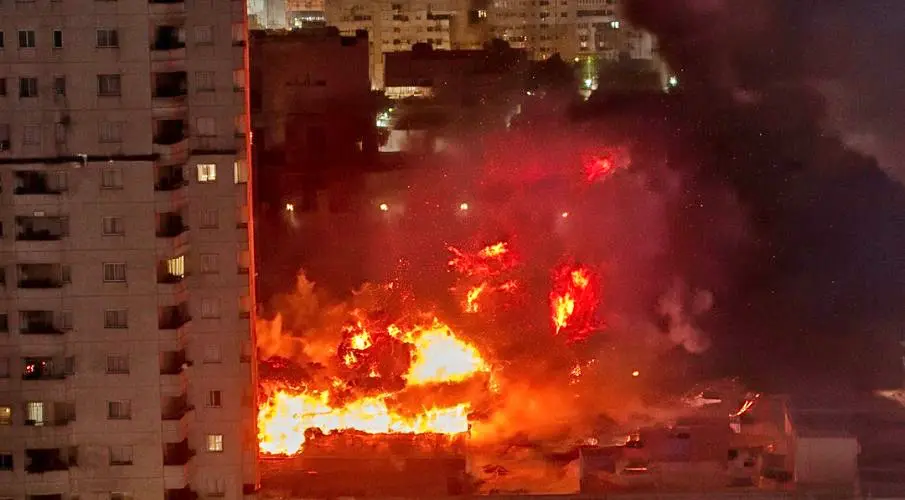
On March 28, a Saturday, one month after the start of the war, a new party entered the conflict. The Houthis, the Shia militia from Yemen that controls large parts of the country and has been supported by Iran for years, fired a ballistic missile at Israel. Israel’s air defense intercepted it. No casualties. But the step itself was the event.
Yahya Saree, military spokesman for the Houthis, said in a video that the attacks would not stop “until the aggression on all fronts of the resistance ends.” That includes the American Israeli war against Iran and Israel’s offensive against Hezbollah in Lebanon. The Houthis see themselves as part of this axis - and have now acted. It is therefore a very bad day for Yemenis. The Houthis have made a reckless decision to enter a war that is not Yemen’s war and, in essence, to respond on the orders of their sponsor in Tehran.
The real reason for international concern does not lie in a single missile fired at Israel. It lies in what the Houthis might do next. During the Gaza war, they disrupted international shipping in the Red Sea for months, attacking ships, sinking them, killing crews. The Red Sea leads to the Suez Canal - around twelve percent of global trade passes through this route. A renewed attack on this corridor, while at the same time the Strait of Hormuz remains largely closed, would put two of the most important sea lanes in the world under pressure at the same time.
At the same time as the Houthis arrived, the Marines arrived and do not know what they are supposed to do.
2,500 American Marines of the 31st Marine Expeditionary Unit, normally stationed in Okinawa, Japan, arrived in the Middle East on Friday. They are part of the USS Tripoli Amphibious Ready Group, accompanied by 2,500 sailors. Their official mission: to be part of Trump’s effort to reopen the Strait of Hormuz. Secretary of State Marco Rubio had said on Friday that the United States does not need ground troops to achieve its objectives in Iran and that the war would end in weeks, not months. Trump himself has not ruled out the use of Marines or special forces. We have more than just doubts about that.
See our article: Ground war against Iran - what the media claims, what the world simply accepts and what research actually found
The problem is concrete: Iran’s navy has been largely incapacitated by the American Israeli bombardment. But Iran is now deploying fast boats with mines and explosives, operating from the rocky coastline and small islands in the strait. Aircraft have difficulty targeting these boats. Infantry landing from ships onto these islands - they can do that. Military experts say the Marines could be used precisely for this. How long such an operation would take cannot be determined.
While missiles were flying and Marines were arriving, diplomats were moving at the same time.
In Islamabad, the capital of Pakistan, the foreign ministers of Saudi Arabia, Prince Faisal bin Farhan Al Saud, Turkey, Hakan Fidan, and Egypt, Badr Abdelatty, are meeting today - invited by Pakistan, which has been positioning itself for weeks as a mediator between Washington and Tehran. Pakistan’s Prime Minister Shehbaz Sharif spoke for over an hour on Saturday with Iranian President Masoud Pezeshkian. In a statement, Sharif condemned Israeli attacks on civilian infrastructure in Iran and informed Pezeshkian about Pakistan’s contacts with Washington and the Gulf states.
Pakistan has its own calculation. The country shares a roughly 900 kilometer border with Iran. The economic consequences of the war hit Pakistan directly - energy costs, supply chain problems, rising sectarian tensions within its own population, a large part of which is Shia and looks to Tehran religiously. Field Marshal Syed Asim Munir, Pakistan’s army chief, has established direct channels to Trump. Sharif himself has spoken with at least twenty heads of state over the past week.
Whether Pakistan can actually mediate remains open. There is no concrete plan yet. But Pakistan is currently one of the few countries that is speaking with both sides - and that is more than most others can claim.
In Tehran, Saturday was one of the heaviest days since the beginning of the war.
The human rights organization HRANA documented 701 airstrikes within 24 hours - according to its own data, one of the highest daily figures since February 28. Three quarters of the strikes hit the capital. 24 civilians were killed, 88 injured. The University of Science and Industry in central Tehran was hit. Esmaeil Baghaei, spokesman for the Iranian Foreign Ministry, wrote that the university was “one of many educational institutions that have been deliberately targeted since the beginning of the war.”
A 62 year old woman from Tehran, who did not want to give her name out of fear, wrote in a text message: “I cannot put into words what it was like last night in Tehran. We did not sleep at all, there were hours of explosions.”
US Central Command reported on Saturday that since the beginning of the war more than 11,000 targets in Iran had been hit, including more than 150 Iranian ships.
On Friday, two of the country’s largest steel complexes had been attacked - the Mobarakeh Steel Complex in Isfahan and the Khuzestan Steel Industries Complex. At the plant in Isfahan, one person was killed, 15 injured. At the Khuzestan plant, 16 workers were injured. A senior Iranian official said the attacks on the steel plants were a severe blow to the economy and would significantly complicate the reconstruction of the country after the war. The steel plants produce material needed for building roads and structures.
Israel had announced this week that it would intensify attacks on Iran’s infrastructure. The Israeli military describes such industries as “dual use” - with civilian and military applications. Iran’s Foreign Minister Araghchi said attacks on civilian infrastructure contradicted Trump’s own statement to refrain from such targets for ten days in order to allow space for diplomatic negotiations.
Iran’s neighboring states also did not find rest on Saturday.
The United Arab Emirates reported 20 ballistic missiles and 37 drones from Iran in the past 24 hours. Debris from an intercepted missile caused a fire in Abu Dhabi, six people were injured. The aluminum plant Aluminium Bahrain - known as Alba - reported a hit, two employees were slightly injured. Emirates Global Aluminium reported significant damage at its Al Taweelah site in Abu Dhabi. Several drones struck Kuwait airport, damaging the radar system, without injuries. In Oman’s port of Salalah, two drones struck, one worker was injured. Iran stated it had attacked an American “military support vessel” near the port.
Sirens sounded in Bahrain. Saudi Arabia’s Defense Ministry reported intercepted drones and missiles.
In Lebanon, an Israeli airstrike near the southern city of Jezzine killed three journalists. Ali Choeib, correspondent for Hezbollah’s Al Manar network, and Fatima Ftouni, reporter for Al Mayadeen, as well as cameraman Mohammad Ftouni, were killed. They were traveling together in a car when the vehicle was hit. The Israeli military accused Choeib of being a member of Hezbollah’s military Radwan unit and of spying on Israeli military positions through his work for Al Manar. It presented no evidence.
Libanons Präsident Joseph Aoun verurteilte die Tötungen als "offensichtliches Verbrechen" und "Verletzung der grundlegendsten Regeln des Völkerrechts." Die libanesische Regierung will beim Sicherheitsrat der Vereinten Nationen Klage einreichen. Ramzi Kaiss, Libanon-Forscher bei Human Rights Watch, sagte: "Allein die Berichterstattung über das Vordringen israelischer Truppen oder die Verbreitung von Propaganda macht jemanden nicht zu einem militärischen Ziel."
In Dubai, the Dubai World Cup took place this Saturday - the richest horse race in the world, with nine races and 30.5 million dollars in prize money. Sheikh Mohammed bin Rashid Al Maktoum, ruler of Dubai, was present. In the morning, phones in the city issued security alerts about possible missile attacks. At the same time, the Dubai Racing Club announced that ripped jeans were prohibited - even if they are designer fashion. Women were asked to wear hats.
It is this simultaneity that defines this war. Missiles and horse races. Bombs on universities and gala receptions. Evacuation alerts and dress codes.
Elon Musk also appeared this week where he was not expected. During a phone call between Trump and Indian Prime Minister Narendra Modi on Tuesday, Musk was present - confirmed by two American government officials who did not want to be named. No government office, no official title. His companies have received substantial investments from sovereign wealth funds in Saudi Arabia and Qatar. Tesla is waiting for the Indian market. SpaceX is considering an initial public offering. What exactly he said during the call - unclear. That he was there - fact.
The death toll at the end of this fifth weekend of the war stands at over 3,300 people - including more than 1,492 civilians in Iran, among them 236 children according to HRANA. Over 1,110 people in Lebanon. Over 50 in the Gulf states. At least 16 in Israel. 13 American soldiers. We will now also try to leave Tehran within the next 48 hours to reach a border. Our first attempt unfortunately failed.
In Islamabad, as mentioned, diplomats will meet today. In Washington, Trump is waiting for his gut feeling. And somewhere off the coast of the Middle East, 2,500 Marines are on a ship waiting to find out what they are actually supposed to do.
Updates – Kaizen News Brief
All current curated daily updates can be found in the Kaizen News Brief.
To the Kaizen News Brief In English


Ich drücke die Daumen, dass ihr die Grenze erreicht.
… danke, wäre mal was