
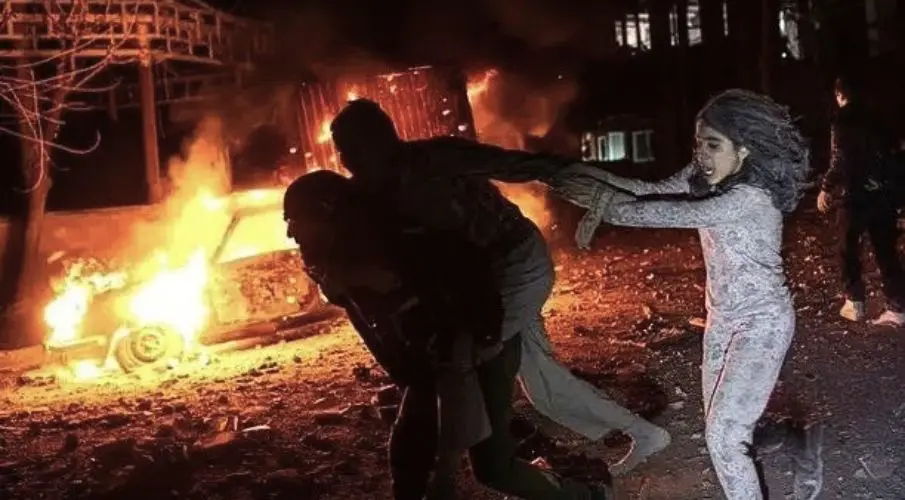
The front of this war is no longer limited to a single region. Rocket alarms sound in Jerusalem, explosions are reported in Tehran, drones strike military bases in the Mediterranean, and diplomatic phone lines are burning between Europe, China and the Middle East. While the United States and Israel continue their airstrikes against Iran, Tehran responds with attacks on American bases, ships and allies across the entire region. The result is a conflict that continues to expand and now touches several continents.
Trump: “I have to go back and look at the war. I have a lot of things going on at the same time right now.”
The world watches as if it were observing a slow fire while debating the color of the fire trucks. Trump is no longer a political anomaly - he is a system failure that has declared itself the norm. Wars, human rights violations, destroyed climate agreements, damage to the global economy, humiliated allies: every misstep is not punished but rewarded because institutions have learned to capitulate instead of correct. World leaders bending like grass in the wind legitimize every day what should actually be unthinkable. Future generations will not ask why no one said anything - they will ask why so many watched as if it were entertainment. History does not judge the wicked alone - it judges above all the silent.
In Jerusalem the sirens wailed again on Thursday morning. The Israeli military reported rocket launches from Iran. Residents were instructed through warning systems to move into shelters. Initial reports of casualties did not appear at first. At the same time residents reported explosions in Tehran, both in the west of the city and in the direction of Karaj. The attacks are part of a broad air campaign which according to the Iranian Red Crescent has already struck 174 cities. The organization speaks of 1,332 attacks on 636 locations in the country. Residential areas were hit, as were medical facilities and rescue stations.
The war now extends far beyond Iran and Israel. In the Gulf region several states reported attacks on military facilities, energy installations and civilian infrastructure. Iranian missiles according to regional authorities struck American facilities, including a CIA station in Saudi Arabia. In Kuwait six American soldiers were killed when an improvised operations center in a civilian harbor was struck by rockets. At the same time satellite images report that billions of dollars in American reconnaissance equipment may have been destroyed or damaged.
The situation is also escalating at sea. Iran’s Revolutionary Guards declared that they had attacked an American oil tanker in the northern Persian Gulf. The incident could be connected to an attack on a ship off the coast of Kuwait that a British military monitoring center had previously reported. Earlier an American submarine had sunk an Iranian frigate, the IRIS Dena, in the Indian Ocean. Iran’s foreign minister Abbas Araghchi responded with a sharp warning. America will “bitterly regret” the action, he declared. The ship had been located around 2,000 miles from the Iranian coast in international waters.

The war is now even drawing other conflict regions into its orbit. Ukrainian President Volodymyr Zelenskyy declared that his country is ready to support states in the Middle East and the Gulf with experts in drone warfare. In a statement after a meeting on the situation in the region Zelenskyy said possibilities are being examined to protect lives, prevent further expansion of the war and at the same time secure the stability of global markets. After more than two years of war against Russia Ukraine has extensive experience in the use and defense of drones. This knowledge could now also be used in a completely different conflict zone.

The conflict has also exposed new political fault lines in Washington. Defense Secretary Pete Hegseth publicly criticized the American media. When a few drones get through or American soldiers die it immediately becomes a headline.

Sgt. 1st Class Nicole M. Amor, 39 (Minnesota)., Capt. Cody A. Khork, 35 (Florida), Sgt. 1st Class Noah L. Tietjens, 42 (Nebraska), Sgt. Declan J. Coady, 20 (Iowa), Maj. Jeffrey R. O’Brien, 45 (Iowa) Chief Warrant Officer 3 Robert M. Marzan, 54 (Kalifornien)
The press wants to make the president look bad, he said. One should try for once to report reality as well. At the same time former American government officials report that Hegseth and Secretary of State Marco Rubio are arguing fiercely over the future course. Hegseth apparently favors the deployment of American ground troops in Iran, while Rubio warns against drawing the United States into a long war.
Donald Trump himself commented on the course of the war in characteristically optimistic terms. Militarily things are going very well. Someone asked him how he would rate the situation on a scale of ten. His answer: about fifteen.
Meanwhile Iran is trying to spread its own narrative of the war internationally. Esmail Baghaei, spokesman of the Iranian Foreign Ministry (He is also often described as deputy foreign minister, however this claim is not correct), rejected the justification of the American government that Iran had been attacked to preempt an imminent strike. This portrayal is a great lie. Iran never intended to attack the United States. Baghaei posed a counter question: whether Iran had sailed into the Gulf of Mexico to attack Los Angeles - or whether American forces were operating 6,500 miles away along Iranian coasts.

Baghaei also warned of a new front inside Iran. He referred to reports that Donald Trump had held talks with Kurdish leaders in the region and that American services could support Kurdish forces that might later also be used in ground operations. American policy toward the Kurds appears contradictory. In Syria they were abandoned only a short time ago in order to secure contact with the new leadership in Damascus. Now Kurdish groups in Iran are once again coming into focus - this time as possible ground troops in the conflict with Tehran. At the same time according to his statements the United States and Israel deliberately attacked Iranian security forces, including police and Basij units. For Baghaei this produces a clear pattern. Washington and Tel Aviv are attempting, according to his description, to create unrest inside Iran and prepare a regime change.
The diplomatic level is also marked by mutual accusations. Baghaei declared that Iran had still been negotiating with the United States only days before the beginning of the war. Another round of talks had been planned for March 2. Two days earlier America and Israel had attacked Iran. Diplomacy had been betrayed, he said. In the region itself the danger of further escalations is growing. Azerbaijan accused Iran on Thursday of carrying out a drone attack on its exclave of Nakhchivan. One drone crashed near the airport, another near a school. Two civilians were injured. The government in Baku summoned the Iranian ambassador and declared that it reserves the right to retaliate.
Europe is also attempting to exert influence. France’s foreign minister Jean Noel Barrot spoke with his Iranian counterpart and condemned attacks on neighboring states. Paris emphasized its support for de escalation and a return to diplomatic talks in accordance with international law. China announced that it would send its special envoy Zhai Jun to the region. Foreign Minister Wang Yi has already spoken with colleagues from Russia, Iran, Oman, France, Israel, Saudi Arabia and the United Arab Emirates. Beijing calls for an immediate end to military operations and a return to negotiations.
At the same time numerous states are trying to remove their citizens from the region. Spain has flown more than 170 people out of the Middle East. Australia is sending crisis teams and military support to evacuate stranded citizens. South Korea reported that thousands of its citizens remain stuck in the Middle East after air traffic was severely restricted.
At the same time religious rhetoric in Iran is radicalizing. State television broadcast a message from Ayatollah Abdollah Javadi Amoli calling for retaliation and speaking about “spilling the blood of the Zionists” and about Donald Trump. Such statements fuel international concerns about possible attacks by lone actors or covert networks. The military situation at the same time remains confusing. Israel reported new airstrikes against Hezbollah positions in Beirut. In Cyprus authorities confirmed that a drone that struck a British air force base had apparently been launched from Beirut. In Bahrain meanwhile the government banned any publication of images of military facilities or defense measures while the country remains under Iranian attacks.
While rockets fly and drones launch the Iranian leadership is simultaneously attempting to organize its political future. After the killing of the supreme religious leader Ali Khamenei a transitional council is working to determine a new leader. An Israeli strike on a building of the Assembly of Experts in the city of Qom apparently aimed to disrupt this process. Iranian authorities however declared that the actual meeting had not taken place at that time.
The war is therefore developing into a conflict that militarily, politically and economically is capturing more and more spaces. Attacks on energy facilities, trade routes and military bases have already begun to disrupt global supply chains. At the same time the number of states being drawn directly or indirectly into the confrontation continues to grow. The military fronts now lie not only between Israel and Iran. They stretch across the entire Middle East, through international waters, over airports, ports and diplomatic channels. And with every new missile the danger grows that a regional war will become a conflict that reaches far more countries.
Updates – Kaizen News Brief
All current curated daily updates can be found in the Kaizen News Brief.
To the Kaizen News Brief In English


