
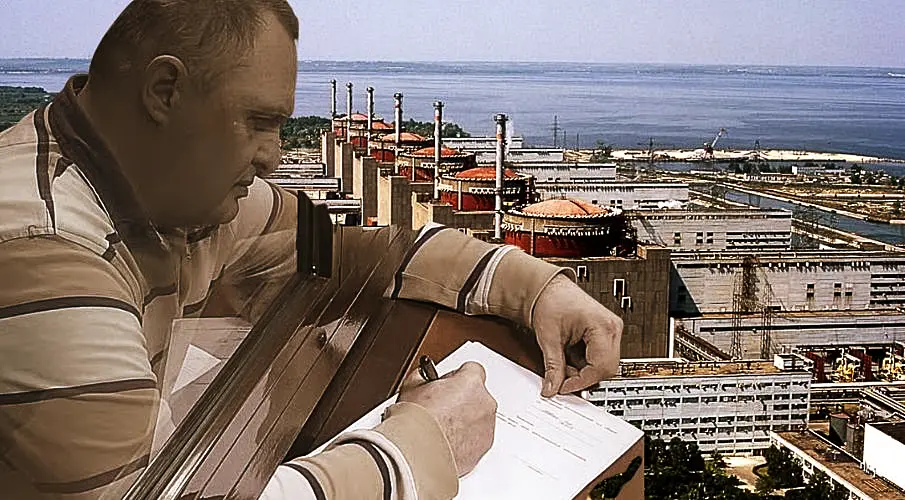
Ruslan Lavryk was 51 years old when Russian troops took over the largest nuclear power plant in Europe in the spring of 2022. A place that was supposed to stand for stability became a military base within a few days. Ukrainian defense had been broken, Russian soldiers moved between reactor blocks, laid mines and searched buildings. Many employees fled Enerhodar. Lavryk stayed. Not out of loyalty to the occupiers, but because someone had to keep the six reactors running safely.

Shortly afterward, men from Rosatom arrived. Officials, engineers, functionaries from Russia. They took control, replaced the Ukrainian management and began to apply pressure. Contracts were to be signed. Those who refused were intimidated. Witness statements report abuse, targeted violence. Oleg Romanenko, a senior engineer from Balakovo, led the new structure. Ukrainian employees were monitored, controlled and put under pressure.
The numbers are recorded. At least 78 cases of physical or psychological torture among the employees. Andriy Honcharuk died after abuse in a police station. Andriy Tuz was detained during an attempted escape, his fingers burned with a lighter until he gave a video statement retracting earlier statements. Anyone who resisted was broken.

Lavryk did not sign. Instead, he sabotaged the work of the new management, disrupted technical systems used for propaganda images. At the end of 2022, twelve FSB officers appeared and openly threatened him. He withdrew, left Enerhodar and from then on lived in a small house in the village of Blahovishchenka, sixteen kilometers away. He could not fully escape the occupation. Roads were controlled, apartments were confiscated, cars destroyed.
In January 2024, he had no choice left. Without a Russian passport, he was no longer even allowed to return to his own city. He accepted citizenship, a decision under coercion. Months later, he discovered Russian paratroopers in his village, hidden at a grain silo. He marked their position on his phone and sent the information to his son Wladyslaw so it could be passed on to Ukrainian units. Occasionally, he donated small amounts for equipment of the Ukrainian army.
On June 7, 2024, they came. Eight men, masked, armed. They broke down the door, dragged his wife Inna into the street, beat Lavryk, searched the house and took everything. Computers, phones, documents. He disappeared into a basement of the FSB in Enerhodar. There they confronted him with the data on his phone. Donations, location sharing. They threatened immediate execution. Out of fear, he said he had not known where the information would go. After a few days, they released him. Two days later, they came back.
What followed was a system without end. Six months of detention without charges, ever new administrative accusations, ever new arrests. This procedure has a name: administrative carousel. Release onto the street, immediate re-arrest for alleged violations of curfews. Transfer from Enerhodar to Melitopol, from cell to cell.
From his letters, smuggled out of prison, a clear picture emerges. Blood on the floors, screams from neighboring rooms. Electric shocks, beatings, constant threats. An 84 year old woman is tortured. A 74 year old man is hung up and abused. Lavryk himself is beaten, repeatedly subjected to electric shocks. He describes headaches so severe that he believes experiments are being carried out on him.
He writes that people take their own lives. That young women hang themselves. That guards and FSB personnel come every day with papers that are to be signed. Anyone who refuses is beaten until he signs. “Sign or it continues,” fellow prisoners report. There is no contact with the outside world. No lawyer, no visits, no official letters. Nevertheless, Lavryk manages to smuggle out messages. Through fellow prisoners, through bribed guards. Finally, he hides notes in dirty laundry, sews them into the seams of his clothing. In this way, names get out. He can identify forty prisoners. For thirteen of them, relatives can be found.

At the beginning of 2025, his family tries to send a lawyer. He is turned away. Shortly afterward, the endless detention turns into an official case. Charge of high treason. The basis consists of two points: the passing on of the position of Russian soldiers and money donations for the Ukrainian army. Lavryk writes to his wife that they threatened to also prosecute her if he did not confess. He describes blows with the blunt end of an axe, electric shocks, blows to the head and arms, a bucket over his head during the abuse.
There is no further evidence. Only his phone and the statements extorted under coercion. In September 2025, the case is brought before a court in Melitopol. The verdict follows. 16 years in a penal colony for high treason. A man who stayed so that a nuclear power plant would run safely. An engineer who did not want to sign. In the end, a prisoner in a system that has turned a workplace into a place of violence.
Updates – Kaizen News Brief
All current curated daily updates can be found in the Kaizen News Brief.
To the Kaizen News Brief In English


