
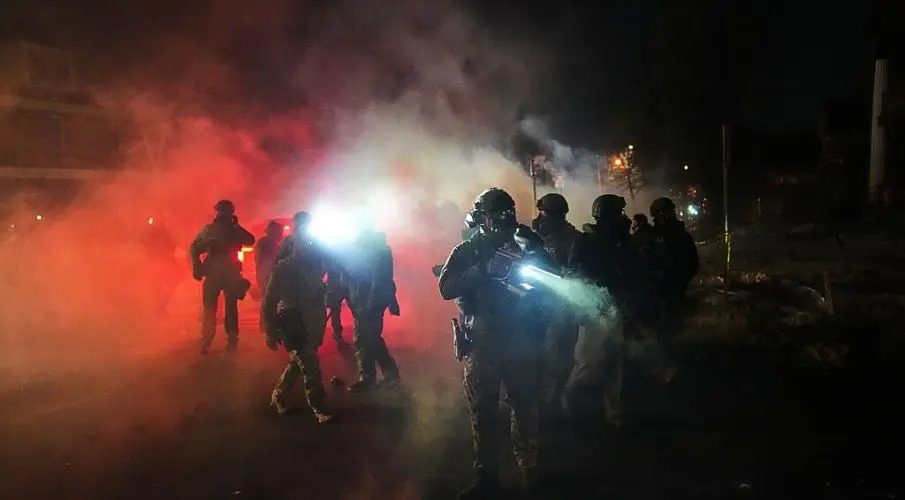
In Minnesota, something is coming apart that long seemed stable. Quietly, but unmistakably, federal prosecutors are leaving their offices, clearing their desks, turning in their badges. Not for career reasons, not because they are moving to private practice, but out of conviction. The Trump administration’s handling of the fatal shooting of Renee Good has triggered a wave that has now reached the entire U.S. Attorney’s Office in Minnesota. At least five federal prosecutors have resigned just this week alone, including the deputy head of the office. Further departures are considered likely internally. Former and current staff openly say that experienced, respected lawyers are leaving - people who formed the backbone of the office. Nearly fifty of roughly 135 employees are said to have left the U.S. Attorney’s Office in Minnesota since Trump’s reelection. What remains is a thinned-out structure in which hardly anyone knows how the work can continue at this level.

“What we are experiencing feels like war. That is what it feels like here. In Minneapolis. As if you are watching rules shift, roles blur, and you yourself become part of a game you did not choose. We are told we must learn to eat in order not to be eaten. We are told there are only sheep and wolves. But that is too cheap.”
The trigger lies on January 7. On that day, the 37-year-old mother Renee Good was killed in Minneapolis by an ICE officer with shots to the head and chest. She had partially blocked a neighborhood street with her vehicle and was protesting an operation by federal authorities. Multiple videos document the sequence from different perspectives. The shooter himself was also filming. In his recording, after the shots, a male voice can be heard insulting Good. That it is his own voice was reviewed and confirmed.

Instead of focusing on the shooter and the course of the act, the Justice Department defended the officer. Good had attempted to run him over with her car, it was said. At the same time, the U.S. Attorney’s Office in Minnesota was instructed to shift the focus to Renee Good’s wife, who had also been protesting at the scene. For many prosecutors, this was the point at which they could no longer go along. A detailed frame-by-frame analysis of the videos shows that Good steered away and did not drive toward the officer. The official account did not withstand this review.
Brennan: Tell me something about the officer, Jonathan Ross. - Noem: Do not say his name. For heaven’s sake, we should not allow law enforcement officers to continue to be doxxed. - Brennan: His name is publicly known.
Noem: I know, but that does not mean he should continue to be named. (January 18, 2026)
In addition, federal authorities excluded state investigators from the investigation at an early stage. This made it significantly harder for local offices to secure evidence. Staff at the U.S. Attorney’s Office in Minnesota report that colleagues cried while watching the footage, that the emotional burden was enormous - not only because of the act itself, but because of the political response to it.
At the same time, the situation in the city escalated. Since the start of what is known as Operation Metro Surge, more than 2,400 people have been arrested by federal agents in the Twin Cities. Videos are spreading that show brutal scenes: a disabled woman dragged from her car; an unconscious man in handcuffs; a vehicle with six children against which a flashbang was deployed, a six-month-old baby had to be taken to the hospital. Public pressure is growing, calls for accountability are becoming louder.
But this is precisely where the structural problem lies. To initiate proceedings for civil rights violations against ICE officers, the U.S. Attorney’s Office in Minnesota needs approval from Washington. And internally, that approval is considered unattainable. If not even for a woman shot at close range an independent investigation can be enforced, how are other cases to be pursued? This is the question many of the lawyers who are now leaving are asking themselves.
The personnel consequences are severe. Even before the most recent resignations, the U.S. Attorney’s Office in Minnesota had fewer than thirty prosecutors. That is not even half of the intended staffing level. To cope with the flood of cases at all, military lawyers are now being deployed. More are to follow. For experienced observers, this is an alarm signal. Knowledge, experience, and institutional memory are being lost. Investigations into fraud, serious violent crimes, and politically sensitive cases are grinding to a halt.
Particularly bitter is the way some of those who resigned were treated. Several had offered to support a transition period using accumulated leave. Instead, after submitting their resignations, they were dismissed, their access was revoked, and they were escorted out of the building. A hard cut that further poisons the climate.

What is emerging in Minnesota is more than a regional crisis. It is a glimpse of a justice system that is beginning to tear under political pressure. When career prosecutors leave en masse, not out of convenience but out of principle, that is a warning signal. The consequences will be felt for years - not only for ongoing cases, but for trust in the rule of law itself.
Updates – Kaizen News Brief
All current curated daily updates can be found in the Kaizen News Brief.
To the Kaizen News Brief In English


Unglaublich, dass Minnesota als souveräner Bundesstaat, die Erlaubnis von US-Regierung braucht um gegen einen kriminellen ICE Typen zu ermitteln.
Damit ist doch jedes Rechtsgefüge der einzelnen Bundesstaaten nichts wert.
Bundesbeamte können sich entspannt zurück lehnen, weil sie wissen durch Trump haben sie letztlich komplette Immunität.
Sie können vergewaltigen, morden, Menschen verletzen und ihnen wird rein gar nichts passieren…
Was für ein Rechtssystem ist das?
Nord Korea? Russland? China?
Ich verstehe die Staatsanwälte auf der einen Seite.
Sie wollen sich an diesen Verbrechen nicht mit schuldig machen.
Andererseits fehlen dadurch Staatsanwälte, denen das Recht und nicht Trumps Agenda wichtig sind.