
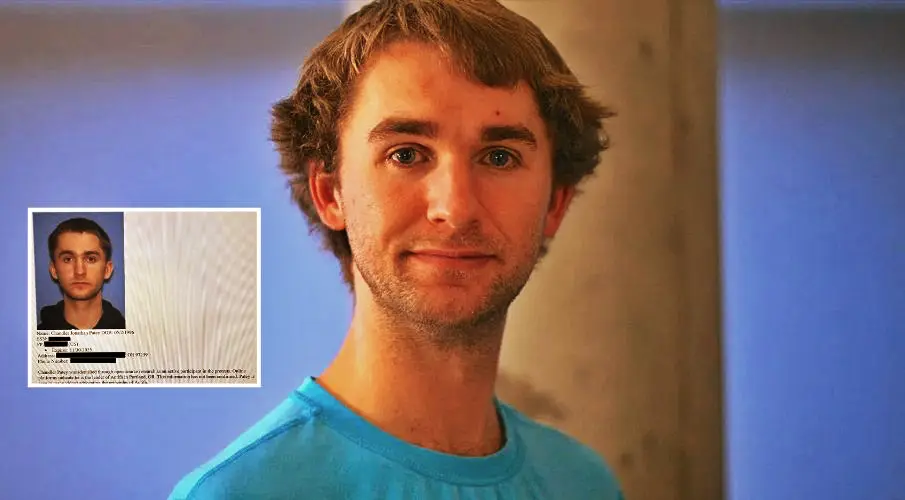
Chandler Patey is 29 years old and has been standing for months in front of an ICE facility in South Portland. He protests. He lets demonstrators into his apartment so they can wash pepper spray from their eyes or briefly use the toilet. For the Department of Homeland Security, that apparently suffices to list him internally as the “leader of Antifa in Portland, Oregon.” That sentence appears in an internal agency report. A young man without charges, without a criminal record, is classified there as a domestic terrorist.

Internal, leaked documentation from the Department of Homeland Security’s “Intelligence Reporting System” showing an entry on Chandler Patey
At the same time, the matching theater was playing out on right wing television. Fox hosts turned his apartment into an “Antifa safe house.” Patey did not respond with slogans, but let a local newspaper look inside the apartment: normal, unremarkable, no secret headquarters. That is precisely why the story is so revealing. The police “looked away” because there was nothing to see. The state, however, writes things down. In fact, he showed a local journalist his “very normal apartment.” No weapons cache, no clandestine meetings. A kitchen, a bathroom, a living room. Nevertheless, his name appears in an internal system that was originally created for foreign terrorist threats: “Intelligence Reporting System - Next Generation,” or IRS-NG. In the documents, “open source research” is cited as the basis. What that means is whatever appears somewhere on the internet. Videos, posts, allegations. The entry claims in substance that online platforms show Patey to be the “leader” and visible in many videos promoting Antifa principles. That is the entire logic: “online” says something, so it is officially recorded - and thereby acquires an official tone it did not have before.

Through IRS-NG, analysts access datasets, link profiles, flag names. The system, originally designed for border protection and international threats, is being applied to domestic protesters. Anyone who regularly demonstrates in front of a detention facility, anyone who calls for assemblies on social media, can fall into the net. Through this portal, federal agencies can access at least 28 databases - including the Terrorist Screening Dataset, the Watchlist Service, the National Crime Information Center, the Automated Biometric Identification System, passenger data, visa information, border crossings, even seized or copied contents of electronic devices, Social Security numbers, passport numbers, residential addresses. Once someone lands in this system, they are fully mapped. Added to that are criminal record checks, immigration files, student program data, biometric systems. And it does not end there: driver’s license data, license plate information, “certain” intelligence or law enforcement data. Whoever is drawn into such a grid is not merely observed, but fully retrieved.
Patey is not an isolated case. Dustin Ragsdale is also listed as an “Antifa protester” because he stands with a megaphone in front of an ICE facility and behaves aggressively toward counter demonstrators. A woman using the pseudonym “Mossy Matriarch,” a photographer from the state of Washington, likewise appears in internal memoranda because she collects donations for demonstrators. No allegation of a crime. No proceedings. Just classification.

In an internal entry of the Intelligence Reporting System, the Department of Homeland Security lists Dustin Ragsdale as an “Antifa protester.” The basis is said to be research from publicly accessible sources. According to the document, Ragsdale lives opposite an ICE detention center and is regularly seen there with a megaphone. He is attributed with “aggressive behavior toward counter demonstrators.” Further checks regarding his person were ongoing. The entry repeatedly emphasizes that he was identified on the basis of online research. A specific crime is not named.
The foundation for this lies in the political decision to designate “Antifa” as a domestic terrorist organization. Yet Antifa is not a registered association, not a structured organization with membership cards or a chain of command. Nevertheless, within the agency work is apparently conducted as if there were a network with leadership personnel and regional heads. The assumption generates its own evidence. At the same time, the bureaucratic apparatus grows.

In the internal entry of the Department of Homeland Security, “Mossy Matriarch” does not appear as a photographer or local activist, but as a security relevant figure. She is reproached for having called on social platforms to support demonstrators in Portland with material donations. The records precisely note that she names a post office box in Vancouver, Washington, and also receives material donations at a school. Later, in a video, she is said to have shown the materials received, explained that she would bring them to Portland, and announced that she would interview one of the organizers in her podcast. No criminal allegation is raised - only engagement is documented.
An employee from the homeland security sector describes this internal culture in substance as paranoid leaps of the sort otherwise heard on conspiracy radio: “maybe Antifa,” “has Antifa loyalty,” “motorcycle club and Antifa.” This way of thinking does not fall from the sky. It follows a political directive: Trump declared Antifa a “domestic terrorist organization” and set guidelines that place agencies in an absurd position. If “terror” is demanded at the top, something must be delivered at the bottom - if necessary from fragments of the internet.

An internal entry in the Department of Homeland Security’s “Intelligence Reporting System” lists the Matisse Apartment Complex in Oregon as a “Location of Interest.” Specifically, an apartment at that address is described as an alleged “safe house” for demonstrators. The unit in question is said to have been searched, and there were several arrests. Chandler Patey is named as the lawful resident, who had previously been arrested in front of an ICE detention facility. The screenshot thus shows how unverified attributions, residential addresses and protest activities are transferred into an official situation report - with all the consequences such an entry can have for those affected.
What is pernicious is the contradiction outward. When asked how such an entry fits with the public statement of a DHS spokesperson that there is “no database for domestic terrorists,” according to the report no answer was given. Internally, however, exactly that which is publicly denied exists: a system that marks people, categorizes them, links them. The documents bear the stamp “Law Enforcement Sensitive.” Through Freedom of Information Act requests, something like this would hardly come to light. And Congress in this matter appears like a spectator who prefers to produce headlines rather than dismantle the machine. Without leaks, no one would know about it.
What becomes visible here is not a single misstep, but a system that places protest and threat in the same folder. A state that turns demonstrators into security risks because the political directive is to find one. In this climate, it is enough to provide water or hold a megaphone to stand in a data field next to terrorism suspects. When open research is replaced by buzzwords and internal registers react to mere attributions, the boundary between legitimate criticism and criminalized opposition shifts. Those affected often learn of it only when they are stopped, checked or flagged.
All of these investigations and database entries that turn rumors into official records and label protesters as security threats lead to a dangerous realization: This country no longer reacts — it hallucinates threats. America has been living under Trump in a state of permanent paranoia, where political opinion is instantly classified as a danger. This condition has become part of the current American story, and it has a name: “Donald Trump.” And yet, Chandler Patey remains a young man with an apartment and a sink. In the files, however, he appears as a “leader.” Between those two images lies the real story.
Updates – Kaizen News Brief
All current curated daily updates can be found in the Kaizen News Brief.
To the Kaizen News Brief In English


Danke, dass ihr das recherchiert und auch danke an die Leute, die diese Dinge leaken.
Wie leicht quasi Jeder ins Visier geraten kann.
Das erinnert mich an Minority Report.
Jeder der abweicht von der Trumplinie, ist ein potentielles Risiko.
Jeder der den Mund aufmacht, wird in einer dieser Datenbanken geführt.
Furchtbar!
Und keiner stoppt es.
Bis alle „Gegner“ erfasst sind und kein Widerspruch ohne sofortige Verhaftung mehr möglich ist.
Leider wird hier dazu gar nicht berichtet.
Aber so löscht man eine Demokratie.
Danke für diese Recherche