
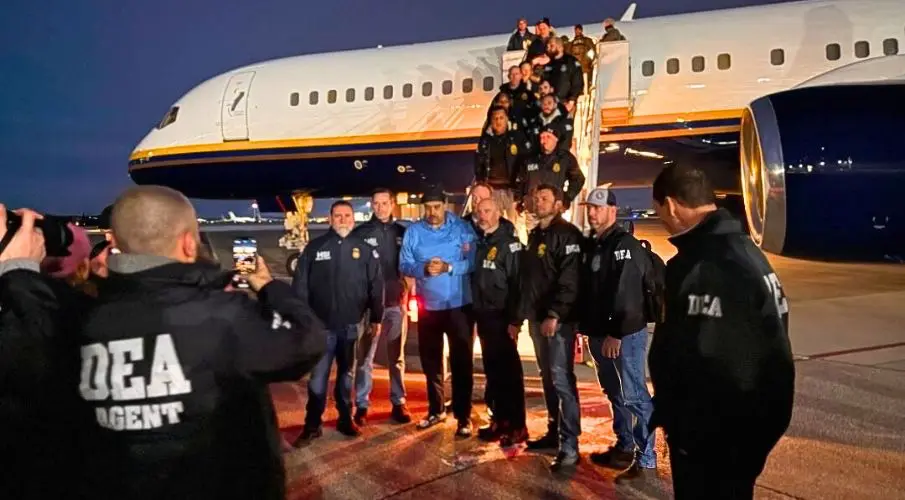
Our intensive investigations show that the US administration’s belligerent change of course is not merely the result of diplomatic pressure or spontaneous reactions to provocative overflights by Venezuelan jets. It is built on internal intelligence papers that show how the Department of Homeland Security DHS and Immigration and Customs Enforcement ICE upgraded the criminal network “Tren de Aragua” TdA to a national security threat. In a confidential letter to Congresswoman Lauren Boebert, which is in our possession, it states verbatim that the “new information on TdA” has led to a “renewed focus within ICE.” Patrick Lechleitner, then acting ICE director, describes how “members of TdA establish command and control centers in residential complexes heavily populated by Venezuelan nationals.” Colorado is highlighted in particular as a focal point, where ICE, together with federal prosecutors and local authorities, seeks to identify, dismantle, and arrest TdA structures and their members.
- ICE Memo (2023): "Members of TdA are establishing command and control centers in residential complexes in communities with a high proportion of Venezuelan nationals."
- DHS Analysis: "TdA uses violence as a means to threaten, intimidate, and maintain control."
- NIC Report (April 2025): "The Maduro regime probably does not have a policy of cooperating with TdA or directing TdA operations in the United States."
- ICE Assessment: "Many groups use the name TdA only for reputational reasons, without direct connection to the leadership."
- Congressional Letter to Lauren Boebert: ICE names Colorado as a focal point of TdA investigations and describes close cooperation with federal prosecutors to dismantle cells.
Supplementary evaluation of the documents

National Intelligence Council Memo of April 7, 2025, the declassified intelligence document on the question of the links between the Maduro regime and TdA. NIC Report (April 2025): Declassified assessment of the National Intelligence Council stating that the Maduro regime "probably does not have a policy of cooperating with TdA (Tren de Aragua) or directing TdA operations in the United States" and that many cells "operate independently."
Our entire newsroom has reviewed the ICE documents and the declassified National Intelligence Council assessment in full. They show that TdA Tren de Aragua “operates in loosely organized cells” spread across at least seven countries in South America and the Caribbean. The leadership has “historically benefited from permissive conditions and institutional weaknesses in Venezuela.” While there is communication between individual cells, “many of these cells likely operate autonomously and coordinate independently.” Particularly explosive is the passage in which ICE concedes that some groups or individuals “use the name TdA only for reputational reasons” and have no direct ties to leadership. This not only complicates investigative work but also raises the question of how solid the classification as a state affiliated threat really is.


In another section it states that the organization focuses on "human trafficking, migrant smuggling, and low-level crime." The decentralized structure makes it "highly unlikely" that TdA is planning large-scale logistical operations such as coordinated attacks or systematic infiltration. Nevertheless, it is emphasized that between 2021 and 2024 there was "an increase in encounters with TdA members at the U.S.-Mexico border" who often traveled together with migrant groups.


The ICE letter also describes how state laws in Colorado make the agency's work more difficult: The "Denver Public Safety Enforcement Priorities Act" prohibits city officials from asking the immigration status of arrested persons or executing ICE orders without a judge's warrant. Other laws prohibit probation officers from sharing personal information with immigration authorities, making jail interviews and detention orders more difficult. ICE emphasizes that these laws "prevent ICE from carrying out its mission effectively and efficiently" - a formulation that suggests Colorado is seen as a kind of safe haven.
The language of the memo sounds more like guerrilla operations than organized crime. The document literally states that TdA "uses violence as a means to threaten, intimidate, and maintain control." In one passage it says TdA uses "tactics and trade routes to disguise memberships, relocate members, and cover their tracks." It is precisely this choice of words that now serves as the basis for military escalation far beyond law enforcement. In Washington, drugs are no longer seen only as a public health crisis but as a reason for war. "A foreign terror network that is poisoning our people with drugs is no different than al-Qaeda - and will be treated as such," Hegseth said after an attack on a suspected drug boat in the Caribbean. President Trump himself calls the fentanyl crisis an "invasion" and thus justifies the use of military force.
The 2020 indictment also accused Maduro of leading a drug trafficking organization called the Cartel de los Soles, the Cartel of the Suns. The name is an ironic reference to the sun insignia on the shoulder boards of Venezuelan military officers. Under Maduro’s leadership, the organization allegedly not only enriched its members and expanded its power, but also sought to “flood” the United States with cocaine and “inflict the harmful and addictive effects of the drug on consumers in this country.” The indictment claimed that Maduro and others had “prioritized cocaine as a weapon against America.”
But this is where the explosive part begins. Because while DHS and ICE create the impression that the Maduro government controls TdA like a secret army, other parts of the U.S. intelligence community come to completely different conclusions. A declassified report by the National Intelligence Council in April states that the Maduro regime "probably does not have a policy of cooperating with TdA or directing TdA operations in the United States." In other words: There is no solid evidence of a direct chain of command from Caracas to Colorado. The paper further states that many TdA cells abroad "probably operate independently and coordinate independently." This assessment calls into question the official narrative of the White House.
Anyone who looks at sober data instead of headlines sees a different picture. Venezuela is not a significant producer of cocaine. It is primarily a transit country - a corridor fed by the porous, thousand kilometer border with Colombia, the world’s largest producer. US government estimates in 2020 placed around 200 to 250 tons of cocaine transiting Venezuela annually - roughly one tenth of global volume. That is substantial, but it is not the epicenter. Other routes move far more product. In 2018, according to US data, about 1,400 tons passed through Guatemala. Geography of logistics is decisive as well. The main flow to North America runs through the Pacific. In 2019, roughly three quarters of all shipments were registered via the Pacific corridor, primarily from Colombia and Ecuador. The Caribbean was the smaller, though visible, stage. And with fentanyl - the true killer of the US opioid crisis - Venezuela is little more than a rhetorical lightning rod. The synthetic drug is produced almost entirely in Mexico, from precursor substances often originating in China. It is documented that cocaine in the United States is cut with fentanyl - but the cutting happens in Mexico or on US soil, not in Caracas. Anyone who turns a military strike, with at least 40 dead, plus 115 dead from 35 US boat attacks, into a blow against the fentanyl epidemic is primarily engaging in symbolic politics.
Trump’s “solution” of redirecting the fentanyl crisis toward Venezuela is nothing more than a media effective diversion. He needs enemy images to distract from decades of failed domestic policy, to divert attention from the real crisis, because the major boom in the United States began in 2018, during Trump’s first term - a crisis that is now deeply rooted in American society. In a country where the health care and social systems are chronically underfunded, where Robert Kennedy Jr. has been installed as health secretary acting like a butcher, where mental illnesses often go untreated, where economic insecurity and lack of prospects drive millions into addiction, drug consumption remains high - regardless of which drug currently dominates.
This does not mean Venezuela is innocent. The country, led by a dictator, is riddled with smuggling networks, enabled by weak institutions and systemic corruption. US indictments and leaked investigative files from Colombia have for years painted a picture in which security forces protect shipments, accomplices collect payoffs, and state structures serve as grease for the business. The American justice system indicted President Nicolas Maduro in 2020 for conspiracy to traffic drugs - together with confidants and military officers, labeled under the collective term Cartel de los Soles. Legally proven, there is little to nothing. Politically effective, it certainly is. Experts describe the “cartel” less as a classic drug enterprise and more as a patronage network: illegal gold, bloated state contracts, embezzled aid funds - money flows that buy loyalty and sustain the regime. Or, as one longtime Venezuela analyst put it: Maduro keeps the upper ranks “fed and quiet.”
ICE and HSI Denver agents have tracked down and arrested Jesus Ramon Estrada-Ivarguen, a member of a Mexican cartel - HSI (Homeland Security Investigations) is the investigative arm of the U.S. Department of Homeland Security specializing in combating transnational crime, drug and human trafficking, money laundering, and terrorism financing.
Our research also shows that even in Colorado the situation is more complex than Washington portrays it. HSI Denver did launch a major investigation into TdA in the fall of 2023, but relied heavily on confidential informants and patterns of violent crime in migrant neighborhoods. The memo describes how TdA "primarily relies on the exploitation of the weak and newly arrived migrants" and thus "was able to evade law enforcement for years." That criminal networks exploit the plight of migrants and make money from human trafficking, drug trafficking, and arms trafficking is undisputed. But the equation of these cells with an operation directed by the Venezuelan president remains speculative.

Nevertheless, the Department of Justice increased pressure and in August placed a 50 million dollar bounty on Nicolas Maduro. The letter to Boebert emphasizes that ICE, together with the “United States Attorney’s Office for the District of Colorado,” is working to “identify, indict, arrest, disrupt, and dismantle” TdA cells. This is language drawn from the world of counterterrorism.
That the United States is facing a veritable fentanyl catastrophe is beyond question. More than 100,000 deaths per year are a tragedy. But the militarization of drug policy carries the risk of fighting an enemy that may not even exist in that form. Even if TdA cells in US cities are dismantled - whether through police work or military force - the demand for drugs remains, and other cartels will fill the gaps.

In the United States people all too readily close their eyes to the homegrown causes of the crisis and shift the blame to foreign states. The truth is: As long as Washington clings to an outdated social system and pursues policies that neglect prevention, health care, and drug treatment, the fentanyl epidemic will continue to escalate. Thousands of illegal drug labs exist in the United States itself - a fact that is hardly mentioned in the public debate. Against this backdrop, the "drug wars" against Venezuela propagated by Trump appear less like a security concept and more like a political distraction maneuver that obscures the real structural problems at home.
Our investigations reveal that the administration was willing to turn an internal crisis - ongoing violence and the drug epidemic - into a foreign policy project. It wants to project toughness, demonstrate military strength, and present a tangible enemy. But as in 2003, this enemy may prove to be an illusion. An attack on Venezuela would neither address the causes of the drug crisis in the United States nor ease social tensions in Colorado. It would, however, dramatically increase the risk of military confrontation in the Western Hemisphere. A war against Venezuela could drive millions to flee, further intensify migration flows, and exacerbate precisely the security situation Trump claims to be fighting. It would be a cycle of escalation with little chance of reversal.
After the military attack on Venezuela and the violent removal of President Nicolas Maduro, the United States openly claims de facto rule over the country. President Donald Trump declared that the US would govern Venezuela “for as long as necessary until a safe, orderly, and reasonable transition is ensured,” while simultaneously announcing investments by US oil companies. This statement constitutes a clear self attribution of foreign sovereign authority and in substance fulfills the criteria of a military occupation under international humanitarian law.
Neither the prohibition on the use of force under Article 2 paragraph 4 of the Charter of the United Nations nor the right of peoples to self determination has been respected. There is no justification through self defense, no mandate of the Security Council, and no internationally recognized responsibility to protect. The announced transitional administration is therefore not a protective measure, but the suspension of Venezuelan sovereignty through external force. That this declaration was made at Trump’s private residence in Mar a Lago underscores the institutional boundary breaking of the act: a military attack based on false premises, combined with promises of economic exploitation, and legitimized through unilateral assertion of power. Under international law, this constitutes an act of aggression with colonial character. Politically, it is a precedent that further weakens the international prohibition on the use of force and dangerously lowers the threshold for future military interventions.

At least 40 people have lost their lives today - for yet another lie by Trump. How long the world will continue to watch this unfold, we will not speculate. Perhaps it is time once again for millions to take to the streets, because Germany in particular is more than just at risk from such a politics of right wing populism.
We will continue our fight, our assistance to people - without ifs or buts, with all consequences. Because most have children and a mirror. You look into both and receive a gaze in return.
Updates – Kaizen News Brief
All current curated daily updates can be found in the Kaizen News Brief.
To the Kaizen News Brief In English


Trump geht es weder um die US Bürger, noch um die Drogentoten.
Es geht nur um Entfernung eines Erzfeindes und um Ressourcen. Viele, viele Ressourcen.
Und damit um Macht.
Die Maske hat Trump doch schon längst fallen gelassen.
Nur MAGA glaubt noch das Mädchen vom Schutz vor den Drogen.
Ihr habt es klar gegliedert aufgedeckt.
Danke dafür