
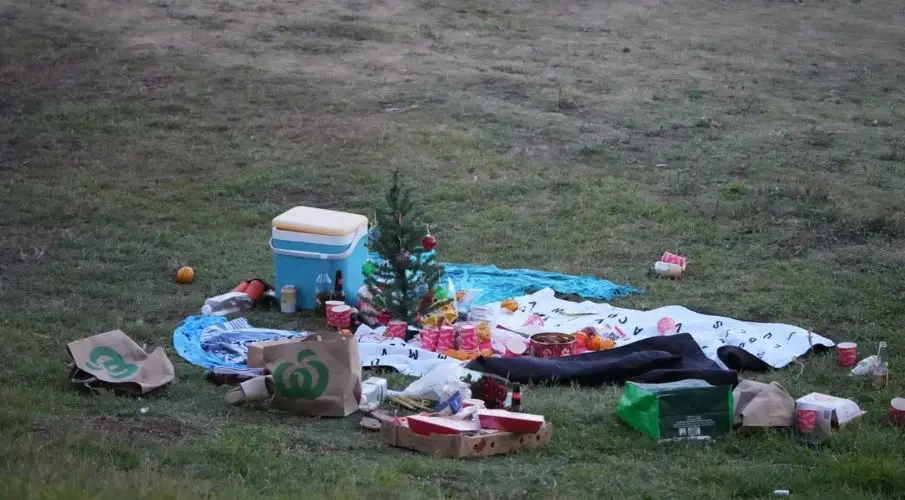
It was the early evening of December 14, 2025, when families filled Bondi Beach. Children were playing in the sand, music was playing, soap bubbles drifted across the lawn. It was the first night of Hanukkah, a holiday that stands for light, community, and joy. At around 6:45 p.m., this scene shattered within seconds. Gunshots echoed across the beach, people screamed, ran, searched for cover. What followed was one of the most severe antisemitic acts of violence in Australia’s history.

According to police, at least 16 people were killed. (As of 8:30 p.m. CET) More than two dozen others were injured, including two police officers. Two shooters are believed to have been involved. One of them, the 50-year-old Sajid Akram, was killed at the scene, while the other, his son Naveed Akram, 24, was arrested while seriously injured and is in custody. Authorities are unanimously describing the incident as a terrorist attack, deliberately directed at the Jewish community. Eyewitnesses report that the perpetrators exited a small silver car that had been parked near a pedestrian bridge at the beach. From there, they opened fire on the people who had gathered for the Hanukkah celebration. A teenage witness later said they did not shoot randomly, but deliberately targeted participants in the celebration. Videos show two men in dark clothing firing from an elevated position. The attack lasted for minutes. For the people on the beach, that time felt endless.
Ebonny Munro was there with her 17 month old child, by chance, without being part of the celebration. When she heard the shots, she threw herself under a metal barbecue. A stranger sought shelter there as well. Munro reports hearing the clatter of bullets and smelling gunpowder. For ten minutes they remained there. She saw at least one person being hit and falling to the ground. Later they were taken to a nearby rescue building, her knees bloodied, her child unharmed. Others ran across the beach from the water, still dripping wet, panicked, not knowing where to go. Finn Foster, an 18 year old backpacker from Canada, initially thought the sounds were fireworks. Then he saw people jumping over cars, dragging children behind them, climbing walls. Fifteen, twenty shots, he said later. Then silence, broken by sirens.
In the midst of this chaos, one man intervened. Footage shows him tackling one of the attackers from behind, bringing him to the ground and wresting the weapon away. The Premier of New South Wales, Chris Minns, later said this man had in all likelihood saved many lives. It was a single act of courage in a situation that had spiraled out of control.
Police Commissioner Mal Lanyon stated that several suspected improvised explosive devices were found in a vehicle linked to the attacker who was killed. Bomb disposal units were deployed. What exactly was found, how far the planning had gone, and whether these devices were operational is still under investigation. What is clear, however, is that the attack was not limited to firearms alone. Police are also examining whether there may have been another participant. This, too, suggests that investigators are dealing with a more complex plot. Prime Minister Anthony Albanese addressed the nation later that same evening. He spoke of a targeted attack on Jewish Australians on the first day of Hanukkah, a day that should bring joy. An attack on Jewish Australians, he said, is an attack on all Australians. The political assessment could hardly have been clearer. Australia’s security authorities officially classified the act as terrorism.
Particularly serious is the statement that one of the perpetrators had already been known to authorities. National intelligence chief Mike Burgess said this individual, the Pakistani Naveed Akram, had been on their radar, though not assessed as an immediate threat. That sentence raises questions that go far beyond this evening. Some journalists had repeatedly warned about him. How were these warnings evaluated. And why were they not sufficient to prevent such bloodshed. The name of the second attacker has not yet been confirmed, and therefore we will not engage in speculation.


According to members of the Jewish community, the Hanukkah celebration on the beach was organized by the Chabad community in Bondi. Chabad is a globally active Jewish movement that offers open events especially during holidays to bring people together. Among the dead, according to Chabad, is a rabbi of the community, Eli Schlanger. Police have not yet released the names of the other victims.

The attack strikes a community that has been under pressure for months. In Australia, the number of antisemitic incidents has risen sharply. Synagogues and Jewish businesses have been set on fire, buildings defaced, threats issued. Jewish organizations have long warned of a dangerous development. Yad Vashem, Israel’s Holocaust memorial, said it had repeatedly alerted the governments of Victoria and New South Wales to the sharp rise in antisemitism. After the attack, it stated that these warnings had not been adequately heeded.
Police neutralized both attackers at Bondi Beach. The father, Sajid Akram, was fatally shot at the scene, while his son, Naveed Akram, was seriously injured during the operation and subsequently arrested. Police stated that the situation had thus been brought under control and that there was no longer any immediate danger to the public.
Australia is the country with the highest proportion of Holocaust survivors outside Israel. This history is part of the national identity. That such a massacre should occur here of all places, in a public space, on a religious holiday, has shaken the country. Internationally, security authorities also reacted. In New York and London, police and city administrations announced that they would increase their presence at Jewish institutions and Hanukkah events. There is another aspect that makes the attack so extraordinary. Australia is considered one of the countries with the strictest gun laws in the world. After the Port Arthur massacre in 1996, in which 35 people were killed, semi-automatic weapons were largely banned, a comprehensive buyback program was implemented, and hundreds of thousands of firearms were removed from circulation. For years, the country was spared mass shootings. That at least 16 people were nevertheless shot dead on a public beach now reinforces the sense that a new level of violence has been reached.

Many questions remain unanswered. What motives drove them? Were there connections to extremist networks? What role did prior warnings, particularly regarding Naveed Akram, play for the security authorities? The investigation is only just beginning. Only one thing is certain: this attack was not random, not an indiscriminate outburst of violence. It struck people who were visibly Jewish, on a day that stands for light and hope.
Bondi Beach, a place associated with summer, freedom, and carefree life, has become a crime scene. For the survivors, the families of the victims, and the Jewish community in Australia, nothing will ever be the same again. And for the state, there remains the uncomfortable task of asking why so many warnings were issued and why, in the end, they were not enough.
Investigative journalism requires courage – and your support.
Support our work against right-wing populism, disinformation, and violations of human and environmental rights. Every contribution goes directly into our daily reporting – we operate without advertising, without subscriptions, without corporations, without political parties. Our journalism is meant to remain freely accessible. For everyone.
Independent – Critical – For Everyone
Thank you for making our independent work possible.
Updates – Kaizen News Brief
All current curated daily updates can be found in the Kaizen News Brief.
To the Kaizen News Brief In English


Danke Rainer, dass Ihr diese furchtbare Tat so sachlich wie möglich darstellt.
Zu viele Falschaussagen, zu viele falsche/unvollständige Nachrichten kursieren.
Zuviel Spekulationen.
Allen Opfern und ihren Familien, sowie Allen Beteiligten kann ich nur viel Kraft wünschen um diese furchtbare Tat zu verarbeiten.
ich danke dir, es ist wirklich sehr, sehr schlimm, und das sind die Artikel, da schreibst du 8-10 Stunden dran, um immer den respekt in den Zeilen zu haben, die Fakten und keine Fehler, dass bis 1 Minute vor aktuellen Stand