
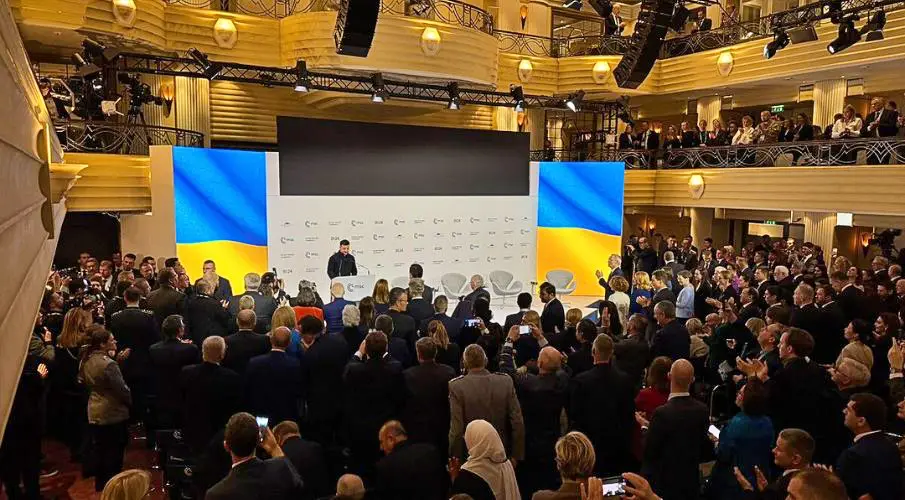
Four years ago, American government officials traveled to Munich with satellite images and intercepted radio communications. They warned of an imminent Russian attack on Ukraine. Many European leaders waved it off. Vladimir Putin was bluffing, they said at the time. A few days later, the war began, now entering its fifth year. This year, the roles have shifted. The small American delegation led by Secretary of State Marco Rubio spoke primarily about negotiations, about a possible end to the fighting. The Europeans, by contrast, issued warnings. Even a ceasefire, the tone in many discussions suggested, would not end Putin’s course. Sabotage, cyberattacks, drone overflights, damaged undersea cables - for many governments, this is already part of a covert conflict on NATO territory.
Rubio sought a conciliatory tone. Europe and America belong together, he said. The United States wants a strong Europe. The history of the two world wars shows that their destinies are intertwined. The applause was noticeably warmer than the previous year, when Vice President JD Vance had sharply criticized European governments from the same stage over their handling of right wing parties and issues of free speech. Yet one thing stood out: Russia played only a minor role in Rubio’s speech. No clear warning to Putin, no mention of the accusations by several European states that Alexei Navalny had been killed with a banned poison. In diplomatic circles, this omission did not go unnoticed.
Rubio painted a picture of a West that in 1945 lay in ruins - destroyed, ideologically pressured, seemingly in retreat. Yet as in the Cold War era, when Ronald Reagan and Mikhail Gorbachev ultimately turned confrontation into a chapter of arms reduction and dialogue, decline today is not inevitable but a political choice. Back then, the West did not capitulate, but showed strength while negotiating. He placed the Trump administration in this tradition: not managing gradual loss of influence, but renewal. Not weak allies, but confident partners capable of standing militarily on their own. Europe, he argued, should not be paralyzed by fear - of migration, of climate, of war - but should expand its defense capability and economic independence.
The reference to Reagan and Gorbachev is central: strength as a prerequisite for negotiations, deterrence as the foundation of peace. Not retreat, but self assertion - and in the end an alliance that preserves its freedom of action and does not rely on “managed decline.”
At the same time, mistrust has grown. In confidential discussions, officials now speak openly about “hedging” against the United States. The term had previously been reserved for dependence on China or Russian energy. Now it is being applied to Washington. Not because of a single conflict, but because of a series of tensions: tariffs, the debate over Greenland, accusations of cultural decline, the harsh tone from the White House.
German Chancellor Friedrich Merz has translated this uncertainty into a strategic question. For months he has been speaking with Emmanuel Macron about a possible French nuclear umbrella for Europe. Officially, everything is to remain coordinated with NATO and the United States. Yet unspoken, another consideration looms: can one rely on Washington to risk New York to protect Berlin in an emergency? France’s deterrent is limited, and whether Paris would be willing to increase its own risk for others remains open. That such conversations are taking place at all would have been almost unimaginable just a few years ago.
Meanwhile, concern is growing in many capitals that Donald Trump could seek a quick deal with Moscow that serves him politically but buys Russia time. Czech President Petr Pavel warned that a hasty peace would bring no Nobel Prize, but a new aggression. Danish Prime Minister Mette Frederiksen said a bad deal could lead to further attacks - in Ukraine or elsewhere in Europe.
President Volodymyr Zelenskyy once again received standing ovations in Munich. He made clear that elections in Ukraine would take place only after a ceasefire, not before. Above all, his country needs reliable security guarantees. A joint European American force of about 7,000 to 10,000 soldiers is under discussion. Whether it would be stationed inside or outside Ukraine remains unclear. Moscow continues to strictly reject European troops on Ukrainian soil.
Alongside these debates, a second issue ran through the conference: the future of Iran. Tens of thousands demonstrated in Munich for regime change in Tehran. Reza Pahlavi, son of the deposed Shah, appeared and called for an end to the Islamic Republic. In London, Athens, Melbourne and Tokyo, people also took to the streets. Many carried flags with the old lion and sun symbol, others signs reading “Regime change in Iran.” Some are counting on support from Washington after Trump said during a troop visit that a change in leadership would be “the best thing that could happen.” At the same time, new talks on Iran’s nuclear program are reportedly set to take place in Geneva. Warships in the Persian Gulf are sending their own signal.
The debate over Greenland also showed how deep the rift has become. The prime ministers of Denmark and Greenland openly rejected the idea of an American takeover. Sovereignty is not negotiable. Even Republican voices in the United States called such demands “offensive.” Defense Minister Boris Pistorius emphasized that Arctic security is a NATO matter, not the issue of a single nation.

In the conference corridors, one comparison was heard repeatedly: in European capitals, people speak as if they were on the brink of 1939. In Washington, that assessment is not shared. That is precisely where the difference lies. For many Europeans, the Russian threat is immediate and concrete. For parts of American politics, it ranks behind domestic issues.
The Munich Security Conference long served as a venue for transatlantic self reassurance. This year it was a forum of cautious distance. No one spoke of a rupture. But increasingly of alternatives. Europe is rearming militarily, discussing nuclear options, investing in its own defense projects and planning long term without certainty that Washington will stand first in line if needed. Four years ago, many in Europe did not believe war would come. Today, many no longer believe in automatic American guarantees. This shift is quiet, but consequential. And it is fundamentally reshaping the architecture of the West.
Updates – Kaizen News Brief
All current curated daily updates can be found in the Kaizen News Brief.
To the Kaizen News Brief In English


Für mich war Rubios Rede, wenn auch in freundliche Worte gepackt, ein „wir sind die Führung und wir entscheiden wie, wann und wo. Und Europa hat sich dem anzuschließen“
Wieso man ihm dafür stehend applaudierte, erschließt sich mir nicht.
Ein paar höfliche Klatscher hätten vollkommen gereicht.
Warum Europa damals so dumm war, die Warnung der USA in den Wind zu schlagen?
Vielleicht würde es heute weltpolitisch anders aussehen, wenn man zeitig reagiert hätte.
Trump ist egal was aus der Ukraine oder Europa wird.
Was für ihn zählt sind Deals, Deals und nochmal Deals.
Mit wem ist ihm auch egal.
Hauptsache seine Taschen und die seiner Lobbyisten füllen sich.
Europa muss eigenständig werden. Das ist ein Fakt.
Man darf sich nicht in endlosen Diskussionen verlieren und immer wieder „hoffen“, dass Trump doch ein Partner Europas ist oder das Putin einen echten gerechten Frieden in der Ukraine will.
Das ist nämlich so unwahrscheinlich, wie eine Herde Einhörner, die auf dem Regenbogen galoppieren und am Ende den riesigen Topf Gold finden.
👍