
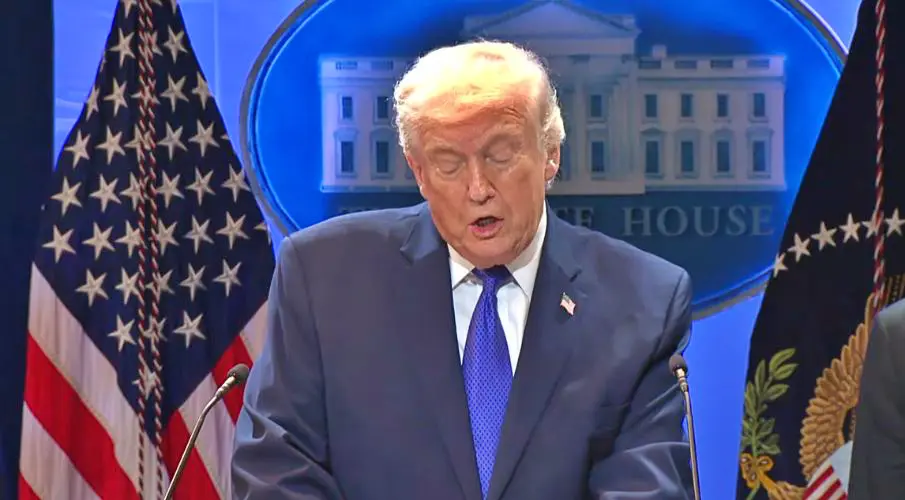
The president stands before the cameras, a prepared statement in his hand, and attacks the justices of the Supreme Court head on. The decision with which the Court struck down his sweeping tariffs he calls “deeply disappointing.” He says he is “absolutely ashamed” of certain members of the Court. They are “unpatriotic” and “disloyal to our Constitution.” These are not spontaneous words, not an outburst in the heat of the moment. Trump reads them. This is not a mood. It is a line. The timing of the decision hits the president at a particularly unfavorable moment: in about five weeks he will travel to China - and the ruling visibly weakens his negotiating position with the world’s second largest economy.
The Court had ruled six to three that Trump could not rely on the emergency law of 1977, the International Emergency Economic Powers Act, to justify his tariffs. That statute allows the president, in cases of national emergencies, to take certain economic measures. The word tariffs does not appear in it. That was precisely the point. May a president derive from a general authorization to regulate imports the power to impose broad based duties? The majority of the Court says: no.
Trump does not engage this legal question. He does not discuss whether Congress explicitly granted him this authority. Instead, he declares the decision politically motivated, influenced by unspecified foreign interests, driven by justices who are “a disgrace to the nation.” He emphasizes that he had previously tried not to unsettle the courts. “I wanted to be a good boy,” he says. Now he will “take a different direction.”
This choice of words is more than rhetoric. It reveals the understanding of separation of powers that underlies it. In the past, the president referred to judges he himself appointed as “our people.” Now he speaks of shame and lack of courage. At the same time, he expressly praises the three dissenting justices, especially Brett Kavanaugh, whose dissent outlines possible ways the president might impose tariffs under other statutory authorities. Trump calls him a genius and stresses how proud he is of his appointment. Agreement is rewarded. Dissent is branded as disloyalty.
More than a single economic policy instrument is at stake. Trump has made tariffs the center of his domestic and foreign policy. He argues they are the key to reviving American industry. Economists point out that in the short term they function like a tax and raise prices. The president has used tariff threats to conduct negotiations over migration, to pressure trading partners, and even targeted European allies as he applied pressure in connection with his Greenland initiative. According to calculations by the Congressional Budget Office, his measures would have reached an economic volume of roughly three trillion dollars over the next ten years.
The Court has now limited that lever. It is the first major defeat for a central pillar of his second term before the highest court, which he himself helped shape. The decision thus strikes not only an instrument, but also the self conception of a presidency that has interpreted emergency powers broadly.
Trump immediately announces alternatives. “We have alternatives,” he says. One might even take in “more money.” He points to other statutory bases. Under Section 122, a flat global duty of ten percent could be imposed. Under Section 301, investigations into unfair trade practices could be initiated, at the end of which new tariffs could stand. He concedes that these procedures take longer. In fact, they require formal reviews and administrative proceedings.
While the president attacks the justices, even Republican senators respond favorably to the ruling. Mitch McConnell declares there is now no doubt that bypassing Congress through the emergency statute is impermissible. If the executive wants to conduct trade policy, it must take the route through the powers of Congress set forth in Article 1 of the Constitution. Susan Collins emphasizes that only Congress has the constitutional authority to impose tariffs, unless it transfers that power clearly and in limited form. John Curtis calls it proof that the system of checks and balances still functions after nearly 250 years, while noting that open questions remain, including regarding revenue already collected.
Trump’s appearance shows a shift that has been emerging for years. Decisions of independent institutions are treated not as interpretations of law, but as questions of loyalty. Those who agree act in the interest of the country. Those who dissent are “disloyal.” The fact that the president reads his sharpest attacks from a prepared manuscript makes clear that this is not merely rhetoric, but political posture.
The confrontation is therefore not over. It shifts. Into new statutes, new proceedings, new tariffs. And into a fundamental question that goes beyond trade policy: how far may a president go when he is convinced he is acting in the name of an electoral mandate? The Court has drawn a line. The president has made clear that he does not regard it as the final one.
Updates – Kaizen News Brief
All current curated daily updates can be found in the Kaizen News Brief.
To the Kaizen News Brief In English


Und weil er so schön sauer ist, gibt es pauschal nochmal 10% Zölle dazu. Man hört den Fuß richtig aufstampfen.
Und es entsteht wieder Verunsicherung.
…die section 122, wird man abwarten müssen, so einfach ist die nicht umsetzbar