
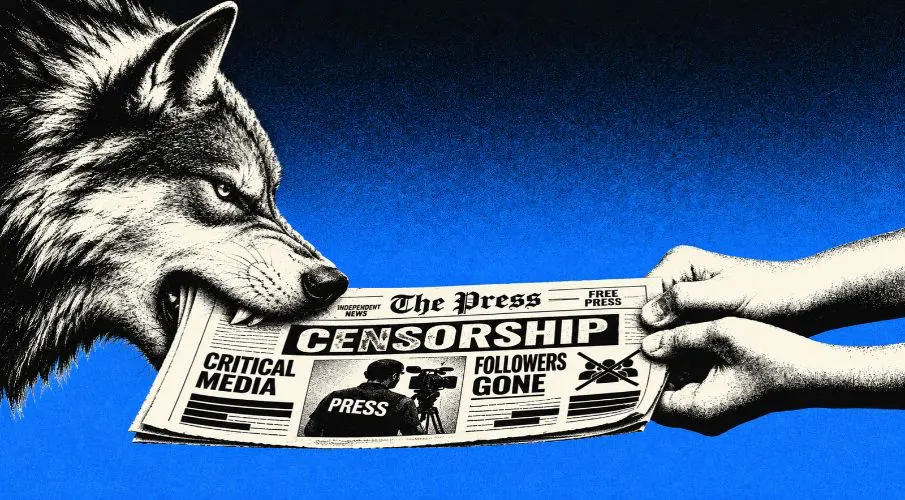
Censorship once came wearing boots. It kicked down doors and had entire print runs loaded onto trucks. Today, it comes in the form of a missing checkmark on a list. A woman opens her phone in the evening and looks for the small news outlet she's been reading for years. The page is there. The newsroom keeps publishing. Except she no longer follows it. She hasn't clicked anything. Dozens of people in many countries are now describing experiences like this, and none of them can say who severed the connection.
As the American election campaign approached its climax in late October 2026, reports were piling up at the organization Repro Uncensored. People were reporting unexplained changes in follower counts on political and socially critical accounts. The organization is reviewing screenshots and accounts from those affected. It's dissecting account statistics and the circumstances under which existing subscriptions disappeared. On November 1, Martha Dimitratou presented the preliminary findings of the investigation. More than 70 reports were already on the table. People reported suddenly discovering that they no longer followed certain sources of information. They had never made that decision. Somebody had made it for them.

Shortly before the midterms, American disinformation researcher Abbie Richards watched one of her posts suffocate online. Of all things, it was a piece about disinformation specifically targeting ethnic minorities and immigrants. People had reportedly been actively sharing it, yet its reach remained unusually low. The warning itself barely reached anyone anymore. Indigenous artist Nicholas Galanin lost several hundred followers within a day or two. In France, users discovered that they no longer followed political accounts, including that of Jean-Luc Mélenchon. Two days before the American election, a question arose that had nothing in common with the usual grumbling about social media. What is access to political information worth when Meta itself controls the connections between information providers and their audiences?
On November 9, Repro Uncensored followed up with its investigation, "Disappearing Audiences." It covers 98 accounts from at least 17 countries on Meta's Instagram platform. Forty-five are American, ten British. Six are from Germany. Journalists are explicitly among those affected. People contacted the German account @stopcryingjosie after suddenly discovering they were no longer following it. Kenyan documentary photographer Georgina Goodwin reported losing approximately 5,000 followers in two months, while her journalistic work reached fewer and fewer people. The investigation describes accounts where every new reader is swallowed up by ongoing losses. It's like pouring water into a bottomless bucket. Meta has the data that could clear this up. To this day, it remains unavailable to the public.
On October 22, 2026, the World Association of News Publishers, WAN-IFRA, which brings together more than 20,000 media brands and 60 national publishers' associations across 120 countries, addressed a letter to Joel Kaplan, Meta's head of global affairs. At issue were new commercial terms through which Meta sought to secure extensive access to publishers' websites. Irene Lanzaco, chair of the association's Member Associations Committee, warned that for many small and independent newsrooms, Facebook and WhatsApp were their means of reaching readers. Walking away was hardly an option. WAN-IFRA President Ladina Heimgartner pointed to the absurd demand that publishers surrender their journalistic work for unrestricted use simply to maintain a presence on a platform. At the same time, Meta was testing restrictions under which Facebook pages would have to pay to post more than two links to their own websites per month. On October 29, the World Association of News Publishers addressed Mark Zuckerberg directly. Among other things, publishers demanded the right to deny Meta access to their content without being punished with restrictions on their reach.
On November 3, 2026, Sara Guaglione and Jessica Davies published an investigation into the dependence of international newsrooms on Meta. The figures come from data analytics companies including Similarweb and Chartbeat. Across ten major news outlets, including The New York Times and the Associated Press, referral traffic from Facebook had fallen sharply compared with the previous year. At one of the news organizations interviewed, Meta had once accounted for more than a fifth of all global website visits. Almost nothing is left of that today. "They hold us hostage," said the executive responsible for audience development at that news organization. Eilidh Wilson of the British publishers' association PPA reported that media companies had invested millions in their social media teams, only to watch their referral traffic collapse almost overnight. For years, publishers accompanied their readers wherever they wanted to get their news. Now they're sitting with them in a house whose owner can change the locks at any moment.

Read the full investigation by Sara Guaglione and Jessica Davies here: „‘They hold us hostage’: Publishers furious over terms change still can’t quit Facebook“
November 20: A small page owner checks his numbers and can't believe his eyes. He reported losing more than 40 followers in twelve hours, even though around 30 new ones had joined. Reactions already left on his posts were disappearing. His analytics reportedly showed only 15 new followers and hadn't updated since that morning. Others report losses in the hundreds. Of all places, these discussions are taking place outside Facebook. A central point of contact capable of explaining to those affected where their audiences have gone appears to be largely unavailable to them.
Reporters Without Borders demonstrated how far Meta's grip on journalism extends in October 2026, using India as an example. The Facebook page of news outlet Molitics, with more than 450,000 followers, was blocked. The backup page created specifically in response was blocked right afterward. Meta removed the page of National Dastak, a news outlet covering social discrimination and life on the margins of society. 4PM News Network, with nearly 1.7 million followers, was blocked in India. National security and public order served as the justification. This is how a government can cut entire newsrooms off from their audiences. It points at a newsroom, and Meta flips the switch.
On October 12, 2026, the Committee to Protect Journalists joined 20 other organizations in speaking out against similar developments in Turkey. Meta had restricted access to Facebook accounts belonging to media outlets and civil society organizations. The signatories demanded that the companies involved fulfill their human rights obligations and resist the suppression of independent media. Western governments regularly extol the virtues of press freedom in authoritarian countries. Western companies deliver the technical means for those governments to enforce their censorship right to their doorstep.

It doesn't even take an order from a government ministry for news outlets to lose a substantial portion of their audiences within a very short time. On August 3, 2026, journalist Sue Ahearn documented how Facebook views for The Pacific Newsroom had plummeted by 70 percent. Dorothy Wickham, founder and editor-in-chief of the Melanesian News Network, lost 45 percent of her reach within four months. Vanuatu's public broadcaster also experienced substantial declines. For large sections of the population there, Facebook is a vital way to access news and official warnings. The newsrooms received no explanation from Meta.
Meta's independent Oversight Board established as early as October 30, 2025, that the company's own procedures failed to protect journalism. A news page from Somaliland with around 90,000 followers had been removed over supposed violations of hate speech rules. Six human reviewers rubber-stamped the removal of four news posts. The appeal against the removal of the entire page was automatically closed. Only the investigation under case number BUN-9C46KKKS overturned those decisions. Facebook had strangled journalism using rules it had never violated.
Reporters Without Borders now describes Meta's treatment of journalism as a ten-year war of attrition. In August 2024, Meta shut down CrowdTangle, one of the most important tools journalists could use to track how news spread on Facebook. On January 7, 2025, Joel Kaplan, Meta's head of global affairs, publicly admitted that "Since 2021, we’ve made changes to reduce the amount of civic content people see." An American corporate leadership has decided that society should learn less about its own political reality. Nobody elected them.
The European Commission must intervene, and it has the legal means to do so. The Digital Services Act requires major platforms to investigate systemic risks to freedom of expression and public discourse. Meta accounts for its advertising revenue down to the last cent. Yet those affected are left to figure out for themselves why millions of people are being denied access to the information sources they've subscribed to. For a company of this size, that's intolerable. Millionen Menschen der Zugang zu ihren abonnierten Informationsangeboten entzogen wird, sollen die Betroffenen selbst herausfinden. Bei einem Unternehmen dieser Größe ist das unerträglich.
For centuries, rulers banned inconvenient newspapers and had their print runs confiscated. At least that produced images people could rally against. Today, a newsroom continues working in plain sight while its audience disappears behind a technical mechanism. At some point, the reader may come to believe that their newspaper is no longer being published. The newspaper, in turn, believes the reader has lost interest. Meta sits between the two, and that's precisely where this company belongs under public and legal oversight.
The damage to the media outlets affected is enormous because our society has allowed itself to become dependent on Facebook for its information. Years of journalistic work and the painstaking effort of building an audience can be wiped out in a very short time by technical interventions from an American company.
And if we're no longer on your following list, don't worry: Facebook simply hasn't allowed you to follow us anymore.
Updates – Kaizen News Brief
Alle aktuellen ausgesuchten Tagesmeldungen findet ihr in den Kaizen Kurznachrichten.
To the Kaizen News Brief In English


So lange Regierungen dieses „Spiel“ mitspielen, wird sich nichts ändern.
Und gerade Trumps Regierung hat diesem Verhalten Tür und Tor geöffnet.
Meta läuft voll auf MAGA Kurs.
Von der EU kommt mal ein „Du, Du“ und eine lächerliche Strafe.
Aus Angst Trump zu verärgern.
Auch andere Länder legen sich kaum nit Meta und Co an.
In den USA kommt noch dazu, dass der Gros der Fernsehsender und Streamingdienste in den Händen von Trumps Freunden sind.
Man kann sich nur selber informieren und gezielt die Seiten, auch außerhalb von Meta, aufrufen.
Leider verfügen nicht Alle über Plattformen außerhalb von FB und Co.
So bleibt nur, Seiten selber aufrufen, checken ob man ihnen boch folgt und für die Reichweite liken und kommentieren.
Ich bin froh, dass Ihr hier eine Meta unabhängige Plattform habt.