
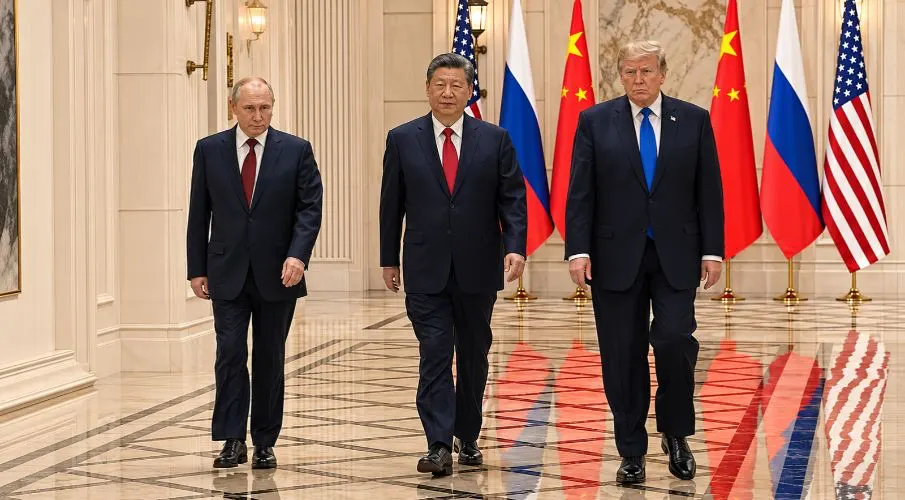
A president wanted by the International Criminal Court speaks about preserving world peace. Sitting beside him is Donald Trump, who wants to treat that very court as a threat to national sovereignty. Xi Jinping recalls the horrors of a world war. For more than an hour on Thursday, the presidents of the United States, China, and Russia held talks in Shenzhen. It was their first joint meeting of its kind. Ukraine, whose future was being discussed, had no seat at the table.
Three presidents present themselves as saviors of world peace while Putin's army continues killing Ukrainians, and sell a collection of nonbinding statements of intent as a historic summit. The only tangible outcome of this diplomatic disgrace is the concern of those in power for their own immunity from prosecution: War victims get warm words, while those who might prosecute their tormentors at the International Criminal Court face a joint threat.
Putin opened the talks with a historical claim whose sheer arrogance was hard to surpass, given his own war of aggression. The three countries were united by their victory in World War II and shared responsibility for international peace and security, he said. They could make the world safer if they worked together as partners, based on mutual respect and equal consideration of one another's interests. The very president who unleashed a war of aggression against Ukraine was claiming the moral authority of those who defeated fascism. His army is waging a war of conquest against a sovereign neighboring country while he stands in Shenzhen, presenting himself as the guardian of a peaceful international order whose very principles he tramples underfoot. History has to put up with quite a lot at moments like these.

Xi also reached back to World War II. China, the United States, and the Soviet Union had formed the "backbone of the world's anti-fascist struggle," he said. For Beijing, this historical memory serves a second political purpose: Xi has repeatedly invoked it in the growing disputes with Japan over recent months. The Chinese president linked the meeting to a warning about another world war. "History tells us that when great powers are at peace, the world is secure; when great powers clash, the world is in chaos," he said. The fate of smaller countries initially had no place of its own in that thinking.
Trump was unusually serious in his public remarks. "It's an honor to be with Vladimir. It's an honor to be with you, Mr. President," he said, turning toward Xi. He declared that the three countries were making history. They were uniquely positioned to reduce the number of nuclear weapons and lower the risk of those weapons being used. The Chinese president spoke of talks aimed at promoting world peace. According to Chinese state television, Xi even called for nuclear weapons to be banned and destroyed. The goal should be a world without those weapons.

The arsenals tell a more difficult story. The last treaty between Washington and Moscow limiting strategic nuclear weapons, New START, expired in February. Both countries possess more than 5,000 nuclear warheads each, while China has more than 600. Trump is seeking a renewed agreement that includes Beijing. Given the enormous difference in arsenal sizes, China has little incentive to accept the same restrictions. Daryl Kimball, executive director of the Arms Control Association, considers a longer series of negotiations conceivable. A single summit is unlikely to produce a breakthrough. A photograph of unity cannot disarm a single warhead.
Before the three-way meeting, Trump had already spent about an hour with Xi and roughly 40 minutes with Putin. Xi described relations with Washington as generally more stable and improved. He had discussed Taiwan with Trump, along with trade and the need for better communication. Trump praised their personal friendship and pushed for additional Chinese purchases of American agricultural products. Both countries share an interest in getting oil flowing freely through the Strait of Hormuz again. The waterway had been repeatedly closed because of attacks during the Iran war.
Trump exchanged pleasantries with Putin. They had enjoyed a great relationship for years, he said, and wonderful things could come out of their meeting. Their previous face-to-face talks in Alaska last year had failed to bring peace to Ukraine. This time, too, the country was the subject of negotiations without being represented. Trump has rejected new sanctions against Russia. Meanwhile, disruptions in satellite support have affected Ukrainian drones during the war. The military reality does not wait for the right diplomatic wording.
The claims about peace also run into trouble in the Pacific. China is conducting military exercises around Taiwan and claims territories in the South China Sea that the Philippines also claim. Washington has a mutual defense treaty with Manila. Trump had visited the island nation just days earlier. Russia, meanwhile, has been linked to a campaign of sabotage across Western Europe. The three leaders talk about security even as their own armed forces and governments are involved in some of the most dangerous tensions.
Another statement by Trump brought the International Criminal Court into the spotlight. The three leaders also wanted to discuss how to protect their national sovereignty from what Trump called "rogue globalist organizations such as the International Criminal Court." His administration has already imposed sanctions on court officials and the institution itself. The measures stem in part from investigations involving the United States and its allies, including Israel. Putin faces an arrest warrant over alleged war crimes in Ukraine. There is a grim logic to the way criminal accountability is being recast at this table as a threat to those in power.

The friendship is unevenly distributed, too. Putin greeted Xi as his dear friend, while Xi called him his old friend. China's trade has helped sustain Russia economically since the 2022 invasion, after Western countries imposed sanctions. Xi was more restrained toward Trump during his state visit to Washington in September. Back then, he spoke of personal rapport and staying in touch. Trump believes his closeness to the two leaders gives him a diplomatic advantage. But shared interests bind Moscow and Beijing more deeply than handshakes in front of cameras.
Iran is among those shared interests. Both countries continued supporting Iran through trade during the American war. The fighting drove up energy prices and slowed the global economy. Meanwhile, tensions between Washington and Beijing over artificial intelligence are growing. Former Nvidia CEO Jensen Huang had admitted to an extramarital affair with Alice Huang. Her company allegedly helped China gain access to powerful American computer chips. Beijing denies that she was working on behalf of the Chinese government. Trump initially held off on imposing tougher restrictions on China's access to those semiconductors, apparently to avoid further damaging relations.
The economic disputes did not disappear behind the smiles, either. China runs large trade surpluses with the rest of the world; the United States runs enormous deficits. American officials accuse Beijing of failing to fully honor earlier commitments to buy American agricultural products and ease export restrictions on rare earth minerals. The trade truce agreed upon after mutual tariff increases expires on January 10. Another meeting between Trump and Xi is scheduled for December at the G20 summit in Florida.

Trump leaves Shenzhen for Washington. Statesmanship has once again demonstrated its old talent: Even the most miserable record can be sold as a historic event with enough official limousines and ceremonial handshakes.
The meeting took place during the Asia-Pacific Economic Cooperation summit. Trump had arrived promising to ease long-standing conflicts through direct personal agreements. During his first term, Washington had begun focusing more heavily on competition with Russia and China. Now the American administration is seeking closer ties with both presidents at the same time. Trump has been pursuing this approach for nearly two years. The war continues, and friendly forms of address do little to change the great powers' ability to enforce common rules.
Read our related articles: First Meeting Between Trump and Xi Ends: An Hour of Talk About Friendship While Putin Continues His War Against Ukraine
The images from Shenzhen also tell a story of limited trust. Chinese officials denied journalist Annmarie Hordern access to the three-way meeting after she had asked a question during the earlier Trump-Xi session. Chinese television showed footage in which Trump appeared drowsy. The White House, meanwhile, released a clip showing Trump helping Xi on an escalator. Every image becomes a battleground, as though the right camera angle could somehow produce a political achievement.
The question of power becomes especially clear when looking at those left out. Germany and France were not involved in the negotiations over Ukraine. Neither was the United Kingdom. Japan and South Korea, whose security is closely tied to the decisions of the three leaders, were also excluded. The talks recall an era when powerful countries claimed the right to determine the fate of other nations. Xi talks about peace among great powers, Putin about shared responsibility. In Ukraine, people under fire are still making decisions about their own survival. The leaders left the negotiating table after more than an hour without announcing a major breakthrough.

After the three-way meeting, Kremlin spokesman Dmitry Peskov announced a joint statement. Russia eventually released it. Four points reveal what the presidents of the three nuclear powers consider worth negotiating: reform of the United Nations, increased oil production and supply, and the inviolability of state officials. Their immunity was "of fundamental importance," the statement said, and the International Criminal Court must not abuse its authority. Putin, of all people, who faces an international arrest warrant over alleged war crimes, thus joined Trump and Xi in affirming the protection of political power from criminal prosecution. On the fourth point, the presidents committed to dialogue on reducing nuclear risks. "A nuclear war cannot be won and must never be fought." No new arms reduction agreement was reached. Nor did the meeting produce a ceasefire or peace agreement for Ukraine. Trump skipped the customary closing news conference. Journalists outside his selected traveling press group never saw him in person during the visit. Neither a White House official nor a State Department representative appeared at the press center to answer questions. After a summit devoted to war and peace, the joint statement places the protection of state officials from international criminal prosecution among its priorities. For the people suffering through the world's wars, it contains not a single binding promise that the killing will stop.
Updates – Kaizen News Brief
Alle aktuellen ausgesuchten Tagesmeldungen findet ihr in den Kaizen Kurznachrichten.
To the Kaizen News Brief In English


Nichts anderes habe ich erwartet.
Sich selber weiter Macht sichern.
Andere diffamieren für eigene Fehler.
Und den IStGh in die Schranken weisen, weil die juristisch aussorechen, was die Drei an Verbrechen begeheen.
Der Rest der Welt wird von drei alten und machtgeilen Männern drangsaliert und hat keinen Plan sich entgegen zu stellen.
… dieser Gipfel sagte alles über den Zustand, der aktuell vorherrscht …