
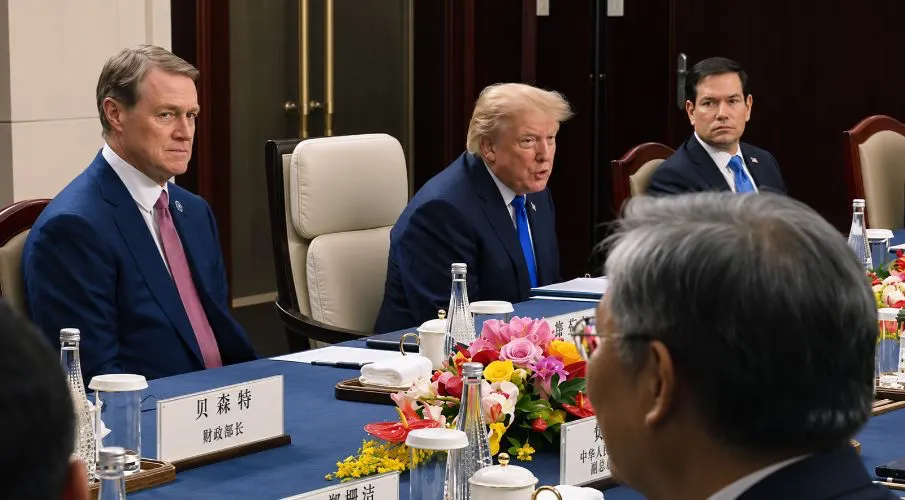
Donald Trump and Xi Jinping just spent an hour together in Shenzhen. Then their face-to-face meeting was over. Trump had previously assured the Chinese president: "As long as you and I are in charge of things, we're never going to have a problem." That confidence sounds generous. It extends well beyond the term of an American president whose party just lost control of both chambers of Congress. Trump spoke of an "outstanding personal relationship" with Xi. He said he wanted China to buy more American agricultural products. Beijing had pledged to purchase at least $17 billion worth annually through 2028 but has fallen far short of that commitment. By September, Chinese imports of American agricultural products, excluding soybeans, totaled around $3.9 billion. Friendship won't pay those bills either.
Trump expressed hope that the war against Ukraine would end. "We'd like to see it ended," he said. He believed he could speak for Xi on that as well. Shortly before, Trump had met with Putin to, as he put it, set the stage for further talks. Whether anything would come of it remained unclear. Trump himself acknowledged that many people doubted the summit would produce results. He was nevertheless firmly convinced that something would come out of it.
After the meeting with Putin, Kremlin adviser Yuri Ushakov said Ukraine had been the main topic of discussion. Russian special envoy Kirill Dmitriev told state television that both presidents were committed to a peaceful resolution. The Europeans, however, were trying to prevent it. Moscow is already placing responsibility for the absence of peace outside Russia, while Russian troops continue their war.

Australian Prime Minister Anthony Albanese chose different words at the same summit. The wars in Ukraine and the Middle East were the biggest disruptions to global trade, he said. Addressing Putin directly, he demanded: "End your war, end it now." A short sentence whose meaning needs no diplomatic embellishment. Japanese Prime Minister Sanae Takaichi, meanwhile, defended her efforts to modernize Japan's military. Those efforts were essential solely to protect the lives and peaceful daily existence of the Japanese people, she said. China condemns that policy. Takaichi nevertheless thanked Xi for the invitation and stressed the importance of dialogue. Even a handshake requires political patience here.
Read our related articles: Trump Praises Putin's Press Secretary, Russia Shows Off Its Nuclear Weapons: Three Presidents Negotiate the Future of the World in China
During his first term, Trump's national security strategy had described Russia and China as powers seeking to change the international order. Washington began shifting its security institutions toward competition with both countries. In Shenzhen, Trump now called Putin and Xi each "my friend." He has been pursuing closer ties for almost two years. The war in Ukraine continues. China is conducting military exercises around Taiwan, and Russia has been linked to a sabotage campaign across Western Europe. Putin and Xi have provided technology to Iran. In the photographs, the presidents stand together. The consequences of their policies lie outside the frame.
Trump and Xi are now having lunch together at the secluded lakeside Kylin Villa, a place that has previously hosted North Korean dictator Kim Jong-il, envoys of the Dalai Lama, and Xi's father, a former senior official of the Chinese Communist Party.
Updates – Kaizen News Brief
Alle aktuellen ausgesuchten Tagesmeldungen findet ihr in den Kaizen Kurznachrichten.
To the Kaizen News Brief In English


