
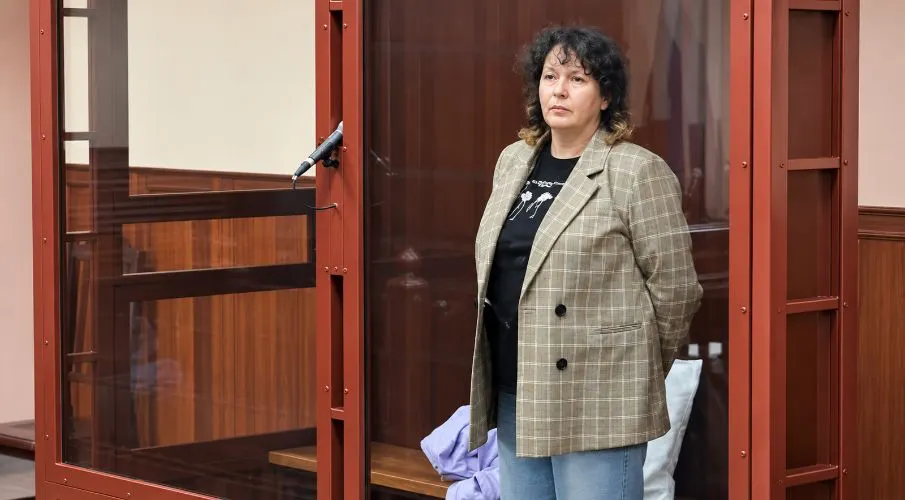
The judge didn't even ask whether Maria Bonzler understood the verdict. On November 12, 2026, Alexander Marochkin of the Kaliningrad Regional Court sentenced the 66-year-old lawyer, who had defended political prisoners, to twelve years in prison for treason. Prosecutors had demanded 15 years. Every day she has already spent in pretrial detention will count toward her sentence. Her phone is to be reset to factory settings and then confiscated by the state, while the SIM card will be destroyed. Her remaining personal belongings entered into evidence will be returned. Even when it came to her personal possessions, the court apparently wanted the final say over what traces of these proceedings would be left behind.
The public was not allowed to know what was being argued in Kaliningrad. The trial was held behind closed doors. Judge Marochkin even had the defendant removed from the hearings. Bonzler was only allowed back to deliver her final statement. The court rejected her request to make at least that statement in public. All the lawyers she had personally hired were also removed from the case. The dispute centered on how to handle documents that the authorities considered state secrets. Bonzler maintained that there were no such secrets in her case at all. Prosecutors also accused attorney Roman Morozov of making an unauthorized recording of a closed hearing. That became another reason for removing him. A woman accused over her work defending clients had to watch as her own lawyers were taken away from her.
Bonzler had asked lawyers in Kaliningrad not to accept court-appointed assignments to represent her. She successfully challenged one of the attorneys assigned to her. She is currently represented by court-appointed defense attorney Anastasia Richter. Lawyer Karinna Moskalenko, who is also working on Bonzler's behalf, disputes the investigators' central allegation. They claim Bonzler passed information about employees of Russia's domestic intelligence agency, the FSB, to Ukrainian intelligence in 2024. Those officers had handled cases involving espionage and treason, as well as terrorism and "confidential cooperation with a foreign state." Bonzler represented defendants in those cases. Moskalenko says the information was public and had already been disclosed in open court hearings. Lieutenant Colonel D. Y. Dolgosheev, the investigator handling the case, maintains the opposite. What could be said inside a courtroom was suddenly supposed to become a secret outside it.
Among Bonzler's clients were Igor Baryshnikov and Vadim Khairullin, along with Yevgenia Fedulova and other defendants in political cases in the region. She was arrested in May 2025. Initially, she was accused of "confidential cooperation with a foreign state." Later, the charge was upgraded to treason, which carries a much harsher punishment. Her son, Vyacheslav Medkov, had previously reported that security officers pressured his mother to testify against a fellow lawyer. Otherwise, they would upgrade the charge to treason. In exchange for incriminating testimony, she was allegedly offered a sentence of approximately two and a half years instead of 15. Bonzler refused to give the testimony they demanded. The charge was nevertheless upgraded. The threat and what happened afterward now stand side by side; her son's account, however, is not independent proof of the investigators' motives.
Bonzler's health deteriorated dramatically in pretrial detention. She reported suffering cardiac arrest and several hypertensive crises, brought on by the heat, inadequate medical treatment, and prison conditions. She also described severe pain in her heart and legs, numb feet, and painful urination. She reported pain in her lower abdomen and kidneys, worsening eyesight, severe ear pain, weakness, and dizziness. She also complained of memory problems. Her former defense attorney, Morozov, blamed a noise generator used by the court as a jamming device during hearings for further damage to her health, back when Bonzler was still allowed to attend the proceedings. He tried to sue Judge Marochkin for compensation for damage to his own health caused by the equipment. The court refused to hear his lawsuit.
Bonzler's complete prepared final statement was published outside the courtroom. The text may differ from what she was actually allowed to say in court. By then, the space left for her voice had become so narrow that a distinction had to be made between a written statement and the words spoken inside the courtroom. Under Russian criminal procedure, the right to a defense is guaranteed by law. In Kaliningrad, a lawyer who had exercised that right on behalf of others was sentenced to twelve years in prison for allegedly disclosing information. The public was never allowed to examine the evidence. The judge kept the proceedings closed, had the lawyers removed, and silenced the defendant until he finally allowed her to deliver her last words.
Updates – Kaizen News Brief
Alle aktuellen ausgesuchten Tagesmeldungen findet ihr in den Kaizen Kurznachrichten.
To the Kaizen News Brief In English


