
Donald Trump has just lost both chambers of Congress. His party is scrambling for explanations, former loyalists are publicly turning against him, and the White House is busy figuring out who still knows how to follow orders. On November 5, 2026, around 3,000 conservative organizations received a letter from the White House Office of Public Liaison. First came the usual self-congratulation, a rundown of supposed accomplishments, and assurances that Democrats wouldn't be able to undo Trump's political legacy, even with their new majorities. Then came a sentence highlighted in yellow: “As always, we are monitoring statements, press releases, and media engagements from your organizations.” The same White House that had just been preaching political unity was suddenly reminding its allies in writing that every public statement was being tracked. How afraid of its own supporters does an administration have to be to address its allies this way? After an election defeat, a president could try listening. Trump has people watched.

The White House published this official statement on November 4, 2026. Following the Republicans' devastating election defeat, Trump's administration attacks Democrats as the “radical left,” denounces the press as “fake news,” and accuses political opponents of wanting to protect criminals and allow children to be mutilated.
Trump spielt längst mit mehr als nur dem Feuer. Trump is playing with a whole lot more than just fire at this point. Anyone spreading this kind of hatred toward political opponents after a democratic election is fueling hostility in an already dangerously heated society and knowingly risking further escalation. What's especially frightening is that this hateful rhetoric comes straight from the White House, the official residence and workplace of the American president.
Earlier letters from the office had never included such a warning. The White House denied that the wording was meant as a threat. Caroline Sunshine, who had worked for Trump during his first term, publicly disagreed. “‘We’re watching you’ is not the message the White House should be sending,” she wrote. “We’re LISTENING to you is what anyone in the WH who has the President’s best interest should be saying.” That's an astonishingly modest expectation for a political movement that has spent years claiming to fight an overbearing government and its surveillance of ordinary citizens. Now its own administration is sending warnings to conservative organizations. The sentence was even highlighted in yellow. Nobody was supposed to miss it.
There's a reason for the nervousness. Conservative commentator Matt Walsh is among those now sharply criticizing Trump's decisions. Florida Governor Ron DeSantis is also holding the president responsible for the defeat. Even Vice President JD Vance has identified the war with Iran as a decisive reason for the election results. People whose political closeness to the White House had previously been taken for granted are suddenly talking about accountability. The president, who has always been generous in demanding personal loyalty and prefers leaving others to take the blame for political defeats, is now discovering just how quickly his followers can develop interests of their own. Right after losing the Republican majorities, his administration reminds conservative organizations that their public statements are being monitored. The right to free speech still exists, of course. Apparently, the White House just wants to know who's exercising it and what they're saying.

While these friendly greetings were being sent to the president's own political family, the Justice Department had another unpleasant matter to explain. Trump wants to build a triumphal arch in Washington, roughly 250 feet tall, at Memorial Circle near Arlington National Cemetery. American service members are buried there, men and women whose names mean more to their country's history than a president's architectural fantasies. Veterans' organizations are fighting the project. The enormous arch would cast a substantial shadow over the cemetery. Even the administration acknowledges that. It still wants the arch built. The idea of an American president wanting to erect a monumental structure celebrating his own vision of national greatness right next to a military cemetery carries a bitterness that's almost impossible to exaggerate. Trump celebrated the war against Iran. Now he wants a triumphal arch. And the gravestones at Arlington will have to live with another shadow.

On Thursday, Justice Department lawyers admitted in court that Grunley Construction Company, the firm hired by the White House, had already painted marking lines on the proposed construction site. The work was carried out despite a court order and without permission from the National Park Service. Now the administration says the company will stop its activities and provide advance notice before resuming any work. Just consider the order of events. A court is examining whether the project is legal, the responsible agency hasn't granted permission, and the construction company goes ahead and starts preparing the site anyway. Afterward, government lawyers explain that they'll give notice in advance next time. American law requires authorization for construction work on protected land. Trump apparently sees that requirement mainly as an unfortunate waste of time.
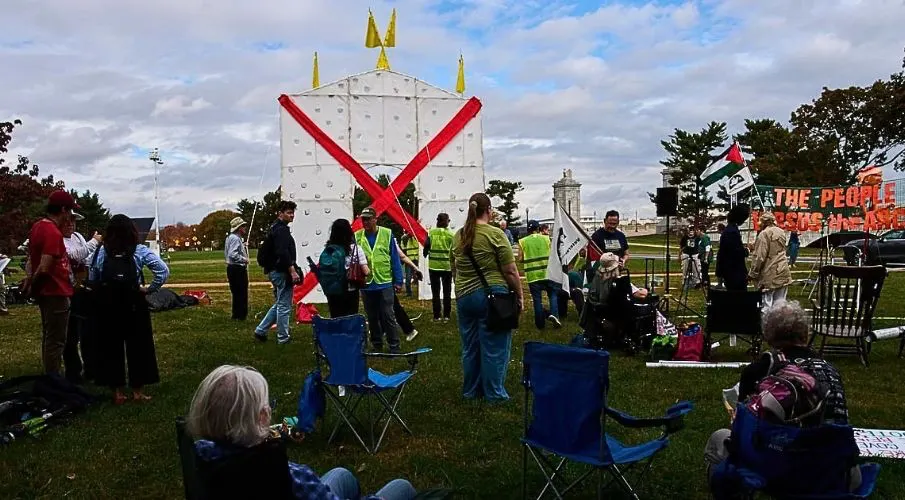
Three lawsuits have already been filed against the triumphal arch. Nearly 1,000 pages of public comments opposing the project have been submitted to the National Capital Planning Commission. Veterans are warning about the impact on Arlington. The historical significance of Memorial Circle is also at issue. The administration wanted to begin construction immediately after the commission's anticipated approval. Apparently, the impatience to get started has grown stronger than the willingness to respect court decisions. At a protest on November 5, a mock-up of the proposed triumphal arch stood with a large red X across it. Kyriaki Chris, a former member of the United States Marine Corps, was among those publicly protesting the structure. The administration knows about these objections. So far, they haven't made the slightest difference to its determination to build a 250-foot monument.

Trump has repeatedly demonstrated just how little patience he has for courts that place limits on his decisions. Other construction projects in Washington are also facing legal challenges. The historic East Wing of the White House had to make way for his ballroom. The Oval Office was covered in gold decorations and then declared a national monument. Now comes a triumphal arch so enormous that it would even affect the neighboring national cemetery. Washington already bears the marks of a president who prefers to immortalize his personal tastes in stone and gold. The possibility that public buildings or historic places might mean something to other people apparently enters into his plans only as another obstacle to be removed.
The Democratic majority in Congress will take office in January. Until then, Trump still has a Republican majority that has largely backed him in pursuing his plans. After the election defeat, that political convenience may soon be over. The president can keep drawing up construction plans and giving his subordinates whatever orders he wants. Courts still have the authority to decide whether the work is legal. And conservative organizations still have the right to say publicly what they think of his policies. Both are part of the American constitutional system Trump swore an oath to uphold. Meanwhile, in Washington, yellow highlighting is being added to political warning letters, and white lines are being painted on the ground where a triumphal arch is supposed to stand. The first is meant to remind people that they're being watched. The second shows where a president wants construction to proceed despite serious legal objections. Those two developments make the difference between public accountability and a personal claim to power pretty damn clear.
Updates – Kaizen News Brief
Alle aktuellen ausgesuchten Tagesmeldungen findet ihr in den Kaizen Kurznachrichten.
To the Kaizen News Brief In English


