
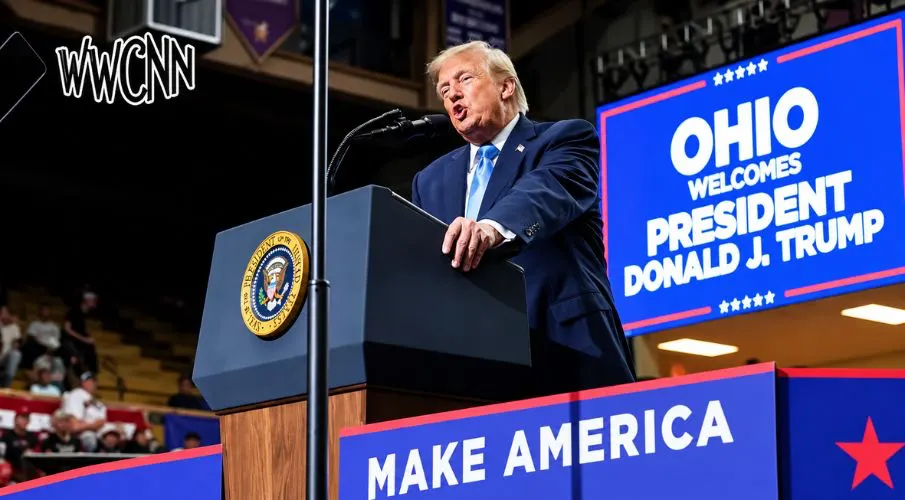
In a gymnasium in Vandalia, Ohio, the President of the United States found the sentence last Saturday that describes his idea of governing more accurately than any platform ever could. “Just go vote,” Donald Trump shouted to the people at Butler High School. “If you do that, we’re gonna win, and we’re gonna win big, and we’re gonna shove it up their ass.” He meant the Democrats. He meant a country the speaker seems to view as something he can do with as he pleases.
Trump: “We’re gonna win big, and we’re gonna shove it up their ass.”
The event was for Republican candidates, among them Senator Jon Husted and gubernatorial candidate Vivek Ramaswamy. Between the insults, Trump slipped in a promise and a threat. If his party stayed in power, people in Ohio would have a direct line to his administration and an easier time getting federal help. If Democrats won, he would be less inclined to help the state. Speaking about candidate Amy Acton, he said simply: “But I’m not going to help her.” Ohio’s Republican officeholders called him often and asked him for money, he said. Praise and punishment in the same breath, and in between there was no thought that evening for the country, only for loyalty to him personally.
Federal money belongs to the federal government, not to the man at the top of it. It comes from all taxpayers, including the people outside the gym holding up signs against him. In Trump’s mouth, it becomes a favor handed down from above, something you earn by putting the right mark on the ballot. He distributes public money like a ruler handing out his own property, based on affection and obedience. When the public treasury depends on the goodwill of one man, government turns into a royal court.

He called the Democrats “dumb sons of bitches.” He brushed aside the polls predicting losses for his party. There would be a big surprise, he said, because the other side did not know what was happening. Numbers he does not like are treated like opponents to be shouted down. That is how someone talks when he believes reality is negotiable as long as he is loud enough.

The reality outside the gym does not care about lines like that. Trump’s popularity has been falling for months while prices stay high, at the gas pump and for other everyday goods, in the middle of the U.S. and Israeli war against Iran. In Ohio, gas prices have climbed 35 percent in a year, to $4.16 a gallon. His tariff policy against Canada triggered retaliatory tariffs that, based on 2025 figures, affect around $3 billion worth of Ohio exports. In 2024, he won more than 55 percent of the vote here. What remains is the bill that other people are now paying.

Outside the gym, his old school north of Dayton, stood Jonathan Smith, 19, a construction worker, holding a sign that read: “Where are my lower gas prices?” He said he was saving for a wedding, and the more gas prices rose, the harder it became to put money aside. He still did not know who he would vote for in the Senate race. The president promises him the humiliation of his opponents. The young man is calculating whether the next tank of gas still fits into the month.

Husted is counting on Trump to bring out voters who might otherwise stay home. At the same time, he went after Sherrod Brown, the Democrat and veteran running against him. Brown had been in office for 50 years, Husted mocked, and challenged people to name a single thing he had ever done for them. Speaking to reporters, he said the Iran war had to be won “on our terms,” and that he was showing people he was fighting for lower prices. Brown spokeswoman Lauren Chou fired back that Husted puts “corporations and billionaires first, and the rest of us pay for it.” She accused him of tax giveaways that had brought data centers into the state, along with his loyalty to Trump’s Iran policy.
Ohio is one of 8 Senate races considered competitive. On November 3, voters will decide who controls the narrowly divided House and the Senate. Outside spending groups have poured tens of millions into the state, and the Husted-Brown race is the second most expensive in the country, according to Federal Election Commission records. The fight is over data centers and over culture-war issues such as surgeries on transgender minors. One apprentice, 20, said he did not think much of the AI data centers, but he was still going to vote because of Trump’s attention to the state and because of the 2025 cap on taxes on overtime. A woman, 60, held up a sign supporting a data center in her town in northeastern Ohio, on the site of a steel mill. “You want a data center there?” Husted asked her. When she wanted to pose for a picture with him, a man from his entourage asked: “Can we do it without the sign?”
You have to look at what happened in plain terms. A sitting president publicly makes federal help for a state conditional on that state electing the right people. In a republic, that is where the republic ends. No court and no foreign government called him to account for it on Saturday. The threat moved through the news like a routine water-level report, checked off somewhere between gas prices and a data center. Getting used to it is the quiet form of consent.
What is disturbing about that day has less to do with Vandalia than with the silence around it. The fantasy of absolute power has slid into normal life and now speaks in the tone of everyday politics. More disturbing still is that the political world beyond the opposition watches it happen, seemingly at a loss. A head of state who ties government help to political loyalty is describing a method every government from Europe to Asia knows from the darker chapters of history. What followed was silence, polite and calculated, waiting to see whether the man would somehow take care of himself. He will not. At every appearance he learns a little more about how far he can go, and he measures the limit by the calm of the people watching him. They know the history of men who confused the state with their own property, and they stay silent anyway. The gallon gets more expensive, the language gets uglier, and eventually no one asks anymore whether it can be done without the sign.
Updates – Kaizen News Brief
Alle aktuellen ausgesuchten Tagesmeldungen findet ihr in den Kaizen Kurznachrichten.
To the Kaizen News Brief In English


