
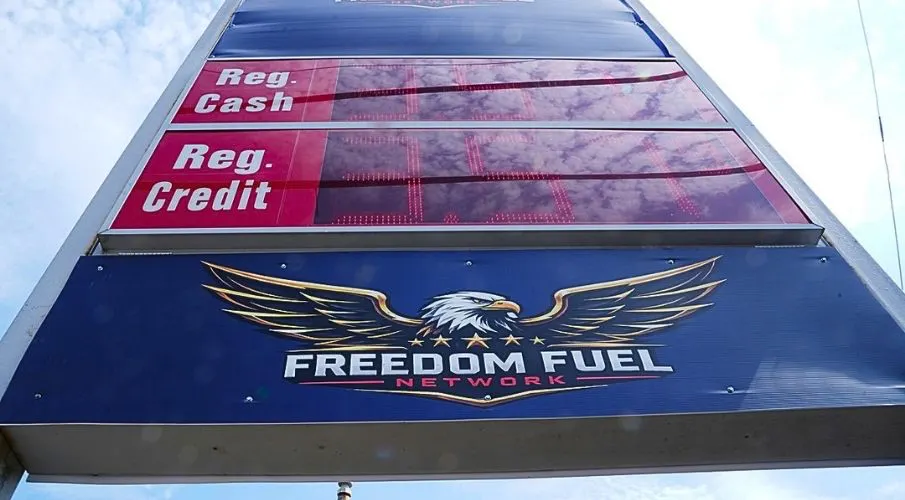
On June 29, Donald Trump publicly demanded that gas stations immediately lower their prices, setting a target of around $2.50 per gallon. The market was high, driven by the war against Iran. Two days later, the president already knew of a company that, until then, practically nobody had heard of. On July 1, he celebrated a "VERY smart dealer" on his Truth Social platform who was leading the way in the Northeast, and he knew that on July 3, exactly 25 stations in the greater Philadelphia area would lower their prices. He tied the whole thing to the country's 250th birthday and his election victory in Pennsylvania. At that point, he still did not name a price.

Where did this company come from? Freedom Fuel's internet domain was registered on June 13, and Freedom Fuel Network LLC was formed in Delaware on June 23, signed by Randy Brown and Yoni Gontownik. Brown coaches the Baltimore Ravens' special teams and calls himself a proud Trump supporter. Gontownik previously traded commodities at the trading firm Mercuria and organizes fundraising events for Republican politicians. A business only a few days old already had the president's attention before it had sold its first drop of fuel. The web address was ready days before the company itself was formed, as if someone had reversed the order of advertising and business.

Sales began on July 3, and the price carried a message. $3.47 per gallon, the 47 honoring the 47th president, around 40 cents below the market price at the time. On July 7, the White House itself explained the meaning, released its own promotional video, and explicitly tied the 47 cents to the 47th president. Mathematically, it made no sense. According to matching market data, the wholesale price on July 3 was around $2.89. With transportation and taxes, a station would have had to charge at least around $3.64 just to break even. At $3.47, Freedom Fuel was selling a good 17 cents below its own break-even point. One industry insider compared the business model to jumping off a cliff. Trump's praise triggered a wave of reports in which experts questioned whether prices like that could be sustained.
One employee admitted that they were selling far below their own costs. At the same time, the White House claimed that nobody was making up the difference. A number tailored to one man, a price below any economic logic, and no explanation of who was covering the gap. The $3.47 was not some randomly cheap market price, multiple news organizations independently confirmed the political meaning of the number. On its website, the chain later wrote that it had answered Trump's call for lower prices at the pump. From this point on, the publicity stunt turns into a search for the trail behind it.
The trail leads to the properties. Around one-third of Freedom Fuel locations sit on real estate owned by Blue Owl Capital, which insists that it is only the landlord and has nothing to do with operating the gas stations. In 2021, Blue Owl bought Oak Street Real Estate Capital, a firm specializing in sale-leaseback deals that buys properties and leases them back to operators on a long-term basis. Through Oak Street, Blue Owl entered into a deal worth up to $1 billion with Mountain Express Oil in June 2021 and financed the acquisition of 286 gas station and travel center properties for more than $825 million. An Oak Street executive, Jared Sheiker, joined Mountain Express's board. The very first station the White House prominently featured at the launch, in Dresher, Pennsylvania, happened to be owned by a Blue Owl subsidiary.

Mountain Express collapsed spectacularly in 2023, and Blue Owl, as its largest landlord, was pulled into the bankruptcy case. The bankruptcy trustee accused Blue Owl and Sheiker of a number of things, from breaches of fiduciary duty to conspiracy. Both denied any wrongdoing and paid $15 million in 2025 to settle the case. Left sitting on a huge portfolio of gas stations, Blue Owl found new operators, and this is where Shamikh and Syed Kazmi enter the picture. In New Jersey, 17 such stations are owned by Blue Owl and operated by the brothers, six of them now part of Freedom Fuel. In May, New Jersey's environmental agency fined the operators of those 17 locations nearly $430,000, more than $202,000 of it involving the six stations that later became Freedom Fuel locations, over leaking underground tanks and fuel deliveries made despite regulatory shutdown orders. Of the original 25 Freedom Fuel stations, 14 could be tied to companies controlled by the brothers, and Shamikh Kazmi leased eight of them from Blue Owl.

The graphic shows how closely Freedom Fuel is connected to an already existing network of gas station operators, companies, and supply structures. At the center are, among others, Shamikh and Mohammad Kazmi, whose companies and gas stations can be traced through official registries and corporate records to several Freedom Fuel locations. Other connections run through MR3 Logistics, US Diesel, and Energy Transfer Marketing & Terminals LP into fuel logistics and supply. What matters is this: Freedom Fuel apparently did not emerge as an entirely new, isolated gas station network, but instead relied on existing companies, locations, and supply relationships. The graphic does not prove shared ownership among everyone involved, nor does it prove wrongdoing. But it does show how many of the stations and companies that later appeared under the Freedom Fuel name were already connected to one another beforehand.
And the president? The landlord was sitting in his investment portfolio. His financial disclosure lists between $5 million and $25 million in a lending vehicle called Blue Owl Capital Corporation, along with $500,001 to $1 million directly in its parent company, Blue Owl Capital Inc., which owns the real estate platform. On May 15, 2026, his investment account bought another $50,001 to $100,000 worth of shares in that parent company, just weeks before Freedom Fuel was even formed. The account had already bought more shares on March 4 and March 17. That does not prove Trump knew about Freedom Fuel or personally ordered the purchases. According to the White House, his accounts are managed independently and through model-driven investment strategies, and according to the latest disclosure, he has since sold almost all of it. The timing still remains.
Then came the bill that nobody paid. Mansfield Oil Company of Gainesville alleges in federal court for the Eastern District of Pennsylvania that Syed Kazmi's KRSM Inc. picked up more than 1 million gallons of fuel worth nearly $4 million from a terminal in Twin Oaks between late May and early July and never paid for it. The fuel had been purchased on credit since 2022, with around 150 loads picked up between May 21 and July 7. The terminal is less than 35 miles from most Freedom Fuel stations. Some of the fuel allegedly went to at least 10 of those stations in Pennsylvania. KRSM was able to sell so cheaply and generate so much attention, the lawsuit states explicitly, because the company never paid its supplier. When Mansfield tried to collect the money on July 27, the bank allegedly said Kazmi's company would not release it. Mansfield's attorney, Urs Broderick Furrer, confirmed the deliveries to the listed stations. The case is Mansfield Oil Company of Gainesville v. KRSM Inc., 26-cv-6072.
Kazmi disputes that. His attorney, Paul Toner, calls it a billing dispute over incorrectly priced invoices, saying his client never agreed to the amounts being demanded and points to duplicate charges. The record paints a clearly different picture. Between late July and August 10, Kazmi allegedly continued promising payment in several phone calls, according to the lawsuit, before denying the debt in a statement dated August 25. On Friday, however, Judge Gerald A. McHugh Jr. ordered KRSM to keep at least $2.75 million in an account. Freedom Fuel itself is not a defendant. The allegations against the brothers are not new. Over the years, more than a dozen lawsuits have been filed against them over alleged financial dealings, several ending in default judgments. In 2021, Shamikh Kazmi allegedly took more than $667,000 worth of fuel over a period of 10 days. Last November, a court ordered him to repay it.
Shamikh Kazmi is not a bit player in these records. In older cases, he ran day-to-day operations at Universal Property Services, while more recent filings list him as its CEO. His path through the industry is lined with lawsuits, and some of them center on whether he follows the judgments entered against him. In a dispute involving BP and Diwan Petrol, a federal court found that an order requiring the removal of BP branding had not been fully obeyed, leaving BP to ultimately enforce it with help from the U.S. Marshals Service. In Florida, the dispute involved 17 former Circle K stations burdened by unpaid rent and outstanding fuel deliveries. A string of cases like that might make others scale back. Kazmi planned the opposite, with the Yum Grills & Market brand and a multimillion-dollar bid for the Centre Square high-rise complex in Philadelphia.
The White House is keeping its distance, and the way it keeps that distance says the most. At first, it acknowledged that it had spoken with the people who put Freedom Fuel together, but refused to explain how the project came about. Asked about the brothers, an official said nobody had spoken or worked with Syed Kazmi, while leaving the question about Shamikh unanswered. The latest version is even narrower, saying there had been no contact or business dealings whatsoever with Syed Kazmi and KRSM. Whether there were contacts with Shamikh, Brown, or Gontownik remains unanswered by that carefully narrow wording.
Blue Owl also leaves a trail into politics. Its two leading executives, Doug Ostrover and Marc Lipschultz, previously donated to both parties, but according to Federal Election Commission records, their more recent donations have gone only to Republicans, including Elise Stefanik and the Congressional Leadership Fund. So far, there is no solid evidence of a direct money flow to Trump's own campaign. Blue Owl's appetite for gas stations goes far beyond Freedom Fuel anyway. A Securities and Exchange Commission filing shows a program with GPM Investments worth up to $1 billion for gas station and convenience-store properties between 2023 and 2025. Donald Trump Jr., meanwhile, manages the family trust as trustee with voting and investment powers, but the individual purchases are directed by independent managers and models. We found no separate Freedom Fuel connection involving the family. Prices, by the way, rose again after the launch, but remained below competitors in early August, and the network grew to 29 locations.
That leaves the question tying everything together. If a company deliberately loses money to finance a political publicity campaign and coordinates that effort with a candidate or a party, under FEC rules that can become an in-kind contribution or a coordinated expenditure. The agency would then examine who paid for it and what was distributed. How closely the effort was coordinated with the politician also matters. Direct corporate contributions to candidates are prohibited anyway. The place for an investigation like that is the House Committee on Oversight and Government Reform, which can demand records and subpoena witnesses. We have turned our reporting over to the committee. James Comer chairs it, and Robert Garcia is its ranking Democrat. It is now up to him to pick up the threads. What is already documented is serious enough for a subpoena: a price built around the president's number, promoted by the White House, at stations sitting on properties owned by a landlord whose parent company the president held shares in and continued buying, sold below cost and, in some cases, with gas that according to a lawsuit was never paid for. Whether that was coincidence or coordination is not something Trump has to answer. The people with the power to subpoena him have to answer it.
Updates – Kaizen News Brief
Alle aktuellen ausgesuchten Tagesmeldungen findet ihr in den Kaizen Kurznachrichten.
To the Kaizen News Brief In English


