
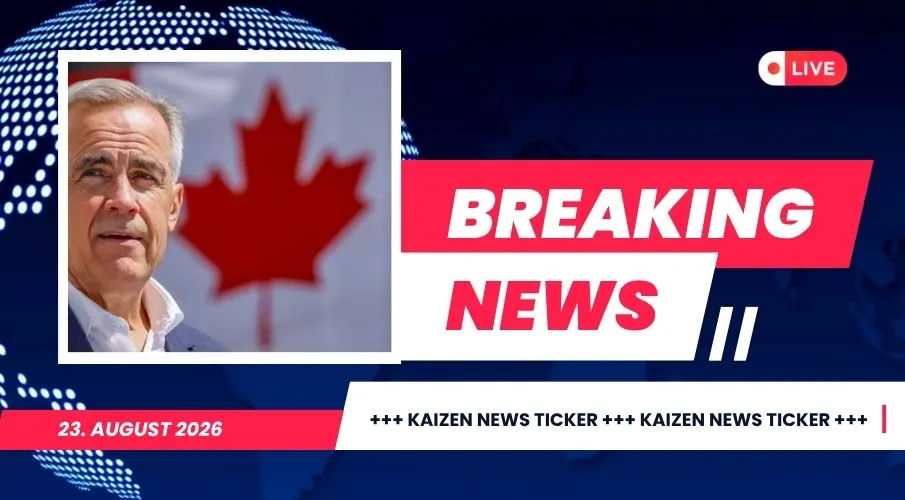
50 Percent Tariffs on Canada - Trump Reaches for a Law From the Great Depression and Opens the Next Round of the Trade War

Since Saturday, Donald Trump's new 50 percent tariffs have been in effect on numerous goods from Canada. They affect Canadian exports worth around $20 billion, about five percent of all goods Canada sells to the United States each year. For Ottawa, it is still a hard blow, because 72 percent of Canadian goods exports went to the U.S. last year. The list ranges from hockey sticks, wine and cement to honey, seeds, agricultural products, cosmetics, clothing, jewelry, furniture and cameras. Even some goods that had previously been protected under the trade agreement between the United States, Mexico and Canada are now being hit with the 50 percent tariffs.
In doing so, Trump is also attacking an agreement that he himself sold as a major success during his first term. The legal basis is particularly unusual. Trump is using Section 338 of the Tariff Act of 1930, created in the middle of the Great Depression and part of the trade policy that is still criticized today for having made the economic collapse at the time even worse. The section allows a president to impose tariffs of up to 50 percent on countries that discriminate against American companies. The provision has never before been used for a specific tariff increase. No prior investigation is required, and the law also sets no deadline for when the tariffs have to disappear again. That is exactly why this is likely to end up in court.
Trump accuses Canada of treating American cars, alcohol and dairy products unfairly, and he is angry that Canadian imports of American cars and alcoholic beverages fell after his earlier tariffs. Canada is no longer responding with further negotiations.
Prime Minister Mark Carney announced "dollar for dollar" countermeasures that are set to begin on September 8. They are expected to hit American steel, dairy products, household appliances, farm machinery, paper and electronics, among other things. Canada had previously been willing to withdraw its own retaliatory tariffs on steel, aluminum and cars if Washington significantly lowered its duties, and the provinces were also supposed to start selling more American alcohol again. Carney says Washington's final demands went too far. He now openly accuses the United States of using the economic integration of the two countries as a weapon and of attacking Canada with the new tariffs. Trump's trade representative Jamieson Greer tells it differently and claims Washington offered lower tariffs on steel, cars and lumber, but Canada did not want to close the deal. No further talks are currently scheduled, and Greer is already threatening additional measures if Ottawa goes ahead with its retaliatory tariffs.
American importers will initially pay for these political battles, because they pay the tariffs at the border. In the end, costs like these regularly land on companies, workers and consumers. The new 50 percent tariffs also come on top of existing burdens, including another 10 percent tariff Trump imposed on Canada just last month. Ottawa had already made several concessions to Trump, including withdrawing its digital services tax. Even with the Gordie Howe Bridge, which is financed entirely by Canada, toll revenues will be shared for 15 years. It brought no peace. Trump then threatened Canada with further tariffs over a critical television ad from Ontario and even during a dispute over Canadian wildfires.
Higher import duties have already contributed to inflation in the U.S., even though that effect eased somewhat recently after the Supreme Court struck down some of Trump's broadest tariffs in February. Now Trump is simply looking for other legal routes. At the same time, the war with Iran is pushing prices even higher. And all of this is happening in a midterm election year in which the cost of living has long been one of the most important political issues for millions of Americans. Trump wants to hit Canada with 50 percent tariffs. In the end, the bill could land much closer to his own polling place than he would like.
Russia Deports People Over "Women's Clothing" - At Least 18 Foreigners Have Already Been Targeted Over Alleged "LGBT Propaganda"

Two men are being jailed in Russia and then thrown out of the country because police officers thought their clothing was women's clothing. Moscow's Lublinsky District Court sentenced H. Rakhimov and E. Saizoda to ten days in jail each and ordered their forced deportation afterward.
The two were detained on the evening of August 18 at Moscow's Sadovod market. About ten minutes later, police arrived and declared that the men had "demonstrated the attractiveness of nontraditional sexual attitudes." Their supposedly feminine clothing and the phrase "Freedom of Choice" were used as justification. The court documents do not say what the men were actually wearing, why the clothing was classified as women's clothing, or where or how the phrase was displayed. After serving their jail sentences, both are to be taken to the Sakharovo detention center and deported no later than November 17. After that, they will be barred from returning to Russia for five years. Their citizenship is not listed in the published rulings. Rakhimov is married and has one child, while Saizoda has four minor children. None of that changed anything, because for foreigners, the Russian statute against "LGBT propaganda" requires deportation in addition to a fine or up to 15 days in jail. And these two men are far from the only ones.
In April, Islomjon Gulomov was jailed for five days in Tula and ordered deported after posting a review of a skirt on Wildberries. He included a photo of himself wearing the skirt and wrote: "Beautiful skirt! It hides not only the flaws in my figure, but even the fact that I'm a guy." Police opened another case over photos and videos on VKontakte showing a man wearing women's clothing. Since 2023, Russian courts have ordered the deportation of at least 18 foreigners over alleged "LGBT propaganda," according to an examination of published rulings: at least seven in 2023, four in 2024, three in 2025 and four so far in 2026.
The actual number may be higher because Russian court statistics group several different offenses together. At the beginning of 2023, four foreign transgender sex workers were deported in Moscow alone over online ads. Police listed skirts, dresses, underwear, wigs, makeup and the use of feminine grammatical forms as evidence of "propaganda." Transgender sex workers were later targeted in Krasnodar as well, and in Volgograd a Tajik citizen was sentenced to 15 days in jail and deportation. In Yekaterinburg in 2025, a man from Tajikistan had to spend ten days in jail and then leave Russia because he allegedly described himself as an "active bisexual" in a Telegram account and offered intimate services. Russia is increasingly using deportation for other private or religious acts as well.
Since 2024, at least 15 publicly known cases have been counted in which Muslims were punished or deported for praying outside a mosque. Courts sometimes treated prayers in dormitories, cafes, stores or public transportation as unauthorized missionary activity. Now, for two men, clothing that some police officer considers feminine and two words about freedom of choice are enough. Ten days in jail, deportation, a five-year entry ban - and when it comes to the question of what was supposedly illegal about their clothing in the first place, the Russian state does not even need an answer.
Millions Barely Know How They're Going to Put Food on the Table - Meanwhile, Trump Is Building His Own Presidential Park

Under Donald Trump, the White House Rose Garden is not growing new roses, but statues. After the president had the lawn outside the Oval Office ripped out and replaced with a large expanse of white stone that strikingly resembles the terrace at his private Mar-a-Lago club in Florida, he is now filling the historic garden with bronze. George Washington is there, Alexander Hamilton, Benjamin Franklin and, most recently, Thomas Jefferson, seated as he signs the Declaration of Independence. There is also the more than 14-foot-tall sculpture "Freedom's Charge," featuring two soldiers from the Revolutionary War.

The Jefferson comes from Colorado sculptor George Lundeen, who created the figure decades ago and kept it at his ranch. It was actually supposed to arrive at the White House in time for the 250th birthday of the United States on July 4, but because of the security measures, it got stuck on a truck. Trump saw photos, liked the statue and decided to put it in the Rose Garden anyway. When he called Lundeen, he only reached his voicemail. "Hi, George. This is your favorite president,
Donald Trump," the message began. The sculpture looked beautiful, Trump said, and there was a wonderful place for it in the Rose Garden. While the Jefferson is a gift, it is less clear who is providing some of the other figures to the president. According to the White House, the Washington statue is on loan from Harlan Crow, the Texas real estate billionaire and major Republican donor whose close friendship with Supreme Court Justice Clarence Thomas has made headlines for years. The Franklin and Hamilton statues come from donors whose names the White House has not disclosed. "Freedom's Charge" was moved from Dallas to Washington. By now, the Rose Garden is only one part of what Trump is doing to the White House and the capital.

The Oval Office got its gold decor, his ballroom and a new helipad are being built on the grounds, and he is pursuing additional construction projects in Washington while also planning a massive "National Garden of American Heroes" with 250 statues on federal land near the National Mall. Historic preservation and cultural organizations are suing to stop it, arguing that Congress must approve it first. Next to the White House, Trump already had a statue of Christopher Columbus installed in March, and more and more sculptures with themes from American history are appearing around the area. The White House sells it as beautification. Spokesman Davis Ingle said no president has done more to improve the White House and its surroundings. Trump, he said, had restored historic sites, cleaned parks and the Reflecting Pool and made sure America could celebrate its 250th birthday with "glory and pride." Then came a title that describes pretty well how this administration now sees itself: Trump is the "Builder-in-Chief," the chief builder. Thanks to him, the White House would be "properly glorified" and remain in excellent condition for generations to come. So this is no longer just about repairs. Trump is changing the appearance of the seat of government according to his personal taste and is now carrying that same style across Washington. The White House has always also been a place for art. Presidents used its collection, first ladies brought in new works, Melania Trump installed a sculpture by Japanese American artist Isamu Noguchi during Trump's first term, and Michelle Obama had previously added a painting by Alma Thomas.
But Trump is turning it into something else
The Rose Garden became stone, the stone is becoming a collection of great men, and all around it more projects are being built that are meant to leave Trump's name, his taste and his idea of America permanently stamped onto Washington. Even at his golf club in West Palm Beach, there is already a more than seven-foot bronze figure of Trump with his fist raised after the 2024 assassination attempt in Butler, also created by Lundeen and given to the president by a Republican businessman. While millions of Americans calculate every month what is left after rent, electricity and groceries, their president is busy with white stone, bronze heroes, gold rooms and a Washington that is increasingly supposed to look like him. The country has enough problems. Trump keeps building his monument anyway.
The Vatican Is Building a 100 Million Euro Solar Power Plant - and Wants to Become Completely Self-Sufficient in Electricity

The Vatican plans to build a solar power plant outside Rome that will supply the small city-state entirely with electricity from renewable energy. The facility is expected to cost around 100 million euros, with a capacity of 80 to 90 megawatts. It is to be built on Vatican-owned land at Santa Maria di Galeria on the northwestern edge of Rome, where Vatican Radio's transmitters have stood since the 1950s. The scale is enormous by Vatican standards: About 200 of the site's total 450 hectares are to be covered with solar panels. The panels will be mounted several meters above the ground so crops can continue to be grown underneath them. This combination of agriculture and electricity generation is known as agrivoltaics.
Under the current plans, the facility is not only supposed to supply Vatican Radio and the Vatican itself. Institutions of the Holy See in Rome could also use the electricity generated there, including the Bambino Gesù children's hospital. Anything produced beyond that is to be fed into Italy's power grid. With a capacity of 80 to 90 megawatts, the project would be one of the largest agrivoltaic installations in Italy. Construction is expected to take between a year and a half and two years, and the construction contracts are expected to go out to tender in the coming weeks. The Vatican itself has not yet officially disclosed the price, capacity or timetable for the project. The plan goes back to Pope Francis, for whom climate protection and renewable energy were major issues during his papacy.
After his death, Pope Leo XIV continued the project. Italy and the Vatican had already agreed in 2025 to use the Santa Maria di Galeria site for energy production. In 2026, the Italian parliament ratified the corresponding agreement. Solar power is not exactly new to the Vatican anyway. Back in 2008, 2,400 photovoltaic panels were installed on the roof of the Paul VI Audience Hall. But now this is on a completely different scale. A state with its own radio station, administration, museums, churches and numerous institutions wants to cover its entire electricity demand in the future with its own solar power plant. And even then, there is supposed to be enough energy left over to send to Italy.
Trump Turns Washington Into a Racetrack - and During Practice, the First Car Already Slams Into the Wall

Right through Washington, past the Capitol and along Pennsylvania Avenue, IndyCars are racing through the government district this weekend. The "Freedom 250 Grand Prix" is one of the events marking the 250th birthday of the United States and is being held on a specially set up 1.7-mile street course with only seven turns. What looks almost simple on paper turned out to be pretty rough during the first real practice session. Points leader Alex Palou talked about huge bumps before Turns 2 and 6 and still said the track was a blast to drive. Pato O'Ward also said the bumps had almost become the defining feature of the course.
That is especially striking on Pennsylvania Avenue, which is regularly repaved because of presidential inaugurations. But for an IndyCar at high speed, even the smallest bump is enough. Louis Foster hit one near the end of the straight on Independence Avenue and slammed the front of his car into the wall. Those spots are not going away before the race. Palou said dryly that all you can really do is try to find a slightly better line. At the same time, that may be exactly what produces a race where passing is actually possible. Turn 2 at the end of Pennsylvania Avenue and Turn 5, where the course turns from 7th Street onto Independence Avenue, are considered particularly good places for it. The track is wider than other street courses such as Detroit, meaning faster drivers should not simply get stuck behind slower cars. Palou posted the fastest lap in the second practice session at 56.6145 seconds and later also took pole position.
Alongside IndyCar, there was NASCAR star power on Saturday as well: Four-time Cup champion Jeff Gordon won both races in the IROC event, Kurt Busch finished second twice and described driving through Washington like being a kid in a candy store, almost losing track of his braking points because of all the colors, banners and buildings. On Sunday, it gets serious. 147 laps, 250 miles, humid heat and a street course that constantly shakes the drivers around. O'Ward expects a physically brutal race, with sweat inside the helmet and cars bouncing over the bumps. Whether this course will ever be used again after this weekend remains open. Washington may therefore get only one IndyCar race in front of the Capitol. That should be enough to make it memorable.
"America First" - Just Not for America's Ranchers: Trump's Cheap Beef Plan Is Turning Even Republicans Against Him

Donald Trump wants to bring down high beef prices in the U.S. by bringing in 300,000 metric tons of beef from abroad tariff-free. The imported beef will be around 25 percent cheaper than current prices, the president promises. For American consumers, that sounds tempting at first, because a pound of ground beef now costs an average of around $6.89, about three dollars more than it did ten years ago.
But anger is growing among Trump's own voters in rural America. Jim Richardson is 77 years old, runs a ranch with around 100 cattle in Georgetown, Texas, and sells his hormone- and antibiotic-free beef at farmers markets and to restaurants. His revenue has already fallen, while processing, diesel, labeling, packaging, labor and electricity have all become more expensive. Richardson has had to double his prices as a result. Now he is also supposed to compete against cheaper imported beef. Richardson describes himself as a conservative and voted for Trump in 2024. Today, he says he is "disappointed." What he is missing above all is stability instead of constantly changing economic decisions that can suddenly move in another direction within a short period of time. Richardson also fears that customers will automatically reach for the cheaper beef, even though production standards and the use of antibiotics or other substances in the country of origin could be completely different. His anger is not an isolated case. Farm organizations and Republican politicians from several states are now openly warning that Trump is putting pressure on exactly those American producers he has counted among his most loyal supporters for years.
Also read our investigation: How Trump Is Turning America’s Cattle Ranchers Against Him – An Investigative and Disturbing Report
The number of cattle in the U.S. is already historically low, extreme weather is putting additional pressure on farms, and Trump's trade conflicts have further increased costs and uncertainty. Garrett Hawkins of the Missouri Farm Bureau says the new imports would further erode confidence in the market. Above all, in his view, they do not solve the underlying causes of high food prices, but instead shift the blame onto American farmers and ranchers. Trump pushes back. He loves ranchers, he said Friday, but even they admit that some help is needed to bring prices down. That, he said, is exactly why the beef is now being imported. Politically, one detail is hard to miss: The tariff-free imports are initially authorized for 90 days, meaning they will not end until after the midterm elections.
In Iowa, where an especially close Senate race is expected, Trump's decision has already become a campaign issue. Republican candidate Ashley Hinson calls the imports a "bad idea" that will bring farmers even more uncertainty. Her Democratic opponent Josh Turek calls it another blow to ranchers who are already dealing with tariffs and higher diesel prices caused by the war with Iran. Republican state Rep. Dawson Holle of North Dakota is particularly clear. He still supports Trump, but he also says plainly that supporting a president does not mean staying quiet when a policy is wrong. His line sums up Trump's problem pretty well: "You don't put America First by putting American ranchers second." Trump wants to present voters with cheaper beef before the midterm elections. To do it, he is making the very farmers he spent years promising would come first under "America First" compete against foreign competition.


Ich habe meine Spende für euch gestern per Überweisung getätigt.
❤ – Ganz, ganz lieben Dank
Im Moment schaffe ich es nicht ausführlich zu kommentieren 😞
Aber ein dices Danke für die hervorragend recherchierten Artikel!