
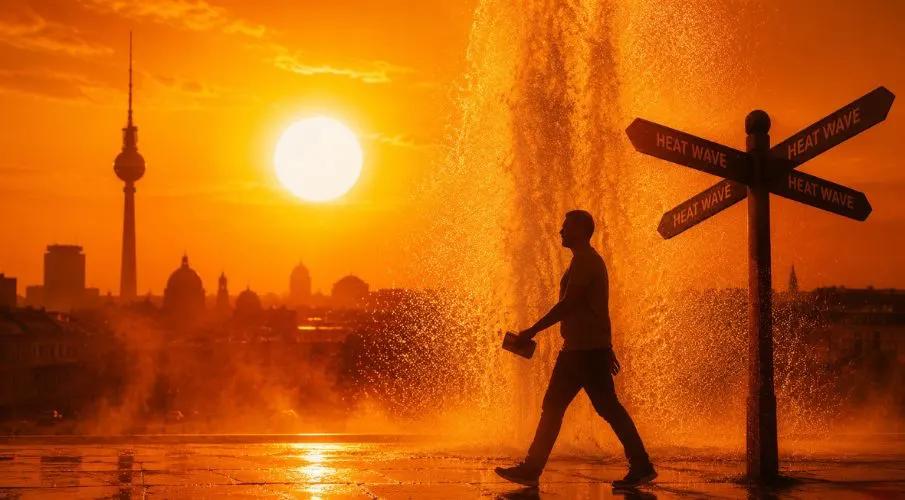
Between April 6 and August 9, around 14,000 people in Germany died prematurely because it was too hot. The number appears in the latest weekly report from the Robert Koch Institute, published on August 20, and it is the highest in 10 years. A conservative estimate, the researchers say, no one knows the full number, only that it is higher. A summer kills without making a sound and leaves behind a number that has still come out too small.

An earthquake with that many victims would have dominated the news for days. But the heat comes without collapse and without an image, it settles over the weakest for weeks and takes them one by one. What remains is a catastrophe that no one experiences as one, divided into hundreds of silent days. Dead people without a photo and without a shared date do not demand an immediate response, they can be put off. Numbers like these are produced in statistics. You compare how many people died during those weeks with how many an average summer would have claimed, and the report puts a number on the difference. A method that knows no names, only the surplus of graves. That is exactly why the number remains an estimate and the grief has no address.
Climate and democracy belong together
That comes to about 17 deaths per 100,000 people. In the heat year of 2018, 8,900 people died, and the gap shows where summers are heading. They make visible how warming is killing people in this country, every year a little earlier on the calendar and for a little longer. The institute is counting the consequences of a political system that treated the climate for decades as a problem for later. Today's record will become tomorrow's normal number if warming continues on its course. Only a few years lie between 2018 and today, along with an increase that no statistic can still write off as an outlier. This year currently stands at the top of a series that is still open.
The heat hits the elderly first. Among people 85 and older, 7,040 died, by far the largest group. Among those ages 75 to 84, the number was 3,450, and among those ages 65 to 74, it was 2,170. Another 1,320 of the dead were younger than 65. Women were affected more often than men, which is also because they make up the majority among the very old. An aging body handles heat less well, and very few of these homes have cooling. For many of them, no one checked in for weeks. In the statistics, the cause often does not even appear. The death certificate then says organ failure, and the heat that triggered it remains unnamed. Most of the time, high temperatures work together with a diseased heart or weakened lungs, damaged kidneys also play a role, until the body gives out. This is how people die unnoticed, hidden behind a diagnosis that sounds less alarming than the heat that forced it. Only the statistics bring these dead people out of hiding, and even they do it hesitantly.
The southwest was hit hardest. In Saarland, there were 46 deaths per 100,000 residents, in Rhineland-Palatinate 42. Hesse and Baden-Württemberg were somewhat lower at 31 and 28. The map of the dead reads like a map of the heat itself. Where summers are becoming hottest, the registers fill up fastest.
The government seems remarkably passive. As recently as the end of June, when asked about a nationwide heat action plan, the federal government said it was first having a research project examine whether such a plan should even be established.
Politics is answering this dying with proposals. Former German Health Minister Karl Lauterbach, an SPD member of parliament, has suggested information portals and telephone hotlines for dealing with the heat. Jochen Flasbarth, state secretary at the Federal Ministry for the Environment and Climate Protection, considers a national heat plan necessary by the summer of 2027. Burkhard Jung, president of the Association of German Cities and mayor of Leipzig, is calling for funding to fight heat and the consequences of climate change to be written into Germany's Basic Law.

A portal answers questions and does not lower the temperature. A telephone hotline only helps the person who can still reach for the phone, and most of this summer's dead were alone. A plan that will not be finished until later comes too late for the summers before then, and a line in the Basic Law ties up money that starts flowing when the next report has long since arrived. What does not look like a catastrophe demands no emergency program and patiently endures working groups and deadlines. Each of these ideas may be reasonable on its own, together they amount to an admission that there was nothing more to be done for this summer. A summer like this gets the country used to its own dead. What repeats itself every year loses its power to shock, and the repetition itself becomes an argument for changing nothing.
The government is cutting, but no one is taking to the streets
The clearest assessment comes from the hospitals. The German Hospital Federation warns that cooling systems in hospitals are outdated and that only a few patient rooms have air conditioning. At the same time, however, the federal government has cut hospital funding. The suspension of one financing rule alone cost hospitals around 1.8 billion euros in 2026, according to the Bundesrat. In July, the GKV Contribution Rate Stabilization Act was also passed, bringing further cuts to hospitals. The German Hospital Federation explicitly calls it an "austerity law at the expense of hospitals, their patients and their employees." The place that promises rescue can barely withstand the heat itself, and the sick find indoors the same burden that had already weakened them outside.
The dying does not stop at the border. World Health Organization Director-General Tedros Adhanom Ghebreyesus said in June that 1,300 people in Europe had died from the heat in a single week, counted from June 21 to June 28. In France, 5,764 deaths above the expected level were recorded during the June heat, 36 percent more than ordinary mortality would have produced. Everywhere, the same calculation, measured excess mortality, distinguished only by the language of the death certificates. June alone claimed thousands across the continent, and this month is only one of many still to come.
"The climate targets are still on paper, but the federal government has blunted the tools meant to achieve them in several ways. Heat protection across the country, meanwhile, continues to lag behind what warming is doing. With around 14,000 estimated deaths in 4 months, the Environment Ministry is no longer enough to describe the failure. Irresponsibility is more accurate."
The Knowledge Has No Consequences While the Death Toll Keeps Rising

28 percent for the AfD, which only 9 percent trust on climate. 55 percent consider the Greens the most competent, 16 percent would vote for them. Germans know who can help against the heat, and vote for the others. On the other side of that equation are 14,000 dead.
14,000 Heat Deaths, and Barely Any Resistance
A summer has cost around 14,000 people their lives in Germany, and the streets remain empty. There is no sign of a mass movement in society. On August 14, around 40 people gathered for a climate action in Lüneburg, while police counted 15 in Oldenburg. For every person protesting, hundreds have died, and no one seems troubled by that ratio. Numbers that would trigger a state of emergency in almost any other situation fade away here without an echo.

The pictures from spring are no bigger. On April 24, Fridays for Future marched through several cities against the rollback of climate policy and for renewable energy. In Bingen am Rhein, around 50 people showed up, according to police. In Münster, about the same number stood there shortly before the demonstration began, looking almost lost in the city center, as one report put it. In Passau, a little more than 50 protested against the federal government's energy policy and for a faster move away from fossil gas. A few dozen people on wide-open squares, that is about all the protest can carry right now.
On August 1, in the middle of another heat wave, around 60 people in Freiburg demanded better protection from the heat. Shortly before that, the region had measured 40.2 degrees Celsius. Against a temperature that kills people, a crowd the size of a bus showed up. Empty streets are read in the ministries as permission. 14,000 estimated heat deaths - and in the country's largest cities, there is not a single climate demonstration in August whose turnout is large enough to attract national attention. Where no one pushes back, weakening climate policy does not cost a single vote, and what costs no votes is cheaply carried on. The equation is crooked. Thousands die, dozens stand up, and the silence between those two numbers is louder than any march. Between the numbers stands a question no statistic can answer, how much a life still counts when it is almost over. These dead do not scream, they stand in tables, under numbers people skim past. They are counted late and imprecisely, the hospital air conditioners, the resistance may come in a few years. The next summer will not wait that long.
This silence spares politics the pressure that so many graves should actually create. Silence on this scale is already an answer.
Updates – Kaizen News Brief
Alle aktuellen ausgesuchten Tagesmeldungen findet ihr in den Kaizen Kurznachrichten.
To the Kaizen News Brief In English


Das ist (ich weiß, der Vergleich zeigt nicht die Dramatik des Klimawandels) wie mit der Böllerei an Sylvester.
2 Monate ist es in den Schlagzeilen, es ändert sich nichts und beim nächsten Sylvester geht es von Vorne Los.
Klimawandel… Hitze… Waldbrände bestimmen4 Monate die Schlagzeilen.
Sobald es kühler und feuchter wird, rutscht das Thema ganz weit nach hinten.
Und im nächsten Spätfrühjahr heißt es wieder „das ist ein einzelnes Phenomenal, das dies/das so extrem ist“
Nein, es ist ein Muster, was sich von Jahr zu Jahr verschlimmert.