
NOAA, the U.S. federal agency directly responsible for fisheries and marine management, is supposed to manage fishing in a way that protects stocks and habitats. Last month, the agency wrote to the country’s regional fisheries councils and told them, in effect, to stop doing that. Nine letters with the same directive, to dismantle existing restrictions in favor of looser and more economically profitable rules. The directive does not come from the regional fisheries bodies, it comes from above. The Commerce Department is implementing an order Donald Trump signed in April 2025 under the title “Restoring American Seafood Competitiveness.” A sentence that sounds like care and means the opposite.
At stake are marine protected areas and the lists of threatened species. Then there are changes to fishing gear and a broad expansion of commercial fishing. Andrea Treece, senior attorney with Earthjustice’s Oceans Program, reads the letters as a declaration. “These letters reflect the administration’s view that fish are just commodities, science doesn’t matter, and short-term economic gains and political points matter more than sustaining ocean ecosystems.” What is missing, she said, is any understanding of the responsibility to protect an ocean that belongs to everyone and that everyone depends on.
The ocean belongs to everyone, that is easy to say. Who it is being taken away from appears in none of the letters. The sea keeps no record and remembers nothing. It answers to no one, and that makes it the most convenient bargaining chip a government can find.

The nine letters went to eight regional fisheries bodies and one division for migratory species, written after consultations with hundreds of industry representatives. They attack environmental rules that have existed for decades and read like a fishing industry wish list that someone translated into bureaucratic language. The priorities are being represented by Eugenio Piñeiro Soler, who was put in charge of NOAA Fisheries three days before Trump’s order. In a statement, he says they are meant to “reduce burdens on domestic fishing, increase production, stabilize markets, improve access, and enhance economic profitability.” The ocean does not appear anywhere in that list.

The July 2, 2026 letter shows just how specifically NOAA is carrying out the change in fisheries policy. The agency is asking the Western Pacific Fishery Management Council to review or completely eliminate several protective rules. These include limits on longline fishing to protect endangered leatherback turtles, catch restrictions for swordfish, and a requirement that hooks off American Samoa be set at least 100 meters deep to protect turtles. The justification is Donald Trump’s order on “Restoring American Seafood Competitiveness”: fewer burdens on fishermen, higher catches and better economic returns. At the same time, the council is being asked to consider whether species can be removed from existing conservation and management lists. NOAA does, however, require that any changes remain consistent with the Endangered Species Act.
All nine letters ask the regional fisheries bodies to review their plans and consider removing species that supposedly no longer need conservation and management. None of the letters says by what standard a species is considered taken care of. The standard is missing, the removal is already on the table, it only still needs to be justified. With the profitable stocks, it becomes clear what this is about. Pacific sardine stock definitions are supposed to be changed so that more can be caught. In the Caribbean, spiny lobsters and queen conches are supposed to be shifted from federal management to the states in order to maximize yield. And the rules are supposed to be loosened enough to let fishermen keep bluefin tuna that do not yet measure 73 inches, not even 1.85 meters.
Elizabeth Cerny-Chipman, who handles U.S. fisheries policy at Ocean Conservancy and previously worked in NOAA’s Office for Coastal Management, counters with something that should be obvious. “If the goal is seafood competitiveness, we need healthy fisheries.” The focus, she says, is usually on short-term political hot-button issues, when long-term, science-based management should be what matters. You strip the stock you want to live off.

Sea turtles are protected and threatened species in the waters off New England and in the North Atlantic
Three regional fisheries bodies were explicitly told to shrink or eliminate protected areas. West of Puerto Rico, fishing is supposed to expand into Tourmaline Bank and Abrir La Sierra, where seasonal closures have until now protected red hind spawning grounds and habitat for large snappers and groupers. In New England, the council is supposed to open “traditional fishing grounds” for scallops in the northern part of Georges Bank, that rich fishing ground between Cape Cod and Nova Scotia. Scallops are the most valuable fishery in the United States, and that is precisely why these grounds have been left alone for years.
The agency is also recommending that clam fleets using dredges be allowed into the Great South Channel east of Nantucket, even though their chains plow up the ocean floor. Andrew Rosenberg, once deputy director of the National Marine Fisheries Service, simply calls reopening the areas stupid. He closed those grounds in his second week on the job in 1994, and for good reason: the abundance of scallops there supports the entire fishery. What is being demanded here, he says, is the complaint of an industry that already makes money and still wants more.
Experts call removing species and shrinking protected areas short-sighted, and Treece explains why. “Protecting spawning grounds is Fisheries 101: if you want more big fish to catch, you have to let them make little fish.” Scooping up the parent fish while they are spawning, she says, is the surest way to ruin a stock. Even recovered stocks still need protected areas, otherwise the growth stops.
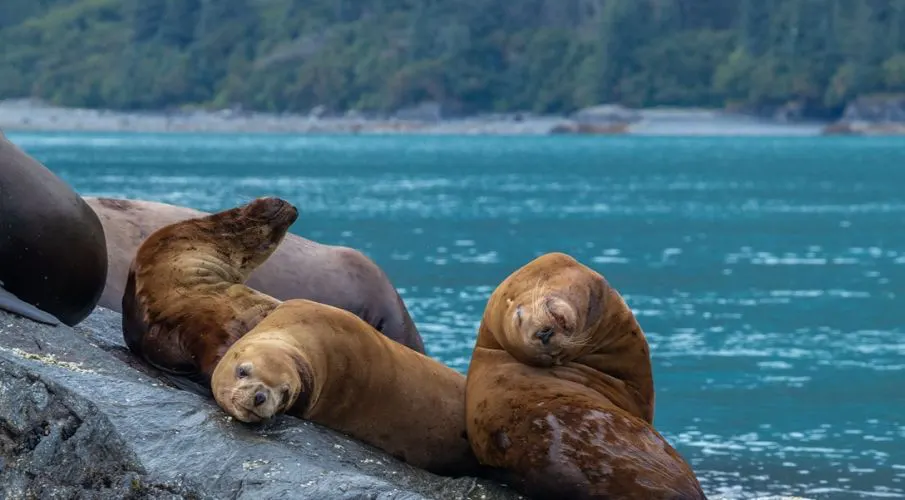
In several places, the letters go directly after protections for endangered species. Hawaii’s shallow-set longline fishery currently has to shut down for the rest of the year once 16 interactions with endangered leatherback turtles have been recorded. NOAA wants to eliminate that limit. Off Alaska, Steller sea lions had collapsed by more than 80 percent before they were protected in 1990 and fishing closures were put around their rookeries. The eastern population has recovered, the western one has not, and it handles marine heat waves poorly because they depress reproduction.
Another strong El Niño event is considered very likely this fall. At the same time comes the instruction to “modify and shrink closures” off Alaska so fishing grounds become more accessible. You take away a weakened species’ refuge and its food at the same time, and you do it in the year when the warm water is coming. An animal cannot file an objection.
In New England and the Mid-Atlantic, the expansion of ropeless fishing gear is also supposed to be stopped. Every year, more than 300,000 whales, dolphins and porpoises die because they become entangled in fishing gear. For decades, NOAA has been working on lobster traps that can be retrieved without permanently stretched lines, especially for the last roughly 350 North Atlantic right whales. In 2023, one of them was seen off Georgia with rope lodged in its mouth. The agency insists it will continue to support the technology while at the same time pushing to make its use optional or end the program altogether.

North Atlantic right whales live off New England, one of the most endangered large whale species in the world. NOAA explicitly lists them for the waters from Maine to Cape Cod, as well as Cape Cod Bay, Massachusetts Bay and the Great South Channel.
Treece turns the accusation around. Instead of blaming animals for trying to survive in their own habitat, she says, fishing should be made less destructive and fish stocks kept healthy so that humans and predators do not have to fight over fewer and fewer fish.
Experts see a double break in this. The top-down order breaks with the usual system in which the councils make their own plans. And it reverses the agency’s job, which under the Magnuson-Stevens Act is supposed to enforce the law, including limits on overfishing and reducing bycatch. Protecting habitats is part of that job too. Rosenberg, who worked with this system for nearly four decades, sees no coherent line in the letters. None of the measures improves sustainability, he says, and some make it worse.
One word is missing from every letter: climate change
That is foolish, Rosenberg says, because some of the greatest pressure on the ocean today comes from exactly that. Plans are written for fixed geographic areas while fish stocks move north and into deeper water as the ocean warms. The agency draws lines in the water and then acts surprised when the fish do not read them.
A NOAA spokesperson responded to questions only by pointing to the “best available information” in the letters themselves. The agency left unanswered how many areas are still at risk and which species could lose protection. It also left unanswered what safeguards would remain for the affected animals and whether economic returns now matter more to the agency than the ocean itself. Cerny-Chipman says many of these priorities have nothing to do with science and put entire ecosystems at greater risk. “Now is not the time to roll back protections that help keep fish and marine life healthy.” Trump sees it differently. And he does what he does best - perhaps even the only thing he truly knows how to do: destroy.
Updates – Kaizen News Brief
All current curated daily updates can be found in the Kaizen News Brief.
To the Kaizen News Brief


Was da an Schäden angerichtet wird, ist unter Umständen nie mehr umzukehren.
Trump zerstört alles.
Er würde am liebsten in einem goldverzierten Marmorturm mit Granit und Statuen drum rum leben.
Vielleicht sollte man ihm Gold oder Granit als Mahlzeit servieren?