
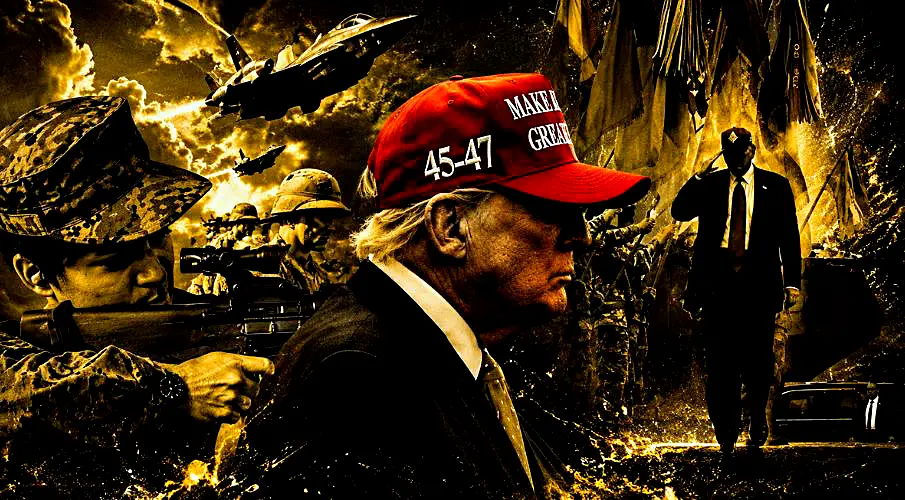
The explosions flash in rhythm. Boom, boom, boom, sings the female voice, and with every beat another blast tears across the screen beneath the words Iran was warned. The White House cut footage of its military strikes to music, and the music was Katy Perry’s Firework from 2010, a song about finding your light after everything falls apart. The fireworks became bombs. A lyric about hope at the end of the night became the soundtrack for explosions. And apparently no one in the White House saw anything wrong with that.
The singer did. On Saturday, the 41-year-old said she was deeply shocked and furious. No one had asked for her permission, and she in no way approved of it. She said she wrote the song for people going through the darkest moments of their lives, as an anthem of hope and inner strength. Turning that message of self-worth into a weapon to score scenes of destruction, she said, betrays everything the song stands for. Her music is meant to bring people together, not celebrate war.

Katy Perry said she was horrified that the White House had used her song Firework to accompany videos of military operations. She said she had never given permission and had never even been asked. According to Perry, the song stands for hope, healing, and unity, not war or violence.
Making war look beautiful, dressing it up with music, and tempting people to take pleasure in destruction is one of the oldest tricks of violent regimes. Anyone who lays an anthem of healing beneath falling bombs is not simply borrowing a song. They are turning its meaning upside down and inviting the audience to enjoy killing as spectacle. What a government cannot create itself, it can still steal and defile. The stain belongs to the thief, not to the song.
Instead of backing down, the White House doubled down. Firework disappeared from the original video, which now simply says the audio is unavailable, but the footage remained. Then on Monday came another video, this time set to another Perry song, Part of Me from 2012. This version even inserted Perry herself, using scenes from her own military-themed music video. Between images of Trump and fighter jets, she appears in camouflage carrying a rifle, and across the screen, almost as a taunt, flashes one of her own lyrics: Now look at me.
Kaelan Dorr, one of Trump’s staffers, shared the clip and tagged Perry with a simple "Hi" and a waving hand emoji. He had already dismissed her first protest by posting another excerpt from the same footage, sarcastically asking whether that was not actually her in the video. The mockery strikes at a vulnerable point. Perry filmed Part of Me at Camp Pendleton in 2012 and deliberately chose to feature real U.S. Marines instead of actors. At the time, she said that serving the country represented the heart of America. Now the administration is using that respect for the military to humiliate her with it.

Whether Perry could even sue remains an open question. In 2023, she sold her music catalog for $225 million to a music company, including the master recordings and publishing rights to her five biggest albums, which include both songs. Part of Me was her seventh No. 1 hit. Deals like these often leave artists with little or no control over where their music is used, and no one knows exactly how much authority Perry still has over those recordings. Her outrage may therefore be moral rather than legal, and the White House appears to be counting on exactly that.
She is far from alone. Bruce Springsteen, Sabrina Carpenter, Neil Young, Jack White, Céline Dion, Kesha, and Ariana Grande have also objected to this administration using their music. In June, after her song Bye was used in a video about ICE, Grande made her position unmistakably clear. She demanded that her music never again be associated with what she described as that cruelty and ended her message with a curse directed at the agency. In May, Kesha called the White House "perverts" after her song Blow was used in a video titled Lethality. She also urged people not to lose sight of what she claimed was the fact that Trump's name appeared repeatedly in the Epstein files. Both songs later disappeared from the videos without explanation and without a single word of apology.
Anyone who believes any of this embarrasses the White House is mistaken. Communications Director Steven Cheung openly explained the strategy. These singers keep falling for it, he said, and that only brings the videos more attention and more views because people want to see what they are complaining about. In other words, the outrage is not the problem. It is the fuel. Art becomes bait in a campaign built to generate clicks.
Our reporting makes one thing unmistakably clear: Cheung works with misinformation the way others work with the truth.

Steven Cheung, seen here with his girlfriend, has served as White House Communications Director since January 2025 and is the man who turns outrage over bombs into click counts. It is time our readers learn exactly what kind of person is speaking.
Who is Steven Cheung?
Steven Cheung has led White House communications since January 2025, and he has turned it into exactly what it is today - a weapon. For years he served as Trump's spokesman and one of the chief attack dogs of his political campaigns. So when he mocks female artists by saying they "keep falling for it," those words come from someone who has made personal attacks part of his profession. He routinely dismisses independent media as biased, publicly insults reporters on social media, and repeatedly singles out individual journalists, especially CNN's Kaitlan Collins. Press organizations have criticized his treatment of the media, while communications experts have condemned what they describe as a systematic effort to escalate political attacks against individual reporters. He has been deeply involved both in the growing hostility toward White House correspondents and in the blurring of the line between government and political campaigning.
But the press is only the beginning. Cheung stood behind every public defense of Trump during his criminal cases, defended Trump's rhetoric after the January 6 attack on the Capitol, and even justified the publication of sensitive documents. He has been accused of promoting the debunked false claim that the 2020 election was stolen and of helping fuel doubts about the legitimacy of the results. He lashed out at judges and election officials, attacked Special Counsel Jack Smith, Manhattan District Attorney Alvin Bragg, Fulton County District Attorney Fani Willis, the FBI, and the Department of Justice, dismissing every criminal case against Trump as political persecution. Derisive nicknames for opponents, attacks on Republicans who broke with Trump, and constant insults aimed at anyone viewed as an enemy have become his daily routine. Anyone who celebrates the anger of those whose work has been taken from them as free advertising reveals exactly how they understand power, and that understanding has a name and a long history.
Perry is now in a relationship with former Canadian Prime Minister Justin Trudeau and drew criticism last year after taking part in a commercial spaceflight. None of that matters here. A government edits footage of bombs to a pop song, steals the singer's image to go with it, and then waves at her with open mockery. It is not ashamed of what it did. It uploads the video and counts the clicks.
Pathetic. America in 2026 - how far you have fallen.
Updates – Kaizen News Brief
All current curated daily updates can be found in the Kaizen News Brief.
To the Kaizen News Brief In English


