
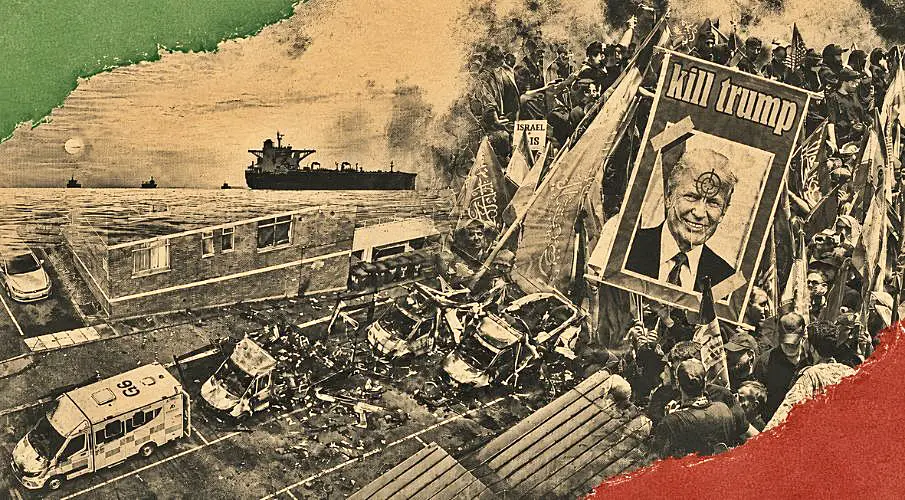
After another night of reciprocal attacks, the United States and Iran are returning to the state of heightened confrontation that the ceasefire of recent weeks was supposed to end. President Trump announced that the U.S. naval blockade of Iranian ports would be reinstated, barely three weeks after he had lifted a months-long blockade as part of a ceasefire agreement. In addition, Washington intends to impose a 20 percent fee on all goods transported through the Strait of Hormuz, the narrow waterway through which one-fifth of the world's oil and liquefied natural gas shipments passed before the war began.
Yesterday's strike on Iran's Bandar Abbas Naval Base, where U.S. forces used one-way attack drones and American sea drones to strike a submarine facility and a ship maintenance yard.

Trump told an American television network that the United States would guard the strait in the future and expected to be paid for doing so. On social media, he elaborated that the United States would reimburse itself with a 20 percent charge on every shipment passing through the waterway to cover all necessary costs of maintaining security in this unstable region of the world. The proposal would effectively represent an expansion of the military conflict and directly contradicts the position Secretary of State Marco Rubio took just last month, when he argued that the Strait of Hormuz is an international waterway under international law and that no nation has the authority to impose transit fees. The United Nations' International Maritime Organization also opposed the proposal while simultaneously condemning the attacks on civilian commercial vessels.
Trump says he will take control of the Strait of Hormuz and impose taxes and fees there: "We're gonna keep the strait, and we'll probably run it. We'll become the guardian of the strait. We should be reimbursed for that. When we do that, we're gonna be reimbursed. We're gonna get paid."
The framework agreement signed by Trump and the Iranian president last month contained language that, according to Tehran's interpretation, granted Iran authority over traffic passing through the strait. Washington insists instead that the passage must remain open to all international shipping. That conflicting interpretation became the spark behind the latest escalation. As early as March, Iranian attacks had nearly brought maritime traffic to a standstill and triggered global fuel shortages. Last weekend, Iran attacked a Cyprus-flagged container ship accused of violating Iranian transit regulations. On Sunday, only 14 vessels passed through the strait, the lowest number recorded in a month. Oil markets reacted immediately. Brent crude climbed back to nearly $80 per barrel, an increase of approximately 5 percent since Friday, while gasoline prices in the United States rose to $3.87 per gallon, 7 cents higher than a week earlier.

Early Monday morning, the Iranian military announced that it had launched another wave of strikes against American military facilities in Jordan, Bahrain, Kuwait, and Oman. Jordan's air defenses intercepted 4 missiles without casualties. Kuwait and Bahrain also reported successfully intercepting hostile aerial targets. Hours earlier, American forces had carried out strikes intended to degrade Iran's capability to attack commercial shipping. U.S. Central Command announced that dozens of targets had been struck overnight, including Iranian air defense systems as well as missile and drone capabilities, while declaring that American warships would begin enforcing the blockade later that same day.
At the same time, Trump confirmed in a letter to congressional leadership, sent on Friday but made public only on Monday, that American forces had conducted what he described as defensive strikes against targets inside Iran on July 7. The disclosure has reignited the dispute between Capitol Hill and the White House over the constitutional authority of a president to continue a war without congressional approval. Both chambers of Congress had already called upon the president either to end the war or seek congressional authorization, but the White House continues to rely on the president's authority as commander in chief.

In Tehran, calls for revenge are growing louder. Ali Bagheri Kani, Deputy Secretary General of the Supreme National Security Council, declared that action must be taken against everyone who ordered, carried out, or supported the attack on the beloved leader. A senior cleric, Ayatollah Mohsen Araki, publicly called for revenge against Trump and Israeli Prime Minister Benjamin Netanyahu. Mojtaba Khamenei, the son and successor of Ayatollah Ali Khamenei, who was killed during the opening strikes of the American-Israeli war in February, declared that his father's pure blood would be avenged, that this was the demand of the nation, and that it would be carried out. Notably, Mojtaba Khamenei did not appear publicly at any of the mourning ceremonies, raising questions about both his health and the extent of his actual control over state affairs.
At the memorial ceremonies, some participants carried red banners, a Shiite symbol of vengeance, bearing the words that Trump would be killed. The president himself had already declared the fragile ceasefire effectively over during last Wednesday's NATO summit in Ankara after Iran had attacked commercial shipping. Trump has repeatedly described himself as Iran's primary target, although Iranian officials have so far refrained from openly calling for an assassination. Foreign Ministry spokesman Esmaeil Baghaei stated that the enemy's propaganda gestures would not deter Tehran from pursuing justice, adding that when and how Iran would respond would be decided by the military. Asked about the death of U.S. Senator Lindsey Graham, a staunch supporter of Israel, whose passing some Iranians publicly celebrated, Baghaei remarked that fortunately the Angel of Death is fair. An Iran expert from the European Council on Foreign Relations placed the rhetoric into context, saying it should surprise no one that elements within the regime favor assassinating Trump as the ultimate act of revenge, but that such views hardly represent either the majority or official state policy. Allowing hardliners to vent publicly, she argued, could actually reduce pressure on ongoing diplomatic peace efforts.

Anyone looking at this week's events as a whole, the attacks across 4 Gulf states within a matter of hours, the dispute over a strategic waterway, the attacks in Europe, and the collapse of a ceasefire in Yemen, is confronted with a picture remarkably similar to the one the English philosopher Thomas Hobbes described nearly 400 years ago: a condition in which, without a recognized sovereign, every actor becomes its own judge of security and revenge, producing the war of all against all that Hobbes identified as humanity's state of nature. Trump's attempt to present himself as the paid guardian of the Strait of Hormuz reads almost like an ironic reversal of Hobbes' idea, a self-appointed Leviathan promising protection in exchange for payment in a region where no one any longer places trust in a single authority.
In Yemen, another front of the conflict escalated on Monday. The Iranian-backed Houthi movement accused neighboring Saudi Arabia of bombing the international airport in the Houthi-controlled capital of Sanaa, apparently in response to an attempted landing by an Iranian aircraft. Houthi military spokesman Yahya Saree warned that the attack would not go unanswered and declared the period of de-escalation between Saudi Arabia and the Houthis to be over. Yemen's internationally recognized government, backed by Saudi Arabia, claimed responsibility for carrying out the strike in order to prevent the landing, despite possessing no operational air force of its own and remaining entirely dependent on Saudi military support. Iranian state television later reported that an Iranian aircraft had successfully landed at Hodeidah Airport on the Red Sea.
Even before the memorial ceremonies began, on July 3, an earlier Iranian aircraft arriving in Sanaa had already heightened tensions. According to Saree, Saudi fighter jets attempted to prevent the landing, although he insisted it was a civilian aircraft returning Yemeni patients from Tehran while transporting a large Houthi delegation to the state funeral ceremonies on its return flight. Saree warned that any violation of Yemeni airspace could provoke Houthi attacks against Saudi airports. Yemen's government described the flight as a blatant violation of its sovereignty, while the Saudi-led military coalition dismissed the Houthi accusations as an attempt to distract from the Houthis' own serious violations.
The Yemeni civil war began in 2014, when the Houthis seized Sanaa and forced the internationally recognized government to flee to Aden. The following year, Saudi Arabia and the United Arab Emirates launched what ultimately became a failed bombing campaign. Saudi Arabia eventually withdrew, while the Houthis consolidated their control over northern Yemen, effectively dividing the country into two states. Although the internationally recognized government continues to designate Aden as its capital, most of its senior officials remain based in Saudi Arabia and are financially as well as politically dependent upon Saudi support. Yemen remains one of the poorest countries in the world and is trapped in one of the gravest humanitarian crises of the modern era. A fragile ceasefire had held since 2022, but recent ground fighting in Hodeidah Province has placed that truce in doubt. Houthi spokesman Mohammed Abdulsalam described the airport strike as a serious violation of the ceasefire. United Nations Special Envoy Hans Grundberg urged all parties to refrain from any action that could trigger another cycle of violence.

The British government says a series of arson and vandalism attacks targeting Jewish sites across Britain, including an attack in which multiple Hatzolah ambulances were set on fire, were carried out by an Iranian-backed terrorist group.
The reach of Iranian retaliation has also become visible across Europe. On Monday, the British government accused a branch of the Islamic Revolutionary Guard Corps of being, to a near certainty, responsible for directing a wave of antisemitic attacks across Europe and initiated proceedings to designate the organization as a terrorist entity. Keir Starmer, who formally remains prime minister because his successor Andy Burnham is not expected to assume office until the coming days, declared that Britain would never allow itself to become a playground for states seeking to spread fear, division, and violence on its streets. An Iranian proxy organization calling itself the Islamic Movement of the Companions of Justice targeted Jewish communities, journalists, and Israeli interests between March and May, claiming responsibility for 7 attacks in Britain alone, including an arson attack against ambulances belonging to a Jewish emergency medical service in London, as well as explosions at Jewish schools and outside synagogues in Belgium and the Netherlands. According to British authorities, Iran increasingly relies on criminal gangs to advance the regime's interests abroad. Under the same legislation, London also designated a network operating under the control of Russian military intelligence that reportedly includes remnants of the former Wagner Group. If Parliament approves the measure, these would become the first organizations designated under the Security Act of 2026.
As early as May, federal prosecutors in New York charged Mohammad Baqer Saad Dawood al-Saadi, a commander of the Iraqi militia Kataib Hezbollah, one of the Revolutionary Guard's proxy forces, with directing the campaign of attacks across Europe. Prosecutors allege that since late February he planned at least 20 attacks against American and Israeli interests throughout Europe and Canada. He was arrested in Turkey, transferred into U.S. custody, and pleaded not guilty. The indictment also includes alleged plans to attack Jewish institutions inside the United States, as well as a secretly recorded telephone conversation in which al-Saadi allegedly admitted responsibility for 2 attacks in Canada. Britain attributed the broader campaign to the Quds Force of the Islamic Revolutionary Guard Corps, whose former commander, General Qassem Soleimani, was killed in a U.S. strike in 2020.
Hostility toward Trump among Iran's hardliners reaches back many years. In 2019, he reimposed sweeping economic sanctions. In 2020 came the targeted killing of Soleimani. The American-Israeli war, which began on February 28 of this year, has since pushed Iran's economy even deeper into crisis. What began as a dispute over a strategic waterway and the fees imposed upon it has, within only a matter of days, expanded into a conflict stretching from the Gulf states across Yemen and into cities throughout Europe and North America, with neither its conclusion nor its next battlefield anywhere in sight.
Late in the afternoon, U.S. Central Command clarified the timeline. Beginning Tuesday evening, it would enforce the blockade against all vessels entering or departing Iranian ports and coastal areas, while continuing to support the passage of all other commercial shipping through regional waters. Markets reacted even more sharply than the previous day. Brent crude surged 9 percent to $83 per barrel, placing it 12 percent above its prewar level. Trump's declaration that the United States should be paid for guarding the Strait of Hormuz and reimburse itself by collecting 20 percent on every shipment passing through it directly contradicts weeks of statements from his own closest advisers, who argued that no country has the legal authority to impose fees or tariffs on transit through a waterway that has been recognized as international for decades.
To be continued ...
Updates – Kaizen News Brief
All current curated daily updates can be found in the Kaizen News Brief.
To the Kaizen News Brief In English


Und kein Staatsoberhaupt weist Trumps Geldgier für die Strasse von Hormus zurück.
Iran wurde sofort von allen möglichen Seiten verurteilt.
Das sagt viel über unsere Gesellschaft aus.
Unrecht ist nicht wirklich Unrecht, wenn es den eigenen Interessen dient.
Trump zündelt ungehindert weiter und wird weiter hofiert.
…ja, die zeiten sind mehr als merkwürdig geworden um es höflich auszudrücken