
There are words that kill without a single hand being raised. Terrorist is one of those words. It is draped over a person like a coat, and suddenly no one sees the person anymore, only the coat. What ICE did to Gabriel Hurtado-Cariaco is the anatomy of that process, step by step, until a video brought the entire construction crashing down. It is the story of how an asylum seeker with a work permit and an immigration court hearing became a public enemy, and of how thin the thread is by which the truth still hangs in cases like this.
Let us begin with the man before the labels. Gabriel Hurtado-Cariaco is a Venezuelan asylum seeker. He requested asylum at the border, entered the United States, and was living with his girlfriend in Bellevue, Nebraska. He told authorities that he had fled Venezuela after leaving the military because he opposed the Maduro regime and feared retaliation. He had a valid work permit. He had a scheduled hearing before an immigration court. According to court records, he was on his way to register his car when ICE arrested him. A man with an ordinary life, a girlfriend, a car, and a pending legal case. That is the person one must know before the government turned him into a monster.

His arrest in June 2025 was not the end. It was the beginning of something much larger than a physical struggle. ICE and the Department of Homeland Security transformed Hurtado-Cariaco into a public threat narrative. They called him a criminal illegal alien and a known Tren de Aragua terrorist. It is a pattern we know well. We have already helped many people get out of detention because baseless allegations of this kind were repeatedly made against them. The government accused him of violently attacking an ICE officer, slamming her head onto the ground, and attempting to choke her to death. What began as an immigration arrest quickly became a criminal prosecution built around some of the most serious accusations a government can level against a human being.
Read also our article: The Shadow Man
Kristi Noem and Her Shadow Men - When an Enemy Image Is Made of Thin Air
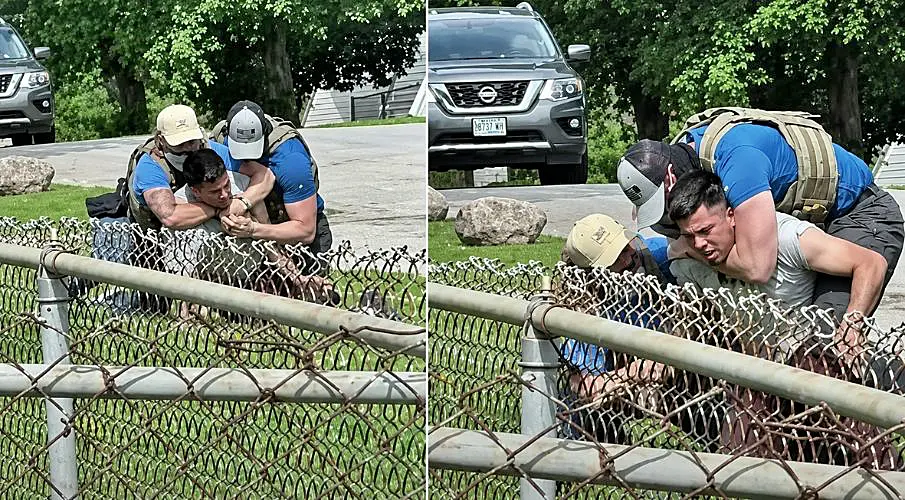
And then there was the video. Footage recorded by bystanders that we were able to introduce into the case through our reporting showed a struggle. That is true. It showed Hurtado-Cariaco resisting arrest and trying to pull away. It showed officers placing him in a chokehold to restrain him. One of the videos even began with the female officer placing him in a chokehold, while another showed the struggle continuing on the ground. What the footage did not show, however, was the heart of the entire attempted murder story. Nowhere was there any evidence that Hurtado-Cariaco choked the officer. Prosecutors later acknowledged that he had not choked her. The central allegation simply was not there, even though it had been the foundation of the most serious charge.
One must remain honest at this point, and it is precisely that honesty which makes this story so powerful. Hurtado-Cariaco was not legally innocent in every respect. He later pleaded guilty to resisting arrest resulting in bodily injury and was sentenced to fourteen months in prison, most of which he had already served. But that is not the point. The question is not whether there was a struggle. The question is that ICE and federal prosecutors presented a far bigger story to the public and, on that basis, intended to place him directly into ICE custody for immediate deportation. Terrorist. Gang member. Would be murderer. Violent threat. There is an abyss between resisting arrest and attempted murder, and that abyss was bridged with words, not with evidence.
The most serious allegation, as so often happens, came through paperwork. An ICE officer who had not even been present at the scene prepared the sworn affidavit on which the criminal complaint was based. In that affidavit, she claimed Hurtado-Cariaco had placed the officer in a chokehold and made the decision to continue choking her instead of simply fleeing. The video evidence did not support that claim. Consider what that means. A person who was not present describes an act that the cameras do not show, and that description becomes the basis for an attempted murder charge. Prosecutors later described the choking allegation as a misperception. It is a mild word for a very serious event because that alleged misunderstanding helped transform an asylum seeker into a defendant facing attempted murder charges.

It took a judge to call the entire construction by its proper name:
Chief U.S. District Judge Robert Rossiter of the United States District Court for the District of Nebraska in Omaha stated that the allegations were, at worst, a misrepresentation and, at best, complete negligence.
The characterization of Hurtado-Cariaco as a terrorist and attempted murderer, as well as the claim that he had choked the officers, was not supported by the evidence. The judge described the investigative reports as embellished and troubling. Those words carry enormous weight because they came from the highest court responsible for this case and because they said what the government itself never would have admitted. The narrative did not merely describe an arrest. It created a public identity around a human being before the evidence supported it.
The ease with which something deeply personal can be turned into incriminating evidence is illustrated by the tattoo. ICE interpreted a tattoo on Hurtado-Cariaco's forearm as proof that he belonged to Tren de Aragua. The image showed two figures walking beneath an eye and a clock, with the date April 30, 2018 beneath them. According to the defense, that date was his son's birthday. Let that sink in for a moment. A child's birthday became evidence of gang membership. A father carries the date of his son's birth on his skin, and a government agency reads it as the symbol of a terrorist organization. It would be difficult to find a clearer example of how a threat narrative works. It does not require a crime. It only requires a detail that can be reinterpreted.

There Was That, Too...
Read also our article: The Fist, the Photo, and the Lie – How Trump Replaced Justice with a Fake Image
That is precisely the mechanism this case exposes so ruthlessly. A nationality becomes suspicion. Fear during an arrest becomes a mythology of violence. A man who left the Venezuelan military because he opposed the regime is declared a known terrorist before a single piece of evidence is forced into the light. When ICE calls someone a terrorist, that word performs a function. It changes how the public sees that person. It changes how the arrest is understood. It makes the use of force easier to justify. It makes detention easier to defend. It makes extreme accusations sound plausible before the evidence has even been examined. It transforms a human being into a category, into a case, into a threat.
Language itself is part of this machinery. Phrases such as criminal illegal alien are not neutral descriptions. They are tools that strip away the context, erase the asylum application, erase the work permit, erase the court hearing, erase the suffering that came before, making it easier to publicly condemn a person before the case has even been fully examined. Hurtado-Cariaco told the court that masked officers triggered traumatic memories of Venezuela and Mexico. He said he had been tortured by police in Venezuela and robbed in Mexico by cartel members posing as police officers. When officers wearing face coverings arrested him, those memories returned, and he ran because they overwhelmed him. His guilty plea to resisting arrest does not erase that background, which the government's narrative sought to bury.
Here the deeper question at the heart of this case begins to emerge. The rule of law rests on a simple order. First comes the evidence, then the judgment. First comes the examination, then the verdict. What ICE did reversed that order. The judgment came first, in the form of a single word, and the evidence was expected to catch up afterward. When it failed to do so, the damage had already been done because a public enemy image cannot be withdrawn as easily as a criminal charge. The man had already been placed in the public pillory before anyone asked whether he belonged there. It is the reversal of the rule of law through the very instruments of the rule of law, through forms, affidavits, criminal complaints, and public statements. Precisely because it arrives dressed as ordinary government procedure, it is so dangerous.
In the end, what remains is a man who is not the story that was built around him. Gabriel Hurtado-Cariaco is a Venezuelan asylum seeker whose immigration case is still pending, but he is no longer in custody. He has a work permit and a life in Bellevue. According to the record, he was on his way to register his car when ICE arrested him. The government's labels attempted to bury all of that beneath a single word. Terrorist. A tattoo became gang evidence, a struggle became attempted murder, and a man with a work permit and a pending immigration case became a known terrorist in the language of the state. The fact that this story ultimately unraveled was not because the government admitted its mistakes. It was because a video happened to exist, because someone went looking for it, and because a judge took the evidence more seriously than the narrative.
And that is the warning that reaches far beyond this single case. Not everyone is fortunate enough to have someone standing nearby with a camera. Not every case ends up before a judge willing to describe official reports as embellished. For every Gabriel Hurtado-Cariaco whose truth was saved by a video, there are others whose label has never been disproved. That is the real question this case leaves behind. How many people are still wearing the coat that was placed upon them simply because no camera was rolling when it was put on?
Updates – Kaizen News Brief
All current curated daily updates can be found in the Kaizen News Brief.
To the Kaizen News Brief In English


