
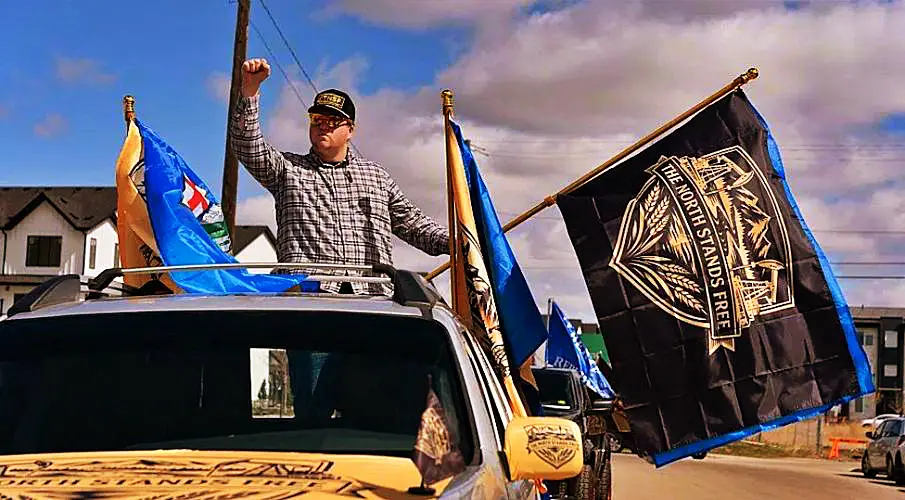
Sometimes political mistakes return in a different form. Not with the same faces, not with the same flags, and not even in the same country. They suddenly reappear and simply carry a different name. Mark Carney believes he may be seeing something like that in Canada right now.
When Britain voted in 2016 to leave the European Union, Carney was serving as Governor of the Bank of England and found himself at the center of a period that continues to shape the country to this day. He witnessed the first market shocks, the uncertainty spreading through businesses, and the political divisions that hardened over the years that followed. A vote that many had presented as a clean break evolved into a prolonged political struggle with consequences extending far beyond election day itself.
Now Carney is looking toward Alberta and hearing echoes that apparently remind him of that period.
Mark Carney: "With these kinds of separation questions, the argument is often made: Vote for it, it costs you nothing. Vote for it, and we will strengthen our position for future negotiations. That is a very dangerous bluff. That is a very dangerous bluff."
The oil rich province in western Canada has suddenly moved to the center of a discussion that would have seemed unimaginable to many only a few years ago. Danielle Smith, Premier of Alberta, announced last week that a vote will take place on October 19. Voters will be asked whether Alberta should begin legal steps to prepare a binding referendum on leaving Canada under the framework of the constitution.

At this point, the issue is not a direct separation. At this point, it is not about border checkpoints, new boundaries, or a new flag. But political developments rarely remain where they begin. That appears to be exactly what Carney is warning about. There is also an important distinction involved. The October vote would not automatically turn Alberta into a new country. Voters would first decide whether legal steps should begin for a future binding referendum. Even if Alberta eventually voted in favor of leaving, a new country would not suddenly appear overnight. Years of negotiations would follow involving borders, state assets, debt, oil and gas rights, trade agreements, currency systems, pension systems, and relations with the rest of Canada. Alberta is also not part of Britain or the United Kingdom. The Brexit comparisons apply solely to the political consequences of a far reaching vote, not to any shared governmental structure.
He called the development a potentially dangerous bluff.
Carney recalled how the discussion in Britain unfolded at the time. According to his view, many people were led to believe they could approve the idea first and work out the details later. Vote first, sort out the details afterward. But that, he says, is exactly where the danger lies today. He explained that Britain, even ten years later, is still trying to deal with consequences many people had not anticipated when they made their decision.

The statement is particularly notable because Carney is not speaking about a theoretical risk. He is talking about something he experienced firsthand.
For Canada, this debate is arriving at a time the government in Ottawa could hardly welcome. Carney is currently trying to attract investment while simultaneously advancing a new pipeline project designed to move Alberta oil to the Pacific coast. For years, Alberta has accused the federal government of paying too little attention to the province's interests. Many people there feel economically constrained. The province's vast oil reserves are expected to gain stronger access to Asian markets. That issue itself has been a source of political conflict for a long time.
Carney, however, has made it clear that political uncertainty rarely attracts investors. Companies eventually begin asking simple questions. How stable will the situation remain? Which rules will still apply in several years? What will happen to jurisdiction, infrastructure, or trade routes? Even the debate itself can create uncertainty. Carney also openly raised another issue. In his view, the proposal lacks a clear democratic foundation. During the last provincial election, such a step was not part of the campaign. People did not vote on it. It was not on the ballot.
Danielle Smith sees things differently
"I know the past decade under Trudeau and the NDP has been difficult, and people in Alberta have every right to feel frustrated. But thanks to the leadership and determination of the people of Alberta, the tide is finally beginning to turn in our favor. Most of Trudeau's nine harmful laws have already been repealed or revised. Investment is returning to energy, technology, and agriculture, and we are creating more jobs than the rest of the country combined. Now is not the time to give up hope. Now is the time to move forward with determination and help Canada reach its enormous potential.
With Alberta leading the way, we can make Canada one of the strongest and most prosperous economies in the world. On October 19, I will vote for Alberta to remain part of Canada. I hope you will join me."
She again stated that she continues to see Alberta as part of Canada. At the same time, however, she emphasized that the people of Alberta alone should decide their future. In a statement she made clear that the frustration felt by many people had not simply appeared out of nowhere. She pointed to the years under Justin Trudeau and argued that decisions made in Ottawa had significantly contributed to that dissatisfaction. Smith also called for Alberta's concerns to be taken seriously. They should not simply be dismissed or ignored. Instead, Canada needed to demonstrate that the country still works and that people could once again develop confidence in it.
In the background, another name emerges. David Cameron
Cameron also never intended to lead Britain out of the European Union. The referendum was largely meant to calm disputes within his own party and ease political tensions. What followed reshaped the country's political landscape for years. Roughly five months remain before Alberta's vote. But the real debate has already begun. Because this is no longer only about a province in western Canada. It is about what happens when frustration eventually stops expressing itself through political change and instead begins speaking the language of separation.
Mark Carney has already witnessed how quickly a vote can transform from a political tool into something that follows a country for years. Perhaps that is exactly why his words this time sound far sharper than usual.
Updates – Kaizen News Brief
All current curated daily updates can be found in the Kaizen News Brief.
To the Kaizen News Brief In English


Danke für den Artikel.
ich bin gerade in Kanada, und erlebe das ganze live mit.
Viele Menschen sind für ein starkes und vereintes Land.
Die Separatisten, so wird hier auch in den Medien berichtet, haben anscheinend auch Unterstützung aus den USA. Klingt für mich schon sehr seltsam.
Interessant auch, dass mit den First Nations keine vorangegangenen Diskussionen stattgefunden haben, und die First Nations sind alle gegen die Separation. Die First Nations haben Verträge seinerzeit mit der britischen Krone geschlossen, die heute noch gültig sind und das ist vom obersten Gericht bestätigt. So einfach kann sich die Provinz nicht trennen….. aber die Diskussion darum bringt Unsicherheit
und hoffentlich Danielle Smith bei der nächsten Wahl eine klare Niederlage
Mark Carney ist ein kluger Mann.
Das diese Diskussion jetzt aufkommt, ist sicher kein Zufall.
Die USA mit ihren Milliardären mischen sich seit Monaten, spaltend, in das Politikgeschehen anderer Länder ein.
Betreiben unverholen Wahlkampf für Rechtsextreme und (Möchtegern) Autokraten.
Alberta hat Öl.
Dazu Trumps Aussage „Kanada der 51. Bundesstaat“
Es gibt in Alberta diverse Native-Reservate.
Mit eigenen Verträgen und Rechten.
Die scheint keiner gefragt zu haben.
zumindest regt sich Widerstand.
Anstatt Spaltung wäre Einigkeit sinnvoll.
Gerade in der heutigen Zeit.