
Cars sit along roadsides in Oklahoma as if their drivers will return at any moment. A white Ford Transit in the northern suburbs of Oklahoma City. Tools are still lying in the rear storage compartment. A work order rests on the passenger seat. Takeout food sits on the dashboard. Farther south, a dark red Ford Fusion stands in the grass along Interstate 44. Gloves, a camouflage jacket, a safety vest, a cooler, and a thermos bearing the Arkansas Razorbacks logo still remain inside the vehicle. The people who owned these belongings have disappeared.

Cars and trucks drive by. Some slow down briefly, some quickly take a picture or video. A few minutes later the scene disappears in the rearview mirror. What remains is something that at first glance looks like an ordinary parking area or a vehicle breakdown. In reality, for some people an entire life ends there within only a few minutes. In Oklahoma, where all 77 counties supported Donald Trump in the 2024 election, state and local authorities have now become important partners of ICE. More than thirty state and local law enforcement agencies have entered into so called 287(g) agreements. These agreements grant them extensive authority in immigration enforcement. The Oklahoma Highway Patrol, with more than seven hundred officers, is among them. According to published figures, more than 1,300 people were arrested by ICE in Oklahoma during just the first two and a half months of 2026.

An attorney from Oklahoma City explained that reality there often looks different from the images seen in cities that regularly dominate headlines. Just because people do not see the same television footage does not mean individuals are not being arrested and torn away from their surroundings. That is exactly what is happening in Oklahoma. At the same time, an economic system has developed around these changes. After years of reforms within the prison system, empty spaces remained in correctional facilities. Empty beds mean lost revenue. For some counties and private operators, immigration detainees became a new source of income. Jails across several districts are now holding people for ICE.

This has become particularly visible in Cushing and Watonga. The Cimarron Correctional Facility outside Cushing, operated by the private company CoreCivic, reportedly holds approximately six hundred people for ICE every day. At the end of 2025, the Diamondback Correctional Facility in Watonga was also reopened. The prison had stood empty for ten years. It now serves as an immigration detention facility. According to the company, Diamondback is expected to generate more than one hundred million dollars in annual revenue for CoreCivic as well as state and local institutions.
In Watonga itself, many people view these developments with mixed feelings. Local officials speak about possible improvements to aging water lines and municipal infrastructure. Other residents see few benefits. One longtime resident stated that he did not believe his town would truly gain much from it. He wondered where workers would come from and whether anything would ultimately benefit local residents at all.

Even in nearly abandoned Picher, once a symbol of environmental destruction and now a town of empty streets, decaying houses, and the traces of a slow disappearance, people recently sought refuge from ICE arrests. In a place where toxic contamination, mining damage, and a tornado destroyed large parts of a community, people tried to find safety from deportation fears. Even places abandoned by the world for years suddenly became places of refuge for people who simply did not want to be found.
While discussions at the political level focus on agreements, revenue, and facilities, families are living through a different reality. Federico has lived in Oklahoma for more than twenty two years. He was born in Mexico, is married, and is the father of two American children. In November 2025 he traveled with fellow musicians to a performance in Texas. In Anson the group was stopped and questioned. For Federico, six weeks in ICE detention followed. He was later released under conditions, including electronic ankle monitoring.

He does not describe the device as a technical measure but as something that follows him constantly. He explained that he lives in continuous fear of damaging the device while sleeping or during daily activities. He said his life has never returned to normal. The device reminds him every day that someone else controls his life.

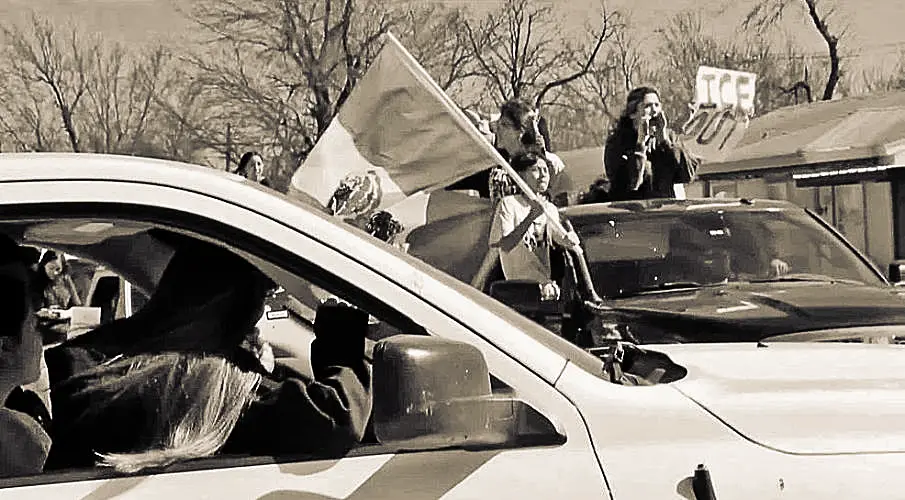
The consequences are also visible in schools. Hundreds of students walked out of classrooms in Oklahoma City and protested immigration measures and developments that they believe threaten families. One student stated that they wanted to be seen as human beings and not as something that could simply be removed. Elsewhere, churches, journalists, attorneys, and volunteers are trying to respond. The Spero Project and other groups operate emergency phone lines. People call searching for missing relatives. Volunteers search databases, call facilities, and try to determine where people have been taken.
One staff member described a call from a mother whose son had been stopped on his way to work and later transferred to ICE custody. After an extended search, he was located at Cimarron Correctional Facility. Shortly afterward another woman called with an entirely different question. She wanted to know how she and her partner could leave the country on their own. One thing remains clear: sometimes even the smallest piece of information matters. Even bad news can be easier to bear than complete uncertainty. Family members continue asking the same question. Where is he. Where is she.

The Grady County Jail is located in Chickasha, a city in central Oklahoma approximately 60 to 70 kilometers southwest of Oklahoma City.
Maria describes how her life has changed. She is thirty years old and depends on rides from friends, family members, and volunteers. She says everything changed after Donald Trump returned to office. She can no longer go shopping or drive to work without constantly looking into the rearview mirror. Before getting out at stores, she first checks parking lots and surrounding streets. She said she had always been independent and had always managed her own life. Today even an ordinary shopping trip comes with fear.

The images from Oklahoma therefore show more than vehicles abandoned along roadsides or buildings behind barbed wire. They show tools that were never picked up again. Freshly washed clothes left on seats. Work helmets, thermoses, and days left unfinished. They show people whose lives were pulled out of their normal routines within only a few minutes. And they show communities learning that political decisions eventually do not remain in Washington but arrive directly at their own front doors.
Updates – Kaizen News Brief
All current curated daily updates can be found in the Kaizen News Brief.
To the Kaizen News Brief In English


Oklahoma, sehr rot.
Ein Staat mit einem der laschesten Waffengesetzen der USA
Ein Staat, in dem Frauen ins Gefängnis kommen, wenn nur Kindeswohlgefärdung vermutet wird.
Ein Staat der Frauen in den Knast stdckt, wenn der Ehemann/Partner die Kinder schlägt. Selbst wenn sie die Plizei ruft. Weil, sie hätte es verhjndern müsssen
Ein Staat, der von seinen Gefängnisinsassen einen erheblichen Betrag pro Tag im Gefängnis verlangt, so dass Viele nach Ablauf der Frist aufgrund der angehäudten Schulden nicht entlassen werden.
All das ist Oklahkma.
Nun kommt noch on Top, dass quasi jede Bundesbehörde im Auftrag von ICE arbeitet.
Wie soll man sich dem entziehen?
Abseits der Tatsache, dass Menschen einfach verschwinden, wird sich ein neuer, geschmackloser, Geschäftszweig entwickeln.
Personen, die sich dieser Autos „annehmen“ und Kapital daraus schlagen.
Das wird wahrscheinlich auch bei Geschäften/Restaurants passieren.
Auf Infrastruktur konnnen die Anwohner der Gefängnisse lange hoffen.
Da wird nichts investiert, sondern maximal Gewinn erwirtschaftet 😞
Das Gefängnis, dass 10 Jahre leer stand, wurde wahrscheinlich nur auf Ausbruchsicherheit geprüft.
Marode Zellen, marode Sanitäranlagen etc das würde man finden, aber wer soll es in einem roten Staat kontrollieren?
Diese gewinnorientierte Abschiebemaschinerie unterscheidet sich kaum boch von Menschenhandel 😞
… für alles schlechte aktuell in US kannst du grundsätzlich Oklahoma immer nennen. der bundesstaat hat jegliches mass verloren