
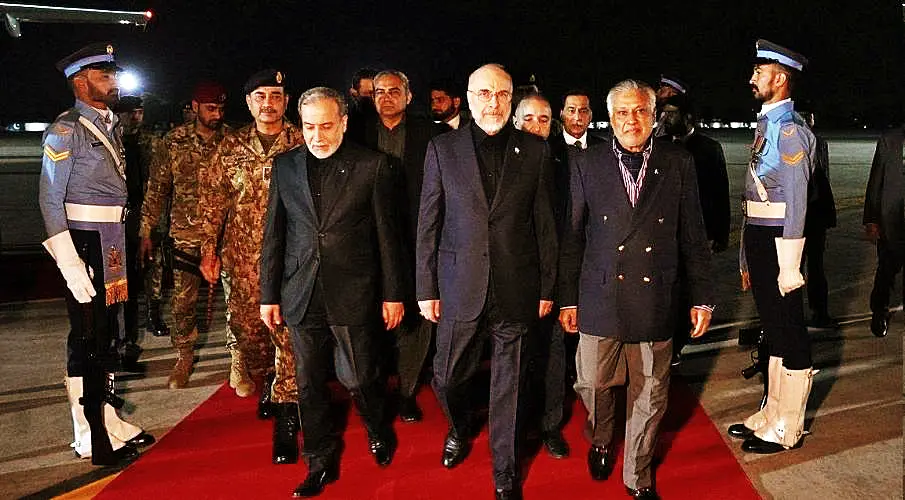
Islamabad – In Islamabad, talks are taking place today. For the first time since the beginning of the war on February 28, American and Iranian representatives are sitting – albeit indirectly – at one table. Vice President JD Vance traveled to Pakistan with Trump’s special envoy Steve Witkoff and Jared Kushner. On the Iranian side, Parliament Speaker Mohammad Bagher Ghalibaf is leading the delegation. Pakistan brought both sides to these negotiations, with Army Chief General Asim Munir said to have played a decisive role. Egyptian, Saudi, Chinese, and Qatari representatives are also in Islamabad – as quiet mediators in the background.

The mood on both sides is anything but relaxed. Iran’s Foreign Minister Abbas Araghchi said openly ahead of the talks that his country is entering them with deep mistrust – triggered by two attacks that took place in the middle of previous nuclear negotiations. His country would strike back if attacked. At the same time, Iran’s First Vice President Mohammad Reza Aref made clear under what condition a deal would be possible: if Washington actually pursued American interests and not Israel’s. His message was direct – there would be no agreement with representatives of “Israel first.”

The delegation from Iran – The Iranian side has put its conditions on the table. It wants compensation for the damage caused by the American-Israeli attacks, the release of frozen assets, a mechanism to open the Strait of Hormuz, and a tangible, lasting ceasefire – in Iran and across the entire region, which is to be understood as a reference to Iran’s allies. According to the Iranian delegation, these conditions were laid out in their meeting with Pakistan’s Prime Minister Shehbaz Sharif.
Pakistan’s Prime Minister Shehbaz Sharif received both sides. First the Iranian delegation under Ghalibaf, then the American delegation under Vance. Sharif’s office stated that Pakistan wants to continue acting as a mediator to help both sides make progress toward a lasting peace. That Pakistan of all countries is taking on this role is no coincidence – the country maintains functioning ties both to the Arab world and to the West, and it understands what further escalation would mean for the entire region.


The Serena Hotel in Islamabad is the central location of the talks
Saudi Arabia, meanwhile, is securing itself militarily. Pakistani forces along with fighter and support aircraft arrived on Saturday at King Abdulaziz Air Base – the very base that was repeatedly targeted with drones and missiles during the course of the war. The defense pact signed in September between the two countries defines an attack on one partner as an attack on both. Pakistan is thus standing militarily alongside Saudi Arabia – while at the same time sitting at the negotiating table as a neutral mediator. Both at once, without contradiction.
In Beirut, meanwhile, there are no negotiations, only rubble. Three days after Israeli strikes on a six-story residential building in the coastal district of Caracas, civil defense teams are using cranes to search for survivors. Six people were killed in that building, and a missing teenager is still believed to be under the debris. Najib Merhi, owner of a snack shop on the ground floor, said the attack shocked him – it had been a tourist district, a safe one, one that connected all social classes of the country. Israel had struck around 100 targets in Beirut and other parts of Lebanon on Wednesday, killing more than 300 people, including over 100 women and children.
At Europe’s airports, a different concern is growing. Olivier Jankovec, head of the airport association Airports Council International Europe, warned the EU in a letter of a systemic fuel shortage – within three weeks if the Strait of Hormuz remains blocked. That would hit the summer travel season and cause significant damage to the European economy. The EU stated there is no immediate threat to energy supply, but acknowledged that jet fuel remains the biggest concern.
In Tehran itself, people are sitting and waiting. It is a hope that has nothing to hold on to – except the silence after weeks of attacks, when even anger is too exhausted and all that remains is the simple wish for it to stop.
Updates – Kaizen News Brief
All current curated daily updates can be found in the Kaizen News Brief.
To the Kaizen News Brief In English


Iran’s Aussage „…Seine Botschaft war direkt – mit Vertretern von „Israel first“ werde es keine Einigung geben…“ spricht Bände.
Ohne Israel bleibt alles ein Pulverfass!
Wahrscheinlich „appeliert“ Iran an Trumps Obsessions Deals zu machen.
Wohlwissend, dass Trump Verbündete dann schon mal schnell fallen lässt.
Damit wäre Israel komplett isoliert.
Irgendwie erscheint mir das gerade als plausibelste Strategie des Iran.
Ich fürchte nur, dass die Positionen der USA und des Irans so weit auseinander klaffen, dass nichts, aber auch gar nichts, dabei herauskommen wird und das Ganze noch weiter eskaliert. Mit dem Resultat dauerhaft hoher Ölpreise, einem Putin, der einen Dauerorgasmus haben dürfte aufgrund des unerwarteten Geldsegens für seine Kriegskasse und einer Ukraine, der die Luftabwehr ausgeht, weil Trump sie für seinen unsagbar dämlichen Krieg braucht. Der aktuell jeden Tag ne knappe Millarde Dollar kostet. Und gleichzeitig im Gesundeits-und Bildungswesen 10 Prozent eingespart werden sollen. Praise bei to Donald…..