
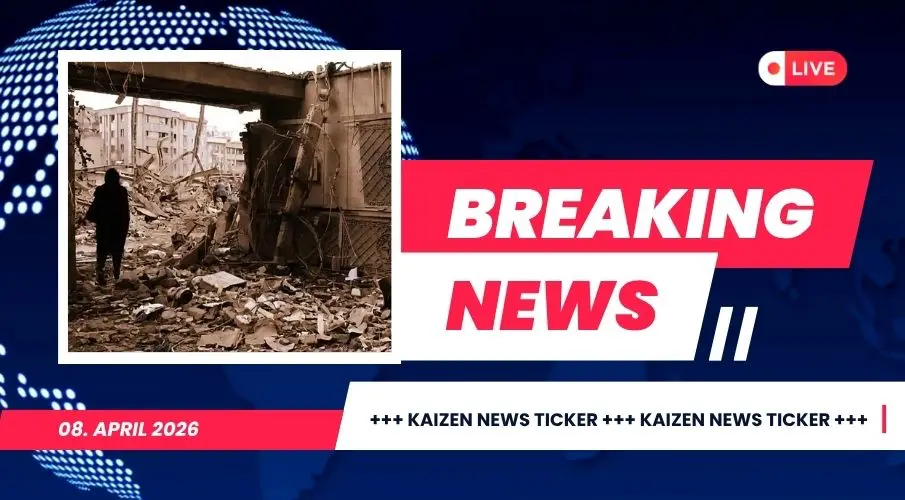
The war as parable!
Pete Hegseth stood in front of the cameras and drew a line. Good Friday, cave, resurrection. A downed pilot as a parable, the greatest of the Christian world as a frame for a military operation in the Iranian mountains. God is good, the man sent from the rock. Hegseth nodded as if he had been waiting for exactly that sentence.
He means it.
There are words one chooses because they land. Because they do something that sober language cannot. They lift the ordinary into another sphere, give it weight it would not have on its own. Hegseth knows that. He has thought in this language his entire life. What is new is the place from which he speaks it.
Not a pulpit. A briefing room in the Pentagon.
When the man who decides on bombs places war into the imagery of resurrection, something changes in the perception of what war is and what it is fought for. Doubt becomes heavier. Criticism suddenly sounds like something it should not be. Whoever questions the decision is no longer just questioning a strategy. He is questioning something that in this language already lies beyond strategy.
That is the silence that follows such sentences.
And in this silence, while Tehran burns and power plants stand on target maps, the word resurrection sounds strangely loud.
Tehran, Wednesday morning. The ceasefire holds. The anger too.
Hardly had the ceasefire been announced when pro government demonstrators took to the streets in Tehran. Not to celebrate. To burn. American and Israeli flags flared at dawn while the crowd shouted: Death to America, death to Israel, death to the compromisers. This last chant is the most revealing. Not the enemy outside was the target, but their own leadership that had given in. Organizers tried to calm the crowd. They did not stop. These are people who had prepared for a final, decisive fight, for something that in their imagination was bigger than a war - a final reckoning.
And then came a post from Washington and a post from Tehran, and suddenly the apocalypse had become a negotiation. For hardliners, this is not relief. It is a defeat that feels like betrayal. Ceasefires do not end wars. They only end the phase in which shooting happens. What comes after already carries the anger of the street within it.
The empty pedestals of Amsterdam

Menucha Latumaerissa found a book in a secondhand store in 2017. Inside: studies about skulls from the Moluccan archipelago in Indonesia, taken to the Netherlands during the colonial period, examined by researchers who believed they could draw conclusions about races from bones. Latumaerissa, 45, a Dutch customs officer with Moluccan roots, wondered whether these skulls were still somewhere in the Netherlands.
He searched. He found them in the Vrolik Museum, a small anatomical museum within the Amsterdam university medical center that has preserved jars with body parts, skeletons and skulls from around the world since the 19th century. The skulls from the Moluccas are now back on the archipelago. What remains are the metal stands on which they stood. Empty pedestals in display cases at the entrance of the museum, as part of an exhibition that runs until June 2027. Museum director Laurens de Rooy says the empty spaces are meant to remind people that these things happened. Europe has thousands of such remains in its collections. Skulls, skeletons, mummies, hair, teeth, collected in a time when colonial doctors believed human bones proved what they already thought they knew. The theories have long been disproven.
The bones are still there. The United States has had a law since 1990 that obliges institutions to return indigenous human remains. The European Union has no comparable framework. Each country, each museum decides at its own discretion. Steph Scholten from the International Council of Museums says the most important word in this process is rehumanization. To return what should never have been taken. To acknowledge that behind every skull stood a human being, not a piece of evidence.
Asia Pacific reacts - approval of the ceasefire, clear criticism of Trump

Governments in Asia and the Pacific welcome the announced ceasefire between the United States, Israel and Iran, but see it only as a first step. Australia speaks openly of necessary de escalation and emphasizes that this conflict has already gone too far. Prime Minister Anthony Albanese and Foreign Minister Penny Wong make it clear that the region has been pushing for exactly this moment for weeks. At the same time, they point to the consequences that are already being felt. The de facto blockade of the Strait of Hormuz, attacks on merchant ships and energy facilities have shaken supply and driven prices up worldwide. For many states, this is not only about politics, but about concrete stability in everyday life. Australia says it is working with partners to reopen the passage so that supply lines function and particularly vulnerable regions are not placed under further pressure.
Japan also evaluates the development positively, but remains cautious. The hope is directed at negotiations, not quick solutions. New Zealand strikes a similar tone and speaks of an important step that only gains meaning if it leads to a lasting ceasefire. At the same time, criticism of the language from Washington is growing. Albanese calls Trump’s threat that an entire civilization could be wiped out clearly inappropriate. Such statements not only create unrest, they also raise the question of how far political rhetoric may go in an already escalating situation. Australia emphasizes that every military step must remain bound to international law and that the protection of the civilian population is the highest priority. Approval of the ceasefire, but no all clear. The region is watching closely because it knows that two weeks pass quickly.
Cyberattacks instead of rockets - Iran hits US infrastructure in the shadow of war

While bombs fall, a second attack runs invisibly in the background. Iran linked hackers have hit several industrial facilities in the United States in recent weeks, including oil, gas and water systems. This is not about isolated disruptions, but about targeted interference in processes that are actually meant to protect people. Facilities had to be shut down, processes suddenly continued manually. Loss of time, costs, uncertainty. In some cases, attempts were made to completely delete data. Whether that succeeded is still unclear, but the intent is clear.
US authorities now openly warn of an ongoing campaign targeting critical infrastructure. The attack does not come with rockets, but through systems that are directly connected to the internet. That is exactly where the attackers start. Control units that coordinate machines in facilities become the entry point. Anyone who gets in there can not only stop processes, but change them. And that is what makes the situation dangerous. Because then it is no longer just about outages, but about real damage.
The strategy behind it is clear. Iran cannot hit the United States directly militarily, so the pressure is shifted. Cyberattacks become the response to airstrikes. At the same time, the incidents show a known problem. Many operators have secured their systems, others have not. The gap is there, and it is being used. At the same time, the impact is amplified online. Successes are exaggerated, damage is portrayed as larger than it is. It is not only about technology, but also about effect. A conflict that has long no longer takes place only on the battlefield.
EU falls behind - TikTok review ongoing, election approaching

While Hungary approaches an election, unrest is growing in Brussels. The accusation is clear: The European Commission is too slow when it comes to possible influence via social media. The focus is on TikTok. An investigation has been ongoing for months, but concrete results are still missing. That is exactly what is causing growing criticism. At the same time, indications are increasing that disinformation and manipulated content could again play a role.
The view turns back to Romania. There, an election was halted after allegations of Russian influence. TikTok played a central role. Content spread quickly, candidates were visibly pushed forward. This exact scenario is now being discussed. Hungary is considered particularly vulnerable, also because of the political line of the government. The rules are actually clear. Large platforms must identify risks and act against them. Label accounts with foreign control, make data accessible, make manipulation visible. But that is exactly where the problem lies. Much is based on cooperation. And that is not guaranteed.
Criticism is not only coming from politics. Experts also warn that time is the decisive factor. Algorithms work immediately, procedures do not. If measures take effect too late, the influence has already happened. At the same time, much remains unclear. The Commission provides little insight into the status of the investigation. This creates a gap between claim and reality. The election is approaching, the open questions remain. Whether existing measures are sufficient will not be shown in papers, but in the result.
Ust Luga hit again - attacks visibly impact Russia’s oil flow

The Russian Baltic Sea port of Ust Luga has again become the target of a Ukrainian drone attack. The attack was confirmed on April 7 and continued through the night into the morning. Regional authorities speak of intercepted drones, while Ukrainian sources confirm the attack and name specific targets in the port. The focus was on a terminal connected to the state pipeline operator. Initial information suggests that several oil tanks were hit.
The impact is already measurable. Over the course of weeks, the port has been repeatedly attacked. A total of six attacks within two weeks have visibly damaged the infrastructure. According to assessments from open source intelligence, large parts of the storage capacity could be affected. Operations at times came almost to a standstill. Only shortly before, the loading of crude oil had resumed. At the same time, the political tone is intensifying. Moscow accuses the Baltic states of enabling Ukrainian drones to pass through their airspace. Clear warnings followed from the Foreign Ministry. A direct response has not yet occurred, while the next attack has already become reality.
Auch innerhalb Russlands wächst der Druck. Militärnahe Blogger reagieren zunehmend spöttisch auf offizielle Verlautbarungen. Die Differenz zwischen Ankündigungen und tatsächlichen Entwicklungen wird sichtbar. Strategisch trifft die Serie von Angriffen einen empfindlichen Punkt. Die Exportkapazität für russisches Öl ist bereits deutlich gesunken. Schätzungen gehen von rund einem Fünftel aus. Damit wird klar, dass diese Angriffe nicht nur symbolisch sind, sondern direkte wirtschaftliche Folgen haben.


Die Evangelikalen werden mit Hegseths Aussage seelig sein.
Für sie ist es eine Art Kreuzzug.
Trump ist der Gesalbte, jegliche Kritik ist Blasphemie und Gott per se in Frage stellen.
Was für eine bigotte und scheinheilige Sekte 🤬
…wahnsinn diese truppe, unvorstellbar was 2026 sich in den usa erreignet
Aufatmen kann man nicht.
Iran wird sich neu positionieren.
Selbst im Land gibt es deutliche Risse. Hardliner, Kompromiss-Bereitere und anti-Mullah.
Aber man darf die tiefe Skepsis der Iraner gegenüber Trump nicht unterschätzen.
Gerade well anstatt Hilfe Bomben fielen. Kinder, Frauen, Menschen die einfach nur ihren Alltag bewältigen wollten, sind gestorben.
Cyberangriffe sind auch eine Form des Krieges.
In den USA bröckelt es für Trump.
Aber nicht genug.
Jetzt mit der „Waffenruhe“ verstummt die Kritik der Republikaner und die der Demokraten wird leiser.
MAGA feiert ihren starken Präsidenten, der „den Iran komplett in die Knie gezwungen hat“.
Gleichzeitig wird das Internet mit Bildern und Kommentaren gegen Demokraten geflutet. Und die Trump-Hater ausgelacht.
Ob die 14 Tage etwas bringen?
Ich weiß es nicht.
Vielleicht eine Verschnaufpause, vielleicht mehr.
Was mir jedenfalls sofort aufgefallen ist, dass Trump das Statement sicher nicht selber geschrieben hat.
Es ist nicht wirklich sein Stil und zuviele „gerade“ Sätze.
Mal sehen, wann er wieder wütet.
Jetzt hat er aktuell Strafzölle auf Waffenlieferungen an den Iran angedroht 🙈🤣
Wie war das doch gleich mit den Strafzöllen …
👍
Die EU ist schon seit langem bequem und schwerfällig.
Ein Luxus aus der Vergangenheit, den wir uns jetzt nicht mehr leisten können.
Anstatt Wasserkopf der alles totdiskutiert ohne das etwas dabei heraus kommt, müssen Prozesse in der EU schneller und effiktiver gestaltet werden.
Sonst ist die EU gescheitert.😞
Denn all die unnötige Bürokratie und Regulierung an falschen Stellen, lässt die Unzufriedenheit gegenüber der EU wachsen.
Wasser auf den Mühlen der AfD und anderer Populisten.
neben einem umdenken bei der EU, müssen die strukturen hinterfragt werden
Danke für den Artikel über Amsterdam und die Gebeine.
Die Kolonialzeit ist ein ganz dunkles Kapitel in der Geschichte der Menscheit.
Und im Rahmen von unseren heutigen Erkenntnissen und Forschungen würde es sich für mich von selbst verstehen die Gebeine und auch Artefakte zurück zu geben.
Dafür braucht es doch kein Gesetz.
Mit der heutigen Technik kann man alles digitalisieren und ggf weiter forschen.
… gerne