
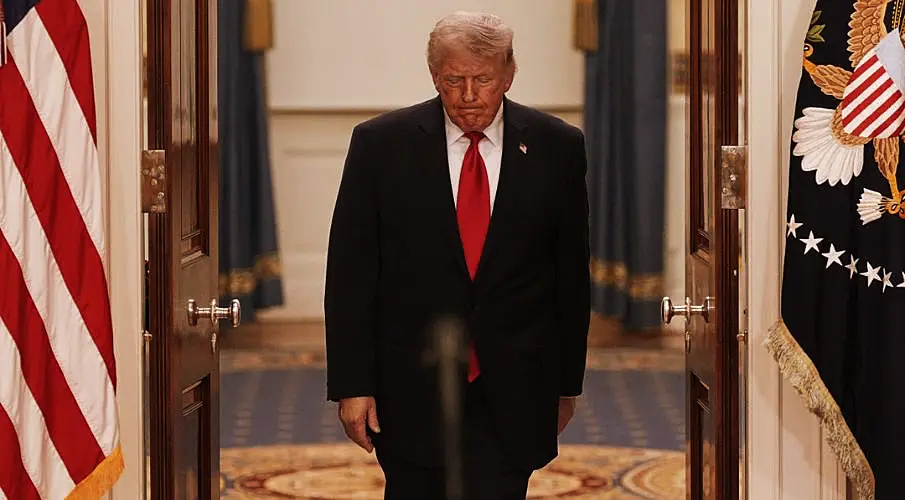
A president writes on Easter Sunday that another country will be living in hell if it does not comply, and adds at the end: Praise be to Allah. No diplomatic language, no attempt, it is the grammar of violence. It is a direct command tone, without any regard for the date on which it is spoken. The quiet certainty of what he says and what he does, because he believes no one will stop him. The day of resurrection becomes the language of inevitability.

Donald Trump crossed a line that morning that stands out even by his own standards. "Tuesday will be power plant day and bridge day at the same time in Iran. There will be nothing comparable. Open the damn strait, you crazy bastards, or you will be living in hell - just wait and see. Praise be to Allah," he writes. A sitting president naming civilian infrastructure as a target and placing religious language in the same sentence.
The reaction comes immediately. The Council on American Islamic Relations, a nationwide advocacy organization, sharply criticized Trump for invoking Allah in his Truth Social post while issuing threats against Iran. "President Trump’s outrageous mockery of Islam and his threats to attack civilian infrastructure in Iran are reckless, dangerous, and reflect an attitude that shows indifference toward human life and contempt for religious beliefs," CAIR said in a statement.
Trump had demanded in his post on Easter Sunday that Iran open the Strait of Hormuz by Tuesday, "or you will be living in hell - JUST WAIT AND SEE! Praise be to Allah."
"The casual use of 'Praise be to Allah' in the context of violent threats shows a disturbing willingness to instrumentalize religious language while at the same time demeaning Islam and its followers," CAIR said.
Iran sees in Trump’s threats against infrastructure an "intent to commit war crimes"

Hours after Trump’s profanity filled post, in which he told Iran it would be "living in hell" because of the blockade of the Strait of Hormuz, the Iranian UN mission said that the open threats against civilian infrastructure were "a direct and public incitement to terrorize civilians and clear evidence of the intent to commit a war crime."
"The international community and all states have legal obligations to prevent such heinous war crimes," the mission wrote in a post on the platform X. "They must act now. Tomorrow is too late."
At the same time, a second pressure is emerging, this time from within the United States itself. Within a few hours, the 25th Amendment becomes a trend. An instrument that is rarely mentioned, suddenly everywhere. Mehdi Hasan writes that this Easter message must lead the vice president and cabinet to remove the president. Chris Murphy goes further and says he would contact constitutional lawyers that very day. Joe Walsh calls for its immediate use. Anthony Scaramucci reminds that a mechanism was created precisely for such situations to remove a president who is no longer capable of governing.
Senator (Chris Murphy) raised the possibility of the 25th Amendment after the crude Iran war post
Even from his own political camp, unusually sharp tones are emerging. Marjorie Taylor Greene, long one of his loudest supporters, speaks of the need to intervene in Trump’s madness and openly states that he has gone insane and that everyone around him shares responsibility. S.V. Dáte responds briefly that this is exactly the domain of the 25th Amendment.
This amendment is not a political toy. It allows the vice president and a majority of the cabinet to determine that the president is no longer able to carry out his duties. At that moment, JD Vance would assume the powers of the office. It is an instrument for exceptional cases. For situations in which a president is no longer controllable.
Trump himself joked about it just a few weeks ago. At a press conference on March 26, he said that if he revealed his plans, he would probably be removed quickly. Then he himself asked for the name of the procedure and answered it immediately. They would use the 25th Amendment. He laughed while saying it. Next to him stood Pete Hegseth and laughed along.
Two weeks later, the joke has become a seriously discussed scenario.
While this debate is unfolding, the political base is also shifting. A poll by Economist and YouGov shows that only 14 percent of Americans support the deployment of ground troops in Iran, while 62 percent are against it. 24 percent are undecided. That is not a stable base of support for a war that is expanding. Within the Republican Party, there are conflicting signals, and even allies warn that this course could fracture their own base.
At the same time, intelligence services confirm behind the scenes that Iran is not as weakened as it is portrayed by the White House. The reality on the ground and the portrayal from Washington are diverging. This is not a new approach, but it becomes dangerous when decisions follow that can no longer be reversed.
The combination is decisive. A president publicly naming civilian targets. A growing domestic counter movement that questions his ability to govern. A war that is expanding while support for it is declining. And a constitution that provides a way out precisely for such moments.
Tuesday is the deadline that Trump himself has set.
The silence before a sentence that has already been spoken. And this time, it is not only about what happens next in Iran.
Updates – Kaizen News Brief
All current curated daily updates can be found in the Kaizen News Brief.
To the Kaizen News Brief In English


Vielleicht werden wir eines Tages aufwachen und die Welt ist von Trump befreit! Was danach kommt, kann nicht schlimmer sein.
Vielen Dank für Eure Recherche, wie immer gnadenlos ehrlich.
…das wäre was, ein feiertag. – vielen dank
Ich bin mir nicht sicher, ob es nicht doch noch schlimmer kommen kann – Vance trau ich auch für keine 5 Cent
Vance ist noch bedeutend schlimmer, auch wenn er sich aus dem Iran Krieg zurück zieht, oder gerade deswegen, wird er in den Umfragen steigen. Seine Politik gegen Amerika wird noch härter sein als die von Trump.
Die einzige echte Alternative wäre das Absetzen aller Regierungsmitglieder, die sich nicht explizit gegen dieses Scenario gewandt haben. Ein JDV wäre der Schritt vom Blizzard ins Gewitter. Klar, die Reps würden ihre Gallionsfigur verlieren, auf der die ganze Strategie aufgebaut ist. Und JDV hat sicher nicht den gleichen Rückhalt wie DT. Diesem Wendehals fehlt schlicht das Rattenfänger-Charisma. Aber an Bösartigkeit scheint er seinem Gönner in nichts nachzustehen. Ebensowenig Hegseth. Bleiben sie und ihre Brüder im Geiste, bleibt auch die Kriegstreiberei und das politische Chaos, eine fortgesetzte Kakophonie der Inkompetenz. orchestriert von einer Dilettanten-Riege. Es wäre mit Sicherheit nur ein persistierendes Bereicherungs-Kollektiv, vielleicht mit ein paar neuen Claqueuren. Ein Sinneswandel wäre kaum zu erwarten. Es wäre wie nach dem Dritten Reich: Plötzlich wollen alle entweder nichts gewusst haben oder eigentlich dagegen gewesen sein oder seien nur opportunistische Mitläufer gewesen. Den Wahnsinnigen des Amtes entheben wäre ein Anfang. Eine Lösung wäre es nur, wenn die ganze Regierung des Amtes enthoben würde und Neuwahlen stattfänden. Die Mitglieder der jetzigen Regierung haben DT als Sugardaddy. Sie machen all das möglich. Ansonsten wäre das alles nicht passiert.
Dem ist nichts hinzu zu fügen.👍
Das laute Schweigen Europas und der NATO spricht auch Bände.
All das, was Ihr in Bezug auf Völkerrecht und Menschenrecht recherchiert habt, sollte auf den Tischen der Staatsmänner der Welt liegen.
Jeder Staat müsste klar und deutlich intervenieren und Schritte gegen die USA auf den Weg bringen.
Aber ich höre nur Schweigen, lautes Schweigen.
Der 25. Amendment wäre wirklich an Dr Zeit.
Nur leider würde man damit nur den komplett Durchgeknallten beseitigen.
Die Strippenzieher wie Miller und Co bleiben.
Vance ist nur eine Marionette von denen.
Aber Vance hat kein Charisma… Vielleicht würde dadurch endlich was vom MAGA Kult Brickell.
So oder so, wenn da nicht alle entfernt werden, wird es genau so irre weiter gehen.