
For ten years, American soldiers and Iraqi militiamen fought shoulder to shoulder, in Mosul, in the cities that the so-called Islamic State had taken, and now the Americans are bombing those same men in Anbar province, killing at least 15 of them, and Washington calls them terrorists and Baghdad calls them soldiers of the national army, and both are right, which makes the situation what it is, namely unsolvable.

Footage from the south of Iraq. Shiite militias, armed, organized, their flags and religious symbols openly carried like an answer to a question no one asked. The weaponry is heavy, the presence is not hidden, they are there and they want it to be known.
The Popular Mobilization Forces, in Arabic Hashd al-Shaabi, have officially been part of the Iraqi armed forces since 2016, they receive salaries from the state budget, ranks, pensions, medical care in military hospitals, around 3.5 billion dollars annually from Baghdad, and at the same time an additional estimated eight to eleven billion through business activities, legal and illegal, construction, logistics, agriculture as well as money laundering structures of individual factions such as Kataib Hizballah or Asaib Ahl al-Haq, which are accused of close ties to the Iranian Revolutionary Guard Corps, which is why the conglomerate Muhandis General Company founded by Kataib Hizballah has long been under American sanctions, just like the commander of the Popular Mobilization Forces Falih al-Fayyad, whom the United States accuses of serious human rights violations.

On April 2, an Iraqi convoy reached Iran, around 500 people were involved. On site, it became clear that more food and smaller aid goods were transported than weapons. The vehicles drove visibly with Iraqi flags, a clear political signal: Iraq stands - at least in parts - on the side of Iran. At the same time, these images are also staging, made for the public and for effect. Groups like Hashd al-Shaabi deliberately present themselves as part of state structures.
This story has a long history, after the American invasion in 2003 and the subsequent civil war, the US dissolved the Iraqi army, the state became weak and fragmented, every village, every neighborhood had its own militia, the Americans funded Sunni groups under the name Sons of Iraq against al-Qaeda, Iran funded Shiite groups against American influence, and when the so-called Islamic State swept across Iraq in 2014, Ayatollah Ali al-Sistani, the highest Shiite cleric in the country, called on his followers to defend, tens of thousands followed, the Popular Mobilization Forces emerged, and in 2016 they fought together with the Americans in Mosul, practically as a single unit.

Prime Minister Mohammed Shia al-Sudani cannot today order these forces to stop attacks on American facilities, not because he does not want to, but because he knows his order would be ignored, by the largest and most capable groups for sure, Iran compensates every loss, financially and politically, and the groups enjoy support among the Shiite majority population, sit in parliament, are considered the heroes who defeated the so-called Islamic State, any attempt to dissolve them risks a new civil war.
So al-Sudani did something else, the Iraqi National Security Council published an order on March 25 that allows army units to return fire without consultation if they are attacked, without naming who might attack these units, but the mention of aircraft and drones leaves no doubt, only one side uses combat aircraft against Iraqi territory, this is a demonstrative gesture toward a largely anti-American population, nothing more, because the Popular Mobilization Forces have no air defense that could counter modern American air power.

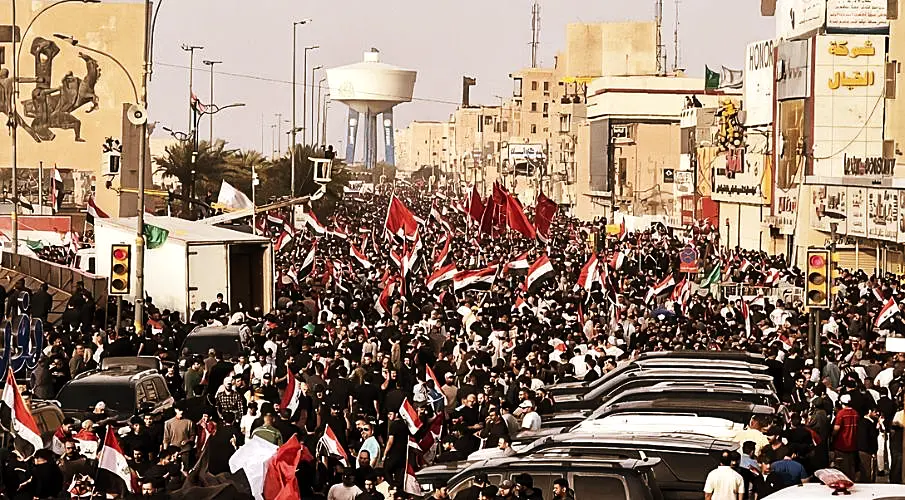
Thousands gathered in Tahrir Square in Baghdad and protest the US Israeli attacks against Iran, Iraq and Lebanon
What al-Sudani really wants is for the Americans to leave, Baghdad and Washington had already agreed on a withdrawal plan, the last American soldier was supposed to leave in the fall of 2026, now the prime minister is pushing for acceleration, and he emphasizes that the remaining American troops are in any case only stationed in Iraqi Kurdistan, a region over which Baghdad has little control, while NATO forces have already withdrawn, to Italy, which makes the situation even clearer.

Footage from the south of Iraq. Shiite militias, armed, organized, their flags and religious symbols openly carried like an answer to a question no one asked. The weaponry is heavy, the presence is not hidden, they are there and they want it to be known.
The groups close to Iran want something else, they do not want to get rid of the Americans through negotiations, but through escalation, rocket and drone attacks on American facilities, in the hope that massive counterstrikes will draw other parts of the armed forces into the conflict and turn a local exchange into a national war, which would be favorable for Iran because it would divert American attention and resources to another theater.

Fighters of Hashd al-Shaabi - Iraqi Shiite militias - have arrived in large numbers in Iran to support the regime. The white flag shows the official emblem of Hashd al-Shaabi, the umbrella organization of Shiite militias in Iraq. The scope and the exact role are disputed. Research on site showed that the numbers are significantly lower than reported. The figures of nearly 5,000 fighters mentioned by intelligence services and media are far from reality. They primarily serve political amplification. According to our research, the actual number is significantly lower, we currently assume at most around 1,500. The often mentioned "60 buses" have also not been confirmed so far - a movement of this magnitude would hardly go unnoticed.
This will probably not happen, the US is relying on targeted strikes against leadership structures of the most radical groups, without pushing the situation so far that full escalation becomes unavoidable, and this third American Iraqi confrontation will likely remain what it is, a low intensity conflict, drones against drones, statements against statements, until the Americans withdraw again, as both times before, and Iraq is left behind with an army in which men serve who at the same time fight for another state, and with a government that knows this and can do nothing about it.
Updates – Kaizen News Brief
All current curated daily updates can be found in the Kaizen News Brief.
To the Kaizen News Brief In English


Das ist höchst interessant.
Ehrlich gesagt waren mir diese Zusammenhänge nicht bewusst.
Danke für den Bericht.
gerne und vielen dank