
Donald Trump stood on Wednesday, April 1, in the Cross Hall of the White House and addressed the nation. It was his first live address since the beginning of the war, five weeks after the first strike. He said the United States had defeated Iran and completely decimated it - militarily, economically, in every respect. Iran’s radar was one hundred percent destroyed. America was unstoppable as a military power. He spoke with the calm of a man convinced that reality is listening to him.

See also our article: Trump speaks for 19 minutes about a war he cannot explain
Two days later, an American fighter jet was shot down over Iran. A second aircraft was hit by Iranian air defense. Trump had said just days earlier that Iran no longer had any air defense.

This is how this war is unfolding in its sixth week. The president speaks, and reality responds with different messages - silent, without comment, but unmistakable.
On Saturday, the Bushehr nuclear power plant was attacked for the fourth time. A guard was killed, an auxiliary building was damaged. The International Atomic Energy Agency reported no increased radiation levels. The plant, operated with Russian uranium and Russian technicians, lies 750 kilometers south of Tehran - closer to the coasts of the Gulf than to the Iranian capital. Iran’s Foreign Minister Abbas Araghchi wrote that radioactive fallout from further attacks would not affect Tehran, but the capitals of the surrounding Gulf states. It was not a warning to his own population. It was a warning to Iran’s neighbors, who have so far mainly appeared as victims of Iranian missiles.

The Bushehr nuclear power plant - an auxiliary building is hit. The strikes resemble a dance on the razor’s edge
At the same time, an airstrike hit the petrochemical special zone of Mahshahr in Khuzestan, another struck a facility of the Iranian Ministry of Agriculture in Mehran. The United Arab Emirates reported 23 ballistic missiles and 56 drones from Iran on that Saturday - one of the highest daily totals since the start of the war. Bahrain counted eight drone attacks in the last 24 hours, since February 28 a total of 188 missiles and 453 drones against the small island kingdom that hosts the US Navy’s Fifth Fleet. Debris from intercepted projectiles damaged buildings in Abu Dhabi, six people were injured. Aluminum plant Alba in Bahrain hit, two employees lightly injured. The Emirates Global Aluminium plant in Abu Dhabi reported significant damage.
Iran’s Parliament Speaker Mohammad Bagher Qalibaf posed a question on social media on Friday that was not a question. He asked how heavily trafficked the Bab el-Mandeb strait is. The passage connects the Red Sea with the Gulf of Aden - one tenth of the world’s seaborne oil and a quarter of all container ships pass through it daily. The Houthis from Yemen, who have already fired a missile at Israel and declared their entry into the war, control the coast on the Yemeni side of this strait. If Bab el-Mandeb were to be closed while the Strait of Hormuz is already largely shut, two of the most important sea lanes in the world would be under fire at the same time. What that would mean for the global economy does not need to be explained. Qalibaf did not explain it either. He only asked.
Trump responds to this situation the way he always does - with self-assurance that allows no doubt and knows no correction. He has asked seven countries to help him secure the Strait of Hormuz. Most are waiting. French President Emmanuel Macron said this week that the United States can hardly complain about not being supported in an operation it began alone. British Prime Minister Keir Starmer continues to refuse to be drawn into the war. NATO Secretary General Mark Rutte spoke of 35 countries discussing a coordinated protection mission for the strait - but after the war, not now.
Trump threatened this week to withdraw from NATO. Senate Majority Leader John Thune, Republican from South Dakota, said dryly that there is no majority for that in the Senate. “We need allies,” Thune said. John Bolton, once Trump’s national security adviser and long since his opponent, said that anyone who does not build a coalition before the war will not be able to assemble one during the war. Julian Zelizer, history professor at Princeton, put it this way: one can be the most aggressive president in the world - but one does not control what happens abroad.
Trump himself said at an Easter dinner in the White House, in front of cabinet members and clergy, that he is such a great king that he cannot even get a ballroom approved. Those present laughed. Trump laughed too.
“They are calling me KING now, can you believe it? No king. I am so much of a king that I cannot even get a ballroom approved!” If I were a king, we would be doing much more!”
Italy’s Prime Minister Giorgia Meloni was this week the first head of government of an EU, G20, and NATO country to visit the Gulf since the start of the war. The beginning of her trip was not announced for security reasons. In Saudi Arabia, she spoke with Crown Prince Mohammed bin Salman about military defensive assistance that Italy is providing against Iranian attacks - her office did not name details. In Qatar, she met Emir Sheikh Tamim bin Hamad Al-Thani and assured that Italy would contribute to restoring the country’s energy infrastructure damaged by Iranian bombs. Qatar’s gas production is considered critical for global energy supply. Austria’s Foreign Minister Beate Meinl-Reisinger spoke on Saturday with Araghchi and emphasized the humanitarian importance of reopening the Strait of Hormuz - for food deliveries, for fertilizers, for the supply of countries that have nothing to do with the war and still bear its consequences.
Five European finance ministers - from Spain, Germany, Italy, and Portugal - called in a joint letter for an EU-wide special tax on the profits of energy companies benefiting from the war while households are strained by rising prices.
In Islamabad, Pakistan, Turkey, and Egypt continue working on a compromise proposal intended to bring Washington and Tehran to the table. Pakistan’s Prime Minister Shehbaz Sharif spoke in the past week with at least twenty heads of state and spoke for more than an hour on Saturday with Iranian President Masoud Pezeshkian. Two regional diplomats said the plan, not yet finalized, envisions a temporary cessation of hostilities to create diplomatic space. Araghchi reaffirmed on Saturday Iran’s willingness to hold talks in Pakistan - but only on the condition of a final and permanent end to the war. When or whether these talks will take place, no one knows.

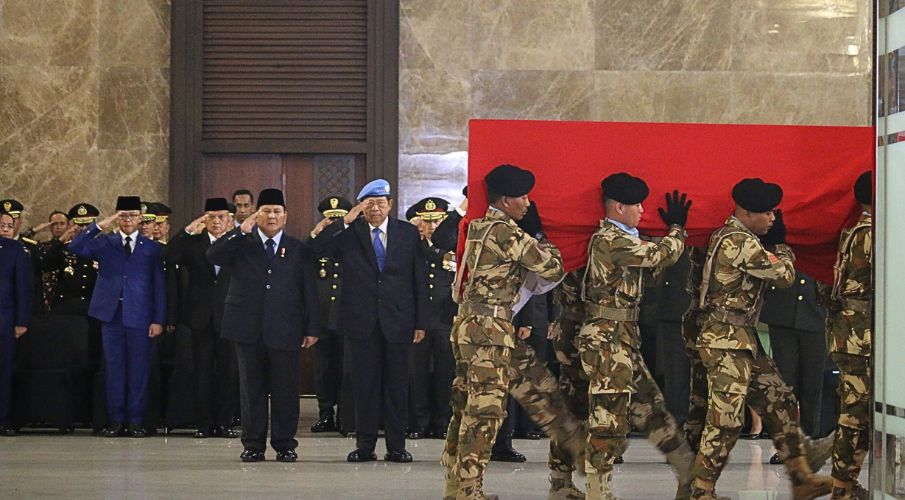
In Jakarta, three coffins arrived on Saturday evening. Three Indonesian UN peacekeepers, killed in an Israeli attack in southern Lebanon during an escort for UN operations. The coffins were covered in Indonesia’s red and white national flag. President Prabowo Subianto received them personally at Soekarno-Hatta Airport, bowed his head, remained silent. Women pressed their foreheads against the flags, their tears breaking the silence of the military ceremony. Jakarta has officially condemned the Israeli attacks in southern Lebanon.
Iran’s government is now also taking action against Iranians abroad. Activists report that family members in Iran are being arrested and threatened with confiscation of property - to silence people in exile who report on the situation in the country. The internet has been largely shut down for weeks, the human rights situation in the country in the dark.
Azerbaijan sent ten trucks with 200 tons of food, medicines, and medical supplies to Iran on Saturday. President Ilham Aliyev wrote that both countries stand by each other - in good times as in bad.
“We have won this war … We literally have planes flying over Tehran and other parts of their country - they can do absolutely nothing about it.” (Whether the term “unfortunate statement” still does justice to this is something we doubt - editorial note)
Somewhere over the Gulf, in the days after Trump’s victory speech, an American aircraft flew into Iranian airspace. It did not return. Iran, which according to Trump no longer has radar or air defense, had shot it down.
The war continues, and in between Abolfazl Dehnavi dies - Red Crescent worker, killed on Saturday in Isfahan province in an airstrike. He is the fourth aid worker to lose his life in this war. Whether he was on duty is still unclear. It changes nothing. In Ramat Gan, Givat’aim, Bnei Brak, and Petach Tikva, Iranian missiles struck residential areas. A 52-year-old man was injured. A paramedic described the scene: destruction, fire, shards on the ground, a lot of smoke. A burning car, a collapsed building, debris in the street.
India’s Ministry of External Affairs meanwhile confirmed the purchase of Iranian oil - made possible by the temporary suspension of American sanctions until April 19. Washington eases sanctions on the oil of a country it is simultaneously bombing. The logic of this war does not follow a straight line.

Turkish President Recep Tayyip Erdogan spoke on Saturday with NATO Secretary General Mark Rutte and said the situation in Iran is heading toward a geopolitical dead end. In Islamabad, Pakistan’s Foreign Ministry spokesperson Tahir Andrabi says the mediation efforts for a ceasefire are on track. Araghchi reaffirmed Iran’s willingness to hold talks. Pakistan’s Foreign Minister Ishaq Dar wrote to Araghchi on X: “I greatly appreciate your clarification, my dear brother.” The war continues. Diplomacy does as well - somewhere in between, still without result.
The war goes on. Trump speaks of completion. And the world waits for Islamabad.
Updates – Kaizen News Brief
All current curated daily updates can be found in the Kaizen News Brief.
To the Kaizen News Brief In English


Wie oft hat Trump den Krieg schon als gewonnen und beendet deklariert?
4 oder 5 Mal?
Trotzdem flogen Bomben, Raketen.
Wurden Lebensgrundlagen zerstört.
Menschen verloren ihr Leben.
Ich wage zu bezweifeln, dass der Iran sich in Bezug auf mögliche Atomwaffen bereit erklärt diese nicht zu bauen.
Und/Oder seine Uranvorräte zu reduzieren.
Ein Nichtangriffspakt ist heutzutage nicht das Papier wert, auf dem es steht.
Das zeigt leider die Vergangenheit 😞
Iran hat mit der Stasse von Hormus einen mächtigen Hebel.
Ich weiß nicht ob all die Gespräche zu einem positive Ergebnis führen.
Dazumal in Keines Israel eingebunden ist.
Auch die USA wird nur wenig beteiligt.
Aber die zwei Länder haben den Krieg begonnen, die Zündschnur angezündet.
Danke für diesen guten und detaillierten Bericht.