
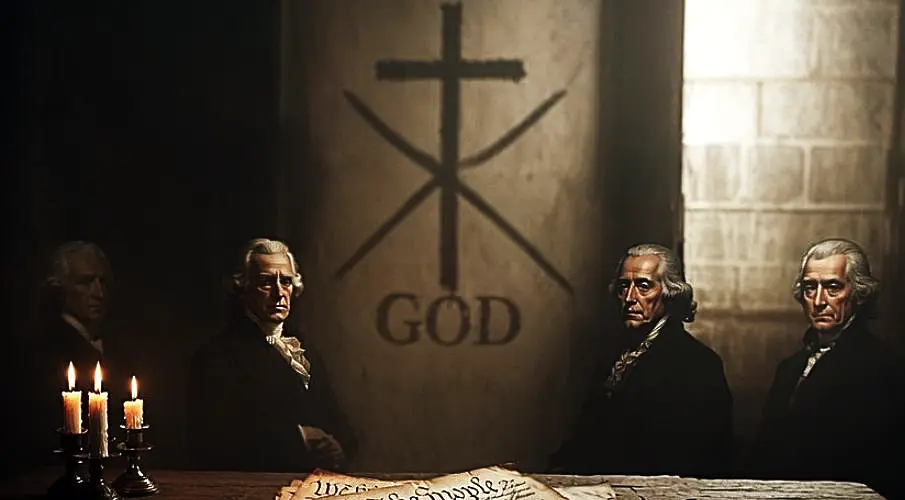
Karoline Leavitt, Press Secretary of the White House, said on March 30 at a press conference that America was founded 250 years ago “on Judeo-Christian values.” It is a sentence one often hears in Washington. It sounds self-evident. It is not.
The Founding Fathers of the United States came from a Christian nation - Great Britain, controlled by the Protestant Church of England, shaped by centuries of bloody religious wars between different Christian factions. That is precisely why they wanted to build something different. Thomas Jefferson, James Madison, George Washington, Benjamin Franklin - they were all deeply influenced by the European Enlightenment, which placed reason above revelation and regarded religious authority with skepticism. Some described themselves culturally as Christians. Others adhered to Deism - the belief in a creator who created the world and then no longer intervenes. It is therefore no surprise that Jefferson compiled his own Bible, from which he cut out the Old Testament, all miracles, all supernatural elements, and even the resurrection of Jesus. What remained was morality. Not faith.

The founding documents themselves speak a clear language. The United States Constitution contains not a single reference to God or Christianity - not one. Its only mention of religion is found in Article VI, which explicitly prohibits religious tests for public office - at the time a radical break with European practices. The First Amendment prevents any establishment of religion by the state and at the same time protects the free exercise of all beliefs. It was not about promoting religion. It was about keeping the state away from it - and it away from the state.
In the Treaty of Tripoli, ratified unanimously by the Senate in 1797 and signed by President John Adams, it is stated in black and white: “The Government of the United States of America is not in any sense founded on the Christian religion.” This is not a marginal remark. This is a ratified document of the early republic.

The Declaration of Independence, which uses language such as “endowed by their Creator,” is also not a Christian document. The philosopher John Locke, whose influence on Jefferson is well documented, argued that natural rights - life, liberty, property - come from a higher source than government and therefore cannot be taken away by any ruler. Invoking the “Creator” was a philosophical move, not a religious confession. The Declaration speaks of “Nature’s God,” of a “Creator,” of a “Supreme Judge,” and of “divine Providence” - nowhere of Jesus Christ, nowhere of the Bible, nowhere of a specifically Christian doctrine. This language was deliberately broad enough to include orthodox Christians, Deists, and all others who believed in some form of higher power.
The term “Judeo-Christian values” itself would have been completely foreign to the Founding Fathers. It simply did not exist in the political discourse of the 18th century. It only appeared in the 1930s and 1940s - initially as a response to the rising fascism in Europe. In the face of openly antisemitic National Socialism, American religious leaders and politicians began to emphasize commonalities between Christians and Jews in order to promote solidarity and counter the image of Jews as outsiders to Western civilization. After the Second World War, the term then became a tool in the Cold War - as a moral counter-model to the officially atheistic Soviet Union. During this period, “under God” was added to the Pledge of Allegiance in 1954 and “In God we trust” was declared the national motto in 1956. Both are often mistakenly regarded today as founding traditions.
The term “Judeo-Christian values” was originally intended as a unifying construct - broad enough to bring Protestants, Catholics, and Jews together under a shared cultural framework. In the late 20th century, however, it increasingly developed into a political instrument used to present certain moral and legal positions as historically rooted. What began as an attempt at inclusion became a tool of exclusion.

In the United States, there are more than 200 different Christian traditions, each with its own theology, its own interpretation of scripture, and its own understanding of how the Gospel should be lived. The most determined Christian nationalists believe that Catholics, Methodists, and many other Christians are not “true” Christians. When a single Christian current claims to define the nation, it threatens the religious freedom of other Christians just as much as that of all other Americans.
Religious influence on the culture and personal lives of many early Americans is undisputed. But cultural influence is not the same as constitutional foundation. Anyone who claims that America was founded as a Christian nation is not stating a historical truth - he is advocating for a concept of government that excludes those who do not share that belief. He retroactively transforms a secular constitutional system into a religious one - against the wording of the founding documents and against the intentions of many of their authors.
Leavitt’s sentence was short. The history behind it is not.
Updates – Kaizen News Brief
All current curated daily updates can be found in the Kaizen News Brief.
To the Kaizen News Brief In English


Danke für diesen Artikel! Kurz und knackig und unglaublich wichtig. Die Gründerväter der USA und auch die amerikanische Führung nach dem zweiten Weltkrieg waren tatsächlich noch fähig, in die Zukunft zu schauen und die Unzuverlässigkeit menschlicher Charaktere in ihre Überlegungen mit einzubeziehen.
Dankeschoen
Die Gründungsväter hatten bei Ihren Worten sicher auch im Blick, dass viele Einwanderer aus extremistischen Religionen stammten.
Die Puritaner, die Hexenverbrennungen aus Europa mit brachten.
Die Pilgrim, die Gott über alles stellten.
Solch eine Nation wollten die Gründungsväter nicht.
Religionsfreiheit ja, aber getrennt vom Staat.
Das hat auch lange recht gut funktioniert.
Aber die Evangelikalen bauten ihr Netzwerk in Politik und Wirtschaft aus.
Unbemerkt.
Jetzt wird das ganze Ausmaß sichtbar.
Die Gründerväter rotieren wahrscheinlich in ihren Gräbern.
Leavitt ist so gläubig, wie sie das Kreuz trägt.
Öffentlich ja, orivat verschwindet es …
Danke für diesen aufschlussreichen Artikel.
„In god we trust“ auf den Dollarscheinen und auch in vielen Gerichtssäalen war und ist ein großer Fehler.
Damit verschwimmt die Trennung von Staat und Religion.