
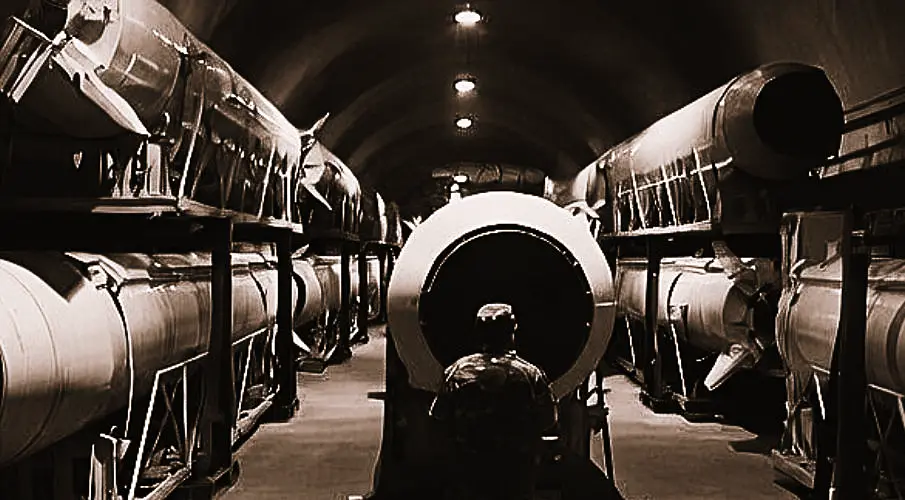
American and Israeli strikes hit underground facilities, hit silos, hit bunkers - and yet these very systems are available again just hours later. US intelligence reports that Iranian units uncover damaged missile positions, dig them out, repair them and put them back into operation. Bulldozers pull launchers out of buried shafts, launch systems are brought out of underground chambers, checked and redeployed. What appears destroyed from the air is often only temporarily disabled on the ground.

In Washington, a different picture is being presented at the same time. The Pentagon speaks of 11,000 targets struck in five weeks. Secretary of State Marco Rubio calls the weakening of Iran’s missile capability a central objective of this war. Defense Secretary Pete Hegseth points to declining numbers of attacks and says remaining missiles will be intercepted. That is more than just naive. From the White House it is said that attacks have decreased by 90 percent, large parts of the infrastructure have been damaged or destroyed, and air superiority clearly lies with the US and Israel.


Even their own intelligence agencies must now place a question mark behind it. Iran still possesses a relevant number of missiles and mobile launch systems. How many exactly, no one can say with certainty. Before the war, there were only rough estimates; today, the data is even more uncertain. Decoys further complicate the situation. It remains unclear which targets were actually destroyed and which merely served as deception. At the same time, systems are stored in bunkers and caves that are difficult to reach through airstrikes.
The strategy is visible. Fewer launches, but used more selectively. Instead of massive salvos, Iran fires smaller units. Around 20 missiles per day, often individually or in very small groups. In addition, dozens of drones are deployed daily, according to Western assessments between 50 and 100. The attacks have become less frequent, but they have not disappeared. Israel and other Gulf states continue to be hit.

Internal tensions within the Iranian leadership complicate coordinated large-scale attacks. At the same time, this very lack of unity ensures that structures operate more decentrally. Systems are distributed, concealed, and restored more quickly. The attempt to achieve a complete shutdown through airstrikes encounters a system designed for recovery. One point is decisive. Even damaged facilities do not lose their value permanently. A hit bunker is not a lost bunker. A buried launcher is not a destroyed launcher. The time between an attack and renewed operational capability shrinks to hours. This fundamentally changes the effect of these attacks.

The war thus becomes a rhythm of destruction and reconstruction. Every strike forces Iran to respond, but it does not end its ability to retaliate. As long as enough systems remain and as long as damaged infrastructure can be made usable again quickly, the threat persists.
Investigations are now drawing a picture. Between official representation and the actual military situation, a noticeable gap is emerging. Communication from Washington conveys an image that increasingly must be questioned. Europe’s dependence on American assessments has proven to be a structural problem - its own evaluations have often taken a back seat, without consistently questioning them itself. The official portrayal of steady progress thus stands alongside a reality in which the military effect does not develop linearly. Numbers appear clear. The situation is not.
Updates – Kaizen News Brief
All current curated daily updates can be found in the Kaizen News Brief.
To the Kaizen News Brief In English


Der Iran hatte sehr lange Zeit sich auf so einen Angriff vorzubereiten.
Israel und die USA haben das total unterschätzt, nicht auf Warnungen gehört.
Es warbklar, dass Iran sich nicht gleich ergeben wird.
Das war das Wunschdenken von Trump.
Weil er ja „immer bekommt, was er will“.
Hier nicht.
Iran kämpft.
Trump erklärt den Krieg für gewonnen und beendet.
Zum x. Mal.
Gleichzeitig wird (wieder mal) eine 48 Stunden Frist verhängt.
Die Welt schaut immer noch zu und handelt wenig 😞