
On the beach of Al Jeer in the United Arab Emirates, no more than 40 nautical miles from the Iranian coast, oil tankers, container ships and bulk carriers stretch as far as the eye can see - all still, all waiting. On the other side of the strait, the sea is empty. Only a handful of ships make it through the Strait of Hormuz each day, compared to more than a hundred before the war began. Those who get through take a detour through Iranian territorial waters and often pay a significant price to the regime. This is Iran’s greatest leverage in this war - and it works.

On Thursday, the CMA CGM Kribi, a French container ship under a Maltese flag, made the first known transit of a Western European-linked vessel since the start of the war. The ship left Dubai, passed through Iranian waters and was near Muscat on Friday. Greek ships have managed the passage sporadically, but for Western European vessels the Strait of Hormuz had effectively been closed until now. Why this particular ship was allowed through remains unclear.


20,000 seafarers have been stranded in the Persian Gulf region since the war began. The United Nations International Maritime Organization describes a situation without precedent in modern history - the last time so many seafarers were stranded in a war zone was during World War II. Damien Chevallier, head of the organization’s security division, reported at a UN conference that more than 20 attacks on ships in the strait had taken place, in which ten seafarers were killed and eight injured.
Kuwait was hit twice on Friday. First, the Ministry of Energy reported that an Iranian drone had damaged a power and water desalination plant. Emergency and technical teams were deployed, the overall grid continues to function. Then Kuwait’s state oil company Kuwait Petroleum reported that the Mina Al-Ahmadi refinery was struck by a drone and fires broke out in several operational units. There were no injuries. Saudi Arabia and the United Arab Emirates reported on the same day that they had intercepted drones and missiles.

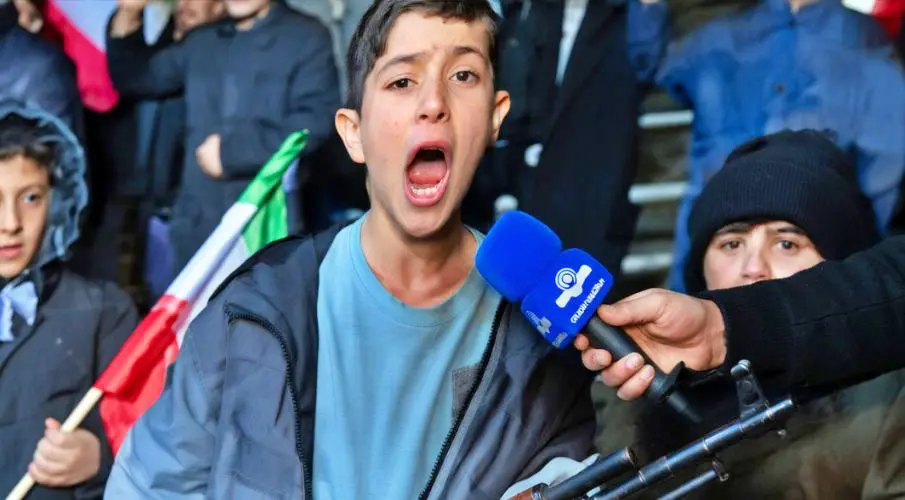
The Revolutionary Guards have launched an abhorrent recruitment campaign called “Homeland Defending Fighters for Iran,” which includes children as young as twelve. IRGC officer Rahim Nadali stated on state television that so many young people had demanded to be assigned to checkpoints that the minimum age had been set at twelve.
It is confirmed, and investigations also show, that children with weapons are supporting checkpoints. Amnesty International classifies the recruitment as a war crime under international law. This is not a new pattern - during the Iran-Iraq war of the 1980s, Iran, by its own account, deployed hundreds of thousands of child soldiers, of whom at least 36,000 were killed, and during the Syria war sent Afghan immigrant children to fight for the Assad regime. What is now happening at checkpoints in Iranian cities is the continuation of a history the country has been writing for decades.
Iran is meanwhile intensifying its preparations for a possible ground offensive. Around Kharg Island, Iran’s largest oil export port, defensive installations are being expanded. At the same time, Tehran is threatening to attack a broader range of targets in the Gulf region - and has launched a mass recruitment campaign that analysts say is reminiscent of the Iran-Iraq war of the 1980s. The Revolutionary Guards are accepting volunteers from the age of twelve. Trump has deployed thousands of Marines and airborne troops to the Middle East. He has not announced a ground war, but the troop movements give the United States more options - and Iran has taken note.

The Pasteur Institute in Tehran, founded in 1920 and one of Iran’s most important medical research institutions, was so heavily damaged in airstrikes on Thursday that it can no longer operate. WHO Director-General Tedros Adhanom Ghebreyesus stated that since March 1 more than 20 attacks on health facilities in Iran have been documented, in which at least nine people were killed, including an infectious disease specialist and a member of the Iranian Red Crescent. A U.S. official said America did not carry out this attack. Israel’s military stated it was not aware of any strike on the institute.
On Thursday, the U.S. military destroyed the B1 bridge connecting Tehran with the neighboring city of Karaj. A senior U.S. official confirmed the strike was part of a broader effort to disrupt military supply routes. Trump had previously posted a video of the collapsing bridge section and announced “much more.” Iranian authorities in the province of Alborz reported eight dead and 95 injured, as many people had gathered under the bridge and along the riverbank for the Sizdeh Bedar holiday.
See our article: Insights, bridges collapse, generals leave – and Trump’s sons sell drones
Foreign ministers from more than 40 nations met in London on Thursday to prepare talks on mine clearance in the Strait of Hormuz following a possible ceasefire. The USS Gerald R. Ford is returning to operations after completed repairs. The USS Abraham Lincoln continues to operate in the Arabian Sea. The USS George H. W. Bush left Norfolk on Wednesday bound for the Middle East.
Javad Zarif, former Iranian foreign minister and now a professor at the University of Tehran, published a peace plan in the journal Foreign Affairs. His proposal: Iran commits bindingly not to pursue nuclear weapons and dilutes its stockpile of enriched uranium. In return, the United States and its allies lift all sanctions, Iran participates freely again in the global market, the Strait of Hormuz is opened, Iranian oil can be traded without restriction. In addition, there is a mutual non-aggression pact, and Washington finances the reconstruction of war damage including compensation for civilians. Zarif acknowledged that parts of Iran favor continuing the war because they believe they hold the stronger position.
See:: How Iran Should End the War
Anyone who places children at checkpoints has stopped fighting a war - they are destroying themselves from within. And while Iran puts its youngest into uniform, the Strait of Hormuz remains closed. As long as it does, no outcome of this war is final - regardless of how many bridges collapse, how many refineries burn and how many seafarers wait.
Updates – Kaizen News Brief
All current curated daily updates can be found in the Kaizen News Brief.
To the Kaizen News Brief In English


Es ist einfach nur unendlich traurig. Zerstörung aktuell und die bleibenden Traumas bei diesen Kindern und Jugendsoldaten. Eine schwer geschädigte Nation auf Jahrzehnte. Und niemand ist scheints in der Lage oder gewillt die kriminelle Bande im Weissen Haus zur Rechenschaft zu ziehen.
… dem ist nichts mehr hinzuzufügen
Kinder… das ist einfach abscheulich.
Aber es folgt dem Muster von Terroregimen oder Warlords.
In Afrika werden 8-10 Jährige für Machtkämpfe eingesetzt.
In Russland werden Kinder schon in der Schule auf Militär gedrillt.
Iran steckt kleine Jungs in Uniformen, weil sie das angeblich wollen.
Jungs, die nicht ein bisschen ausgebildet sind und schlicht Kinder sind.😞
In Afghanistan wurde Jungs ausgenutzt um Sprengsätze direkt zu den Soldaten zu bringen.
Mit Sprengstoffgürteln.
Darauf vertrauend, dass die Soldaten erstmal nicht auf Kinder schießen.
Wie tief sinken Menschen?
Kinder die töten lernen sind traumatisiert für den Rest ihres Lebens.
Und damit auch anfällig für Radikalisierung.