
While Trump posted a video on his social media channel on Thursday showing a section of a bridge in Iran collapsing, writing “much more to come,” Iranian state authorities in the province of Alborz reported that the attack on the B1 bridge - still under construction and, according to Iranian claims, the highest bridge in the Middle East - killed eight people and injured 95 others. The injured had gathered under the bridge and along the riverbank for the Sizdeh Bedar picnic holiday. Trump wrote: “It is time for Iran to make a deal before it is too late and nothing remains of what could still become a great country.” Iran’s Foreign Minister Abbas Araghchi responded that destroying bridges “only conveys the defeat and the moral collapse of a disordered enemy.” Every bridge and every building would be rebuilt stronger. What would not recover, he said, was America’s reputation in the world.
It also raises the question of what exactly about the destruction of a bridge still under construction in the province of Alborz was militarily necessary. Our understanding is that the bridge had no verified operational function at the time of the attack. It neither served active traffic nor functioned as a confirmed military node. The immediate military benefit is therefore barely recognizable. What remains is the impression of a strike against future infrastructure - or against a symbol. Both raise questions that so far no one has answered convincingly.

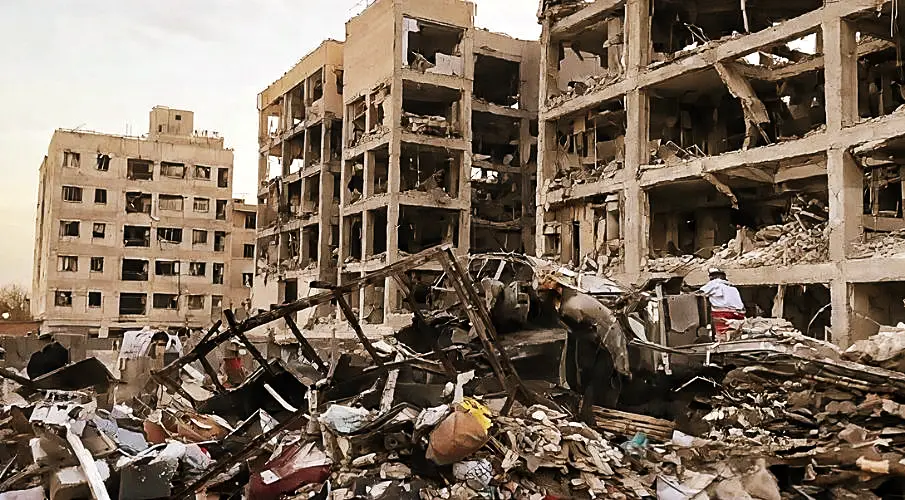
For nights, a steady, nervous hum hung over the city, a sound that settles over people’s heads and does not disappear even when it falls silent for seconds. Along the wide axes in the east, along the Resalat highway, dark scars cut through the sea of buildings. In the side streets branching off the main route, facades stand open as if torn apart. Window panes are missing, curtains hang in shreds outward as if pulled out by the wind. The asphalt is covered with shards, bent metal parts, remnants of air conditioning units ripped from the walls. Between parked, damaged cars, people move carefully, as if every step is still uncertain.

Toward the smaller cross streets, where workshops, small shops and simple residential houses stand close together, the picture becomes tighter, more oppressive. Shutters are half lowered, storefronts shattered, bricks, dust and broken glass lie on the sidewalks. In some entrances, faint lights still burn, generators are running because the power has failed. The smell of burned material hangs in the air, mixed with dust that settles over everything.

Further out, in the more industrial areas, the impacts are also visible. Facilities stand still, gates are bent, access roads blocked. At the same time, the residential area shows how close everything lies together: factories, institutes, homes. The damage therefore does not run in isolation through individual points, but appears like a network that has captured entire neighborhoods.

Against this background, Trump’s threat to bomb Iran “back to the Stone Age” appears less like strategy than like a sentence that misses the reality on the ground. Because what was hit were not only structures on maps, but streets, houses, places where people live.
Iraq is being hit particularly hard by the war. The country derives around 90 percent of its state budget from oil revenues, and most of it is exported through the Strait of Hormuz - which has been practically closed since the beginning of the war. In addition, there is a sharp decline in imported goods via southern seaports and a halt in cross-border traffic with Iran. Iran has pledged that Iraqi crude may pass through the strait. But because Iraq does not have its own tanker fleet and depends on chartered ships, it is ultimately the ship owners who decide - and most are not willing to take the risk.
On Thursday it became known that Defense Secretary Pete Hegseth had asked the highest-ranking uniformed officer of the U.S. Army, General Randy George, to resign. George assumed office as the 41st Army Chief in August 2023 under the Biden administration. He is a West Point graduate, an infantry officer with deployments in the First Gulf War, Iraq and Afghanistan, and served from 2021 to 2022 as the senior military advisor to Defense Secretary Lloyd Austin. The Pentagon gave no reason for his dismissal. Spokesman Sean Parnell only stated that George would be placed into retirement “with immediate effect.” It is the latest in a series of more than a dozen dismissals of high-ranking generals and admirals by Hegseth since taking office. George had survived the first wave of dismissals in February 2025, when Hegseth removed, among others, Vice Admiral Lisa Franchetti as Chief of Naval Operations and General Jim Slife as Deputy Air Force Chief. Trump had at that time also fired General Charles Brown as Chairman of the Joint Chiefs of Staff.
George’s successor as Vice Chief of Staff of the Army, General James Mingus, had also been removed early - after less than two years in office. Trump then nominated Lieutenant General Christopher LaNeve for the position, who until then had served as Hegseth’s top military advisor and had previously commanded the Eighth Army in South Korea - after less than a year in that role. LaNeve now assumes the position of Army Chief in an acting capacity. Two years ago, he was still a two-star general.
Dad gave us a war

The enrichment of the Trump family continues unchecked - without visible consequences, without serious oversight - and the question is increasingly unavoidable of how this conduct can still be adequately described.
While the war continues, Trump’s sons are doing business with it. Donald Trump Jr. and Eric Trump have been involved since last month in Powerus, a drone manufacturer based in Florida, founded by veterans of U.S. Army Special Operations. The company is currently conducting demonstrations of its defensive drone interception systems in several Gulf states - precisely those countries that are suffering from Iranian attacks and depend on the protection of the U.S. military commanded by their father. Powerus co-founder Brett Velicovich confirmed that his team is “currently conducting many demonstrations in the Middle East.” He declined to specify which countries.

Powerus is also seeking a share of 1.1 billion dollars that the Pentagon has allocated for building up U.S. drone production after the Trump administration banned imports of Chinese drones. The company has already raised 60 million dollars from investors and plans a merger with a publicly traded Trump company on the Nasdaq that owns several golf courses in Florida. Such a “reverse merger” allows a private company to go public quickly without undergoing the usual approval process.
Richard Painter, former chief White House ethics lawyer under George W. Bush, said: “These countries are under enormous pressure to buy from the president’s sons so that he does what they want.” It would be “the first presidential family to make a lot of money from a war - a war for which he did not obtain congressional approval.” Eric Trump stated upon request: “I am incredibly proud to invest in companies I believe in. Drones are clearly the future.”
The UN Security Council has scheduled a vote for Friday on a resolution introduced by Bahrain. The final version is significantly weakened compared to earlier drafts. Instead of allowing countries to use “all necessary means” - UN language that also includes offensive military action - the resolution is now to allow “all defensive means that are proportionate and appropriate to the circumstances” to secure passage through the Strait of Hormuz, the Persian Gulf and the Gulf of Oman for at least six months. Russia and China had blocked earlier drafts because they considered the wording too far-reaching. The Secretary General of the Gulf Cooperation Council, Jassim Albudaiwi, said at a Security Council meeting that Iran’s attacks on its neighbors had “crossed all red lines.” The six Gulf states must be included in all discussions and agreements with Iran on regional security.
In Paris, the International Association for Human Rights filed a criminal complaint on Thursday with the French war crimes unit. The complaint concerns an Israeli strike on a residential building in Beirut in November 2024 - before the current war. Seven civilians were killed, including the parents of French-Lebanese artist Ali Cherri. The attack took place only hours before the ceasefire between Israel and Hezbollah came into effect, the organization said. Amnesty International found no military target in or near the building in its own investigation. The civilian population received no effective warning. Israel’s Foreign Ministry referred inquiries to the military, which did not immediately respond.
In France, President Emmanuel Macron stated during his visit to Seoul that a military opening of the Strait of Hormuz was “unrealistic.” Anyone attempting this by force would expose themselves to ballistic missiles and other capabilities of the Revolutionary Guards. The opening could only take place in coordination with Iran, after a ceasefire. France is advocating for an international escort mission for oil tankers involving European and non-European nations.
Oil prices remained elevated on Thursday. U.S. crude at times cost nearly 114 dollars per barrel, closing at 111.54 dollars. Stock markets largely recovered over the course of the day: the S&P 500 closed almost unchanged after falling as much as 1.2 percent at one point. It was the first day of gains on Wall Street since the beginning of the Iran war. Markets will remain closed on Friday due to Good Friday.
The USS Gerald R. Ford, the largest active American aircraft carrier, has left the Croatian port of Split. Its destination was not disclosed by the Navy. The carrier had first docked in Souda Bay in Greece to repair damage after a fire in the laundry room, then spent additional weeks in Split. It departed Norfolk, Virginia, on June 24, 2025 - one of the longest deployments in the history of the U.S. Navy. If it heads to the Middle East, it would have to pass through the Suez Canal and the Red Sea - where Yemeni Houthis, who have recently entered the war, have already fired at Israel. The USS Abraham Lincoln continues to operate in the Arabian Sea. The USS George H. W. Bush left Norfolk on Wednesday bound for the Middle East.

Senator Chris Murphy of Connecticut put it this way: “We are losing this war. We cannot destroy all of their missiles or drones, nor their nuclear program. Iran is projecting more power in the region than before the war, especially if it now permanently controls the Strait of Hormuz. We are spending billions we do not have and losing American lives in a war that destabilizes the world.”
Updates – Kaizen News Brief
All current curated daily updates can be found in the Kaizen News Brief.
To the Kaizen News Brief In English


Trumps Söhne an die Front!
Das wäre die beste Konsequenz … aber die sind mit Sicherheit genau so feige, wie ihr Vater.
Kriegsdienstverweigerer wegen eines lächerlichen Fersensporn.
Wäre interessant, wo da deswegen Geld geflossen ist.
Nun verdient Trumps Familie Milliarden an duesem völkerrechtswidrigen Krieg.
Die Drohnenfirma.
Wahrscheinlicher Insiderhandel.
Und was alles noch gar nicht, faktengecheckt, aufgedeckt ist.
Trump und Putin, die einzigen Gewinner.
Die Verlierer?
Viele, viele Menschen, die sich bicht dagegen wehren können 😞
…das wäre in der tat eine gute idee, das wären die ersten, die fahnenflucht betreiben würden – ja die recherchen dazu werden wochen bis monate dauern