
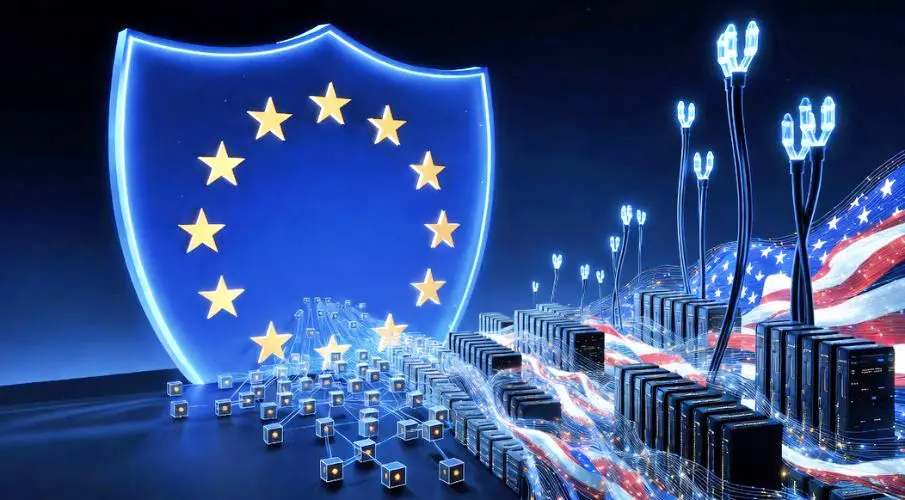
In the European Parliament, a rule now applies that would have been unthinkable just a few years ago. Members are not allowed to use artificial intelligence on their work devices. Officially, this is about protecting confidential information. In practice, this decision shows how deep the mistrust toward large internet platforms has become. Most of them originate from the United States. And that is exactly where the reaction is becoming increasingly sharp. Since 2024, the European Union has been enforcing two laws intended to reorganize the digital space. The Digital Services Act and the Digital Markets Act intervene directly in the business models of the largest tech corporations. Shortly after the deadlines expired, Brussels imposed fines totaling 3.77 billion euros on Google, Apple, Meta, and X. Google alone had to pay 2.95 billion euros. This is not only about individual violations. It is about the question of who sets the rules in the digital space.
The European Union openly speaks of digital sovereignty.
What is meant is the ability to enforce its own standards independently of the influence of global corporations. This includes transparency in algorithms, control over data, and limiting the power of large platforms. A court in the Netherlands has already required Meta to give users a real choice. Instead of algorithmically driven feeds, chronological views must also be possible. For many users, this is an intervention in a system that had previously been taken for granted.
In Washington, this is seen differently. Donald Trump described the European rules as extortion and threatened new tariffs. Elon Musk went even further. After a fine against X, he publicly called for the abolition of the European Union and the return of sovereignty to individual states. Over several days, he directly attacked European institutions and politicians and even blocked EU advertising on his platform. Marco Rubio also spoke of an attack on American citizens. JD Vance had already raised accusations of censorship in advance. Jim Jordan called the law a global censorship instrument.
The European Commission rejects these accusations.
The case of X shows what this is actually about. The platform had changed its verification system. The well-known blue checkmark was no longer assigned to verified accounts but to paying users. For many, this created the impression that these were still verified identities. That is exactly what the Commission assessed as a violation of transparency rules. There were also allegations regarding advertising and the handling of data for independent research. This was not about opinions, but about deception and lack of traceability.
The Digital Services Act applies to all online services, with stricter requirements for large providers with more than 45 million users in the EU. Platforms must explain how they moderate content, how their recommendation systems work, and how advertising is used. Misleading designs that push users toward certain actions are prohibited. At the same time, criticism within Europe remains. Legal experts such as Inge Graef and Martin Brenncke warn that vague terms could lead platforms to either continue to game the system or, in doubt, delete too much.
The Digital Markets Act goes even further. It targets so-called gatekeepers, meaning companies that control entire market segments. Alphabet, Amazon, Apple, ByteDance, Meta, and Microsoft have been officially classified in this category. Google processes around 90 percent of search queries in Europe, Facebook reaches more than 80 percent of internet users, Amazon dominates online retail, Apple shapes the smartphone market. In digital advertising, more than half of revenues flow to Google and Meta. This concentration is the starting point for the new rules.
Gatekeepers must grant users more freedom. Preinstalled apps should be easier to remove, alternative app stores must be accessible. Data must be disclosed when companies operate on the platforms. At the same time, it is prohibited to track user behavior outside their own services or to systematically favor their own products over competitors. Violations can result in fines of up to 10 percent of global revenue, and in severe cases up to 20 percent. In extreme cases, even a breakup is on the table. A historical example is the breakup of AT&T in 1982.
In the United States, this development is viewed as an attack. A report by the House Judiciary Committee titled “The Threat of Foreign Censorship” claims that the European rules would force platforms to suppress political content worldwide. Legal experts disagree and point out that the requirements largely align with existing standards for dealing with illegal content. There is no evidence of targeted discrimination against American companies.
Donald Trump is nevertheless using the situation for political pressure.
He announced that countries with such laws would be hit with additional tariffs. Sanctions against European decision-makers are also being discussed. Trade issues are thus being directly linked to digital policy. At the same time, it becomes clear how closely politics and tech companies in the United States are connected. Elon Musk supported Trump’s campaign with 277 million dollars, Mark Zuckerberg donated one million for the inauguration, Sergey Brin sought direct contact in Mar-a-Lago.
Another EU proposal remains particularly controversial, the so-called chat control. Originally, private communication was to be automatically scanned for content related to child sexual abuse, including on encrypted services. Criticism came from many sides. Experts warned that no technology can reliably distinguish between illegal material and harmless content. False positives would be unavoidable. In addition, such surveillance would call fundamental rights into question.
The proposal has since been softened. The requirement to bypass encryption has been removed. Instead, the focus is on less invasive measures and voluntary cooperation. Nevertheless, risks remain. Identity checks and age verification interfere with anonymity. For journalists, informants, activists, or refugees, this can have real consequences. Also for people who depend on secure communication in repressive states.
In the end, what remains is a conflict that goes beyond technology. Europe is trying to regain control. The United States is defending a system that made its companies powerful. In between are users, whose data, rights, and communication spaces have become the subject of political confrontation. And a digital space that is no longer shaped only by innovation, but by questions of power.
Updates – Kaizen News Brief
All current curated daily updates can be found in the Kaizen News Brief.
To the Kaizen News Brief In English


Es wird Zeit, dass Europa sich nicht immer den Willen von Trump unterwirft.
Wenn in den USA Menschenrechte und Datenschutz abgeschafft werden, ist es das Eine.
Da müssen amerikanische Organisationen klagen und amerikanische Gerichte Urteilen.
Wir haben in der EU Gesetze.
An die hat sich Jeder, der in der EU seine Plattformen/Dienste anbietet zu halten.
Egal, ob Trump sich aufregt.
Das Thema Strafzölle ist ja vom Tisch.
Da hatten ja leider diverse Staaten in der EU vor gebuckelt.
Daher stockte die Umsetzung.
Jetzt, genau jetzt, ist der richtige Zditpunkt!
Nicht nur bei Facebook, Instagram, X, TikTok.
Auch Plattformen wie Palantir sollten diesbezüglich auf den Prüfstand.
Die Tech-Milliardäre müssen lernen, dass Ihre Nähe zu Trump in Europa keinen „Schutz“ bietet.
Gesetze gelten und Niemand darf über dem Gesetz stehen.
👍