
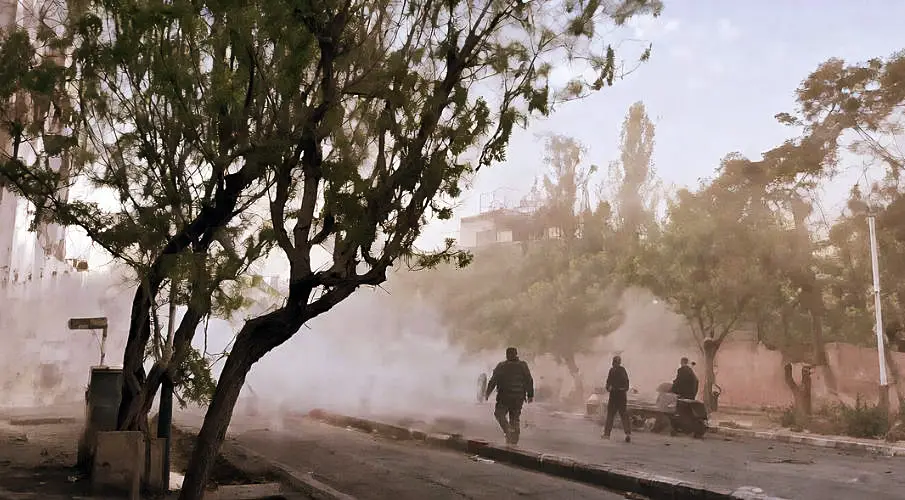
The war has reached a new level, not loudly announced but visible in the impacts, in the fires, in the decisions states are now making. In the United Arab Emirates, another person was hit, an Indian national, injured by shrapnel after air defense systems intercepted a drone. Earlier, a man from Bangladesh had already been killed when debris from an interception fell onto an agricultural area. The number of dead in the Emirates is rising, nine civilians and two soldiers so far, along with a Moroccan contract worker in Bahrain. The war is no longer regionally contained, it is hitting people who have nothing to do with this conflict.
At the same time, a fuel depot in northern Iraq is burning. Drones strike, then more follow, while firefighters are still trying to control the first fire. Black smoke rises over Erbil, the facility belongs to a network around the energy company BP. It is not an isolated attack but part of a strategy that deliberately puts energy supply under pressure. Off the coast of Qatar, an oil tanker is also hit, an Iranian cruise missile strike in which two additional projectiles narrowly miss. The crew can be evacuated, but the message is clear. The transport of energy is becoming a direct target.


In Tehran itself, an airstrike hits a site that has carried symbolic weight for decades. The former US Embassy compound, under the control of the Revolutionary Guards since the 1979 hostage crisis, is struck. Windows shatter, shockwaves move through the surrounding area. The Russian embassy reports damage to the nearby St. Nicholas Cathedral, doors and windows destroyed, a nursing home is also damaged, parts of the roof collapse. Moscow sharply condemns the attacks and says that civilian infrastructure and cultural facilities are increasingly being hit.
As the impacts increase, political lines are shifting. British Prime Minister Keir Starmer announces an international conference on the Strait of Hormuz. 35 states want to jointly find ways to reopen the most important oil route in the world. At the same time, military planning is underway for what comes next. Starmer speaks openly about the need for a combination of military strength and diplomacy. At the same time, he responds to statements by Donald Trump, who is considering leaving NATO. Starmer makes clear that the United Kingdom fully stands behind the alliance, it is the most effective military alliance in the world.

The economic effects are already visible globally. Australia is calling on its population to drive less, to use public transportation. The government is lowering fuel taxes, trying to cushion price shocks, while at the same time shortages arise from panic buying. In South Korea, the government goes a step further. Civil servants are only allowed to use their cars every other day, depending on their license plate. The measure is directly linked to concern that the energy crisis could last longer. Previously, it had already been ordered that vehicles must remain unused on at least one weekday.
At the same time, markets are reacting nervously but also with hope. The oil price falls below 100 dollars per barrel, a sign that at least in the short term there is betting on easing tensions. Stock markets in Asia rise significantly. But this movement stands on fragile ground, because militarily no easing is visible.
On the contrary. The Houthis in Yemen report new missile attacks on Israel. Sirens sound in the south of the country, from Beersheba to the coast. Hits are not initially confirmed, but the series of attacks shows that the conflict is continuing to expand. The situation is also changing dramatically in Lebanon. The army withdraws from several border towns, not out of political will, but because it would otherwise be cut off. Israel continues to push north and declares the south up to the Litani River a security zone. More than one million people have already been displaced.
And then there is the political language that shows how far this conflict has already gone. Iran’s Foreign Minister Abbas Araghchi makes it clear that Tehran will not back down. He rejects threats from Washington, as well as deadlines. Asked about a possible ground war, he responds that the United States would not dare, the losses would be too high. At the same time, he denies that Iran is deliberately attacking Gulf states, even though infrastructure is being hit there, airports, energy facilities, desalination plants.

This simultaneity is the real problem. Everyone denies what is visibly happening. Everyone speaks of defense while the impacts increase. Everyone is already planning the next step while the current one is still underway. The Strait of Hormuz is more than just a geographical point. It has become the center of this conflict. Whoever controls it controls part of the global economy. And that is exactly why everything around it is escalating. Militarily, politically, economically.
The world is reacting, but it is reacting in fragments. Conferences, appeals, energy saving measures, military planning. There is a lot of movement, but no direction that is clearly recognizable.
What remains is a war that can no longer be contained. One that is no longer fought only between states, but runs directly through civilian spaces. Airports, residential areas, industrial facilities, religious buildings. Everything can become a target. And that is the real development of these days. Not the individual missile, not the individual drone. But the fact that there is no longer any place that is safe.
Updates – Kaizen News Brief
All current curated daily updates can be found in the Kaizen News Brief.
To the Kaizen News Brief In English


„Moskau verurteilt die Angriffe scharf und spricht davon, dass zivile Infrastruktur und kulturelle Einrichtungen zunehmend getroffen werden.“
Das ist ja wohl der absolute Lacher.
Was macht Russland denn seit 4 Jahren in der Ukraine?
Im Übrigen, haben die westlichen Staaten der Ukraine in meinen Augen auch nur unzureichend geholfen.
Aber hier geht es um die Weltwirtschaft.
Andere Interessen.
Aber es sterben weiter Menschen 😞
Und es gibt keinen Plan.
Es wird geredet.
Trump droht.
Israel und Trump bomben.
Iran greift die Nachbarstaaten an.
Russland lacht sich ins Fäustchen.
China soldiers noch, was für sie der profitability Weg ist.
Und die NATO.
Nachdem Trump sein Board of Piece gegründet hat, war anzunehmen, dass er einen NATO Austritt zur Drohung nutzen würde.
Ob er austritt?
Dzzu müsste doch der Kongress zustimmen, oder?
Die Lage bleibt sehr bedrohlich.😞
👍 – ohne kongress läuft da nichts
Aber die stehen (noch) hinter ihm