
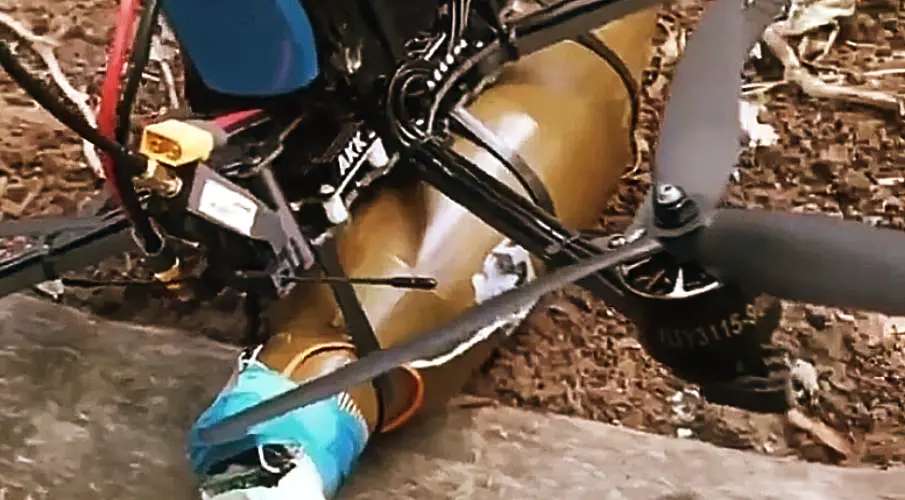
Over Baghdad, drones are hovering that cannot be disrupted. They do not fly blind, they do not fly free, they are tethered to a cable. Fiber optics instead of radio. That means no jamming, no simple shutdown. In the videos that have been circulating this week from Iraq, these FPV drones can be seen moving over a U.S. base and then striking with precision - a Black Hawk helicopter on the ground, an air defense radar. Images familiar from Ukraine. Except they are now appearing in the Middle East.
That changes the situation immediately. What held true for years no longer applies. In Afghanistan and Iraq, threats came from rifles, from improvised explosive devices under the road. Now the attack comes from above, precisely guided, cheap, deployable at scale. If Donald Trump actually sends ground troops into the region or orders operations to reopen the Strait of Hormuz, U.S. soldiers will be operating in an environment they do not know, because every unit on the ground and every ship in the Gulf becomes a close-range target. FPV drones then become standard on both sides. We already know this from the war in Ukraine.
Drone and rocket attack on the U.S. Embassy in Baghdad in the past week
The problem isn’t just the existence of these systems, but the gap on the American side. Vehicles and landing craft still lack the counter-drone capabilities that have long become standard in Ukraine. Jammers offer little protection against these new drones because they don’t rely on radio signals. Iran has recognized this weakness - and Russia has likely helped it understand how to exploit it.
Diese Verbindung ist entscheidend. Russland hat die kabelgesteuerten FPV-Drohnen im Krieg um die Region Kursk 2024 eingesetzt und weiterentwickelt. Gleichzeitig wurden iranische Shahed-Drohnen von Russland modernisiert und im großen Stil genutzt. Andriy Zagorodnyuk, ehemaliger Verteidigungsminister der Ukraine, spricht von einer aktiven Zusammenarbeit zwischen Moskau und Teheran – Austausch von Wissen, Technik und Erfahrung. Iran lernt nicht nur mit, Iran übernimmt.

The same pattern is visible at sea. Ukraine has used maritime drones to disable parts of Russia’s Black Sea Fleet and render entire sea areas impassable. Iran has simpler systems, without satellite-based navigation like those used by Ukraine. But in a narrow passage like the Strait of Hormuz, less is enough to cause significant damage. Warships and tankers become clear targets there.
Technological development is moving faster than military adaptation. In the U.S. military, some units are only just beginning training on FPV systems. Michael Kofman of the Carnegie Endowment describes this as an early phase - an attempt to even understand what this technology means for tactics and deployment. At the same time, a mindset persists that relies on superiority. Fabrice Pothier, formerly responsible for planning at NATO, describes this as a form of overconfidence - a belief that more advanced systems automatically ensure dominance. The reality on the battlefield looks different.
Donald Trump has publicly rejected an offer from Kyiv to share experience in drone defense. His reasoning: there is no need for help, the U.S. already knows enough about drones. Meanwhile, figures from Ukraine show how much warfare has changed. FPV drones account for the majority of losses there. The danger zone extends for many kilometers on both sides of the front. Some of these drones can be controlled over distances comparable to the width of the Strait of Hormuz.
Countermeasures are limited. One option is to eliminate the drone teams themselves before they can launch. That may be one of the most effective approaches. Many point to U.S. strengths in reconnaissance and precision strikes. That is a mistake. Intensive control of a confined area like Hormuz could make the use of such drones more difficult. Yet even these assessments must be treated critically.
Pavlo Klimkin, former foreign minister of Ukraine, says it clearly: no army is prepared for this. Not the United States, not Europe. Not technically, not in thinking, not in experience. He is right.
Meanwhile, the war continues. The airstrikes by the United States and Israel since February 28 have neither stopped the drone and missile attacks nor secured free passage through the Strait of Hormuz. One fifth of global oil trade depends on this route. And above that route, the very systems that were long underestimated could soon dominate. What is emerging here is not a minor adjustment, but a fundamental shift in the reality of the battlefield. Anyone who ignores it enters a war that has already moved beyond their own level of preparation.
Updates – Kaizen News Brief
All current curated daily updates can be found in the Kaizen News Brief.
To the Kaizen News Brief In English


Die westliche Überheblichkeit, gepaart mit dem Narzissmus von Trump.
Eiskalt erwischt kann man hier unter „selber Schuld“ verbuchen.
Die Ukraine wehrt sich seit 4 Jahren.
Entwickelt stetig ihre Abwehr und ihren Angriff weiter.
Niemand kennt diese Drohnen besser als sie.
Aber Hilfe von Selensky?
Das scheut Trump wie der Teufel das Weihwasser.
Wie stand es schon geschrieben?
„Hochmut kommt vor dem Fall“
…ja der hochmut ist ein grosser bestandteil in der politik und auch gesellschaft, wie das endet, kann man in büchern nachlesen