
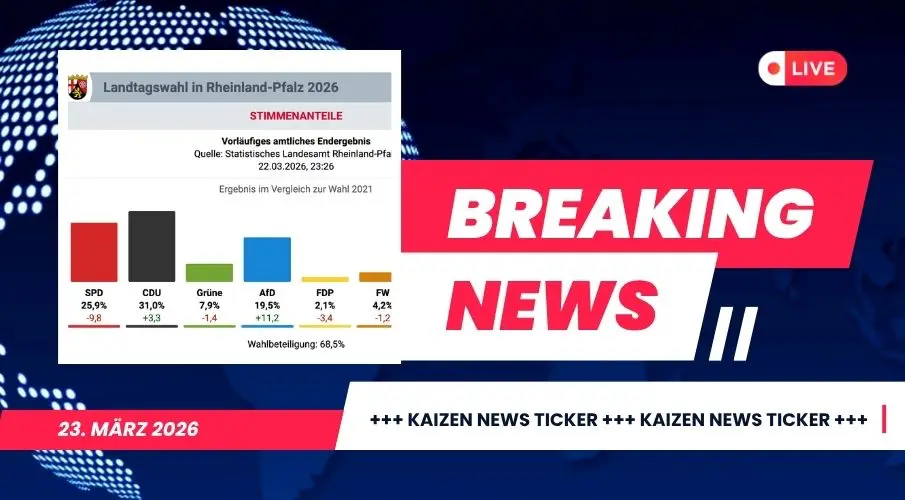
Rhineland Palatinate has voted – and the SPD still does not know why!

You look at these numbers and think: again. 31 percent CDU. 25.9 SPD. 19.5 AfD. FDP out, Free Voters out, the Left just out with 4.4 percent. Gordon Schnieder wins his direct mandate in the Vulkaneifel with 52.6 percent. Alexander Schweitzer gets 41.4 percent in the Southern Wine Route – and still loses. He says himself he will not be part of a new cabinet. Somewhere in Tokyo, Boris Pistorius says there is no need now for a personnel debate. He says it from Tokyo. That also says something.
Schweitzer explains that the SPD defeat in Baden Württemberg two weeks ago – 5.5 percent, the worst result ever in a state election – was put into his backpack. Maybe. He fought against the wind, against the trend. That is probably true. It could be. It sounds like a man who knows he may be right and still goes home. The Seeheimer Kreis says the SPD is losing itself in niche issues, elections are won in the center. They have been saying that for years. The center is somewhere else now.
The AfD gains 11.2 points. Loud, as always. That seems to count. In the Kaiserslautern district it wins the most second votes – ahead of SPD and CDU. Jan Bollinger narrowly misses his direct mandate in Neuwied, still celebrates, Alice Weidel and Tino Chrupalla smile. In Mainz, 70 people protest. Few, for how much is at stake. The police call the evening peaceful. Who is supposed to disrupt it.
Marie Agnes Strack Zimmermann says the FDP has not even started moving since the federal election. She has been part of this party for decades. The sentence lands, but it comes too late. She is sitting there. What shows itself again this evening does not seem to trouble the established parties enough. They use social media, but sparingly, stiffly – out of arrogance, out of naivety, out of reasons they may know internally but do not name. By 2026 it has long been clear what has also been true in agency journalism for years: the headline decides. Not the quality of the story behind it. Not our world. Strategies against right wing parties need to be reconsidered. They are out of place, yet results and reason are needed to break this trend. Whoever is not where people look every day loses the night before the polls even close. Loud beats right. Simple beats true. And the path of loud continues.
Spain calls for opening Hormuz – and does not say the obvious – Iranians put stickers with Pedro Sánchez on rockets
Pedro Sánchez speaks at a moment when every sentence carries weight. The Spanish prime minister calls for the opening of the Strait of Hormuz and the protection of all energy facilities in the Middle East. He names no one. Neither Iran nor the United States appear in his demand. That is exactly what makes the sentence so clear. Sánchez writes that the world stands at a point where further escalation could trigger a long term energy crisis. It is a warning that is not directed at a single actor, but at the dynamic itself. Whoever controls the strait controls the flow of oil and with it part of global stability.
The wording remains deliberately open. It avoids assigning blame and relies on effect. The reference that the world must not bear the consequences of this war is aimed at all sides at once. It is a political sentence that tries to build pressure without addressing it directly. While others take positions, Sánchez remains in the middle. You can read that as caution. Or as an attempt to speak in a situation where any clear attribution immediately becomes part of the conflict.
A quote on rockets – unacceptable
Words that in Madrid were meant as political assessment suddenly appear on metal that flies. The sentence leaves its author. It is no longer read, it is used. Not as an argument, but as a sign. Someone has decided that these words are useful – not because of their intent, but because of their effect. The intent no longer matters. What matters is what is made of it.
No explanation is needed for that. What is documented, what is recorded, explains itself. A political quote on a weapon says more about this situation than many speeches combined. There is only one word for it: unacceptable
48 hours – and suddenly energy stands at the center of the war

Iranian attacks on Israel on March 21
Donald Trump sets an ultimatum. 48 hours, then Iranian power plants are to be destroyed if the Strait of Hormuz is not fully opened. It is a sentence without nuance. Energy itself becomes a target. Tehran responds directly. Anyone who attacks infrastructure must expect energy facilities across the entire region to be hit. The response is clearly formulated and leaves no room. It is no longer only about military targets, but about what makes supply possible at all.
At the same time, Iranian missiles strike in southern Israel. Two locations are hit, buildings destroyed, dozens injured. The attacks take place near a central nuclear research site. The war moves closer to points that had previously been considered particularly sensitive. The situation visibly shifts. Energy, infrastructure, research – areas that long marked a boundary are coming into focus. Decisions are made faster, reactions follow more immediately. The time for distance is shrinking. What remains is a development that no longer moves slowly. It accelerates. And it reaches exactly the places where the consequences extend the furthest.
Macron warns of escalation – and speaks of control in a situation without control

Emmanuel Macron speaks at a moment when every step has consequences. He speaks of a risk that could spiral out of control. At the same time, he calls for a pause in attacks on energy facilities and civilian infrastructure. It is an attempt to draw a line while that line is already under pressure. After a conversation with Mohammed bin Salman, Crown Prince of Saudi Arabia, the focus shifts to what can still be kept stable. Energy, transport, supply. Areas that are not only militarily relevant, but define daily life. Macron calls for exactly these points to be excluded.
At the same time, he demands that the Strait of Hormuz remain open. A demand that sounds simple, but collides with reality. Because the passage has long become part of the conflict. Whoever controls it decides more than just shipping. The sentence about possible escalation remains. It describes less a future than a development that has already begun. Macron is trying to slow it down. Whether that is enough remains open.
The words of a lost man
Donald Trump speaks of 100 percent approval in a CNN poll on the war in Iran. CNN has not published such a poll. The number does not exist, and yet, Trump says it, a number never seen before – Only the sentence exists – and it is now in the world. One could ignore it. One could also pause briefly and consider what it means when a president cites a poll no one knows because no one conducted it. 100 percent. Not 98, not 99. One hundred. The round number of people who have no objections. A society without dissent, represented in a poll that does not exist.
This is not a lie in the classic sense. A lie presupposes that one knows the truth and still conceals it. This is something else. It is a sentence that considers itself sufficient. It needs no source to verify it. It only needs someone to say it. And that is exactly the line. Whoever speaks of total approval declares dissent irrelevant. Not loudly, not with a threat – simply through the number. One hundred percent leaves no space. That is the point. And it is not funny.
Mace against Graham – and suddenly it is no longer about politics

Nancy Mace attacks Lindsey Graham head on. She says he does not belong in the Situation Room. Not because she refutes his position in detail. But because she denies him the basis to even speak about it. Anyone who has no children of their own should not talk about calling on others to send their children to war. That is exactly what she says. And it lands.
With that, the discussion shifts. It is no longer about strategy or risk. It is about responsibility. About the question of who pays the price when decisions are made that send others to the front. The sentence comes from within the Republican ranks. And that is exactly why it carries more weight than any criticism from the outside.
Important notice for travel to the United States: ICE at airports – and how long lines become a political signal

Tom Homan announces that ICE officers are to be deployed at U.S. airports. Officially, the goal is to reduce long waiting lines. Thousands of TSA employees are working without pay due to the shutdown or are staying away entirely. The gaps are visible, waiting times reach several hours. The solution comes from a direction that triggers more than just relief. ICE is not known for speeding up baggage checks. The agency stands for immigration enforcement, for arrests, for deportations. This presence is now to appear in an environment that until now was about security and processes.
Trump initially framed the measure as leverage to force movement in the budget dispute. Shortly afterward, it becomes a concrete deployment plan. Homan says ICE is to help speed up processes, while at the same time it remains open how many officers will come, where they will go and what exactly they will do. At airports themselves, the situation is tense. Travelers stand in line for hours while official figures promise much shorter waiting times. Frustration is visible. At the same time, uncertainty grows about what it means when an agency like ICE becomes a visible part of these processes.
Criticism comes immediately. It is not only about organization, but about trust. Union representatives point out that the real problem is not a lack of personnel, but a lack of pay. Others warn that the presence of ICE could worsen the situation. In the end, what remains is a measure that is more than operational support. It changes the perception of what an airport is. A place of control it remains. But the nature of that control shifts.
Reporting under pressure – and why being on the ground makes the difference

Journalism takes time. Investigative journalism takes more of it. War reporting takes both – and in addition access, money and the willingness to go where it becomes uncomfortable. That is becoming rarer. Research is cut, paths are no longer taken, documents are no longer read. What remains are second hand texts. Statements are adopted because no one has the time to check them anymore. Investigative does not mean sounding critical. It means finding out for yourself. Recognizing contradictions, making connections visible, going deeper than the press release. That does not fit into fast processes. That is why it is slowly disappearing, without anyone deciding it out loud.
In war, this intensifies in a way that cannot be argued away. Whoever is not on the ground cannot verify what is claimed. Militaries provide information. Governments provide information. Official bodies provide information. They all also provide their version of it. Without your own eyes, that version remains. We are on the ground. We do not only see, we verify. We do not only listen, we cross check. We do not accept statements, we follow them, we help those affected. This is not a claim, it is the work. The difference between passing on and finding out is small in description and large in effect. We are on the side of finding out. Everything else would have been easier.
At the End a Kaizen Moment of the War:
After the rockets – life goes on, right?
Life goes on. That is the strangest part. Shops are open. People walk through the streets, shop, go about their routines. From a distance, it could look like a normal day. Then you hear the sirens. Then comes the next impact, somewhere, not far. People have to go to work, food still has to be on the table
Tehran is not destroyed. But Tehran is no longer what it was. The city still functions – and at the same time carries something that is hard to name. A tension that shows in faces, in movements, in the way people pause briefly and listen before moving on. After the rockets comes the normal. Not because the war is over, but because life knows no other choice.


Unglaublich, dass die AfD so viele Stimmen gewonnen hat.
Man hat das Gefühl die Menschen verblenden/verblöden immer mehr.
Der Irankrieg hat der AfD mit Sicherheit in die Hände gespielt.
Die Angst vor einer erneuten Flüchtlingswelle, wie 2015, wurde instrumentalisiert und perfekt in Stimmenfang umgesetzt.
Mir grabs es schon vor den Wahlen in den östlichen Bundesländern 😞
Ind ein AfD Verbot rückt in immer weitere Ferne.
Irgendwann demnächst, mit AfD Mehrheiten, wird es zu spät sein.
ja, aber die fehler liegen auch in der politik, arroganz, dass dieser rechte mist mehr und mehr wächst. auch das aufhalten an kleinigkeiten führt zum gegenteil – ja der september wird wohl der horror
Spanien ist im Moment ein Lichtblick bei den buckelnden Politikern.
Das der Iran ausgerechnet sein Zitat auf Raketen schreibt, ist so perfide.
Macron versucht Grenzen zu ziehen.
Einigkeit zu beschwören.
Beides liegt nicht in seinen Händen.
Und durch jemanden wie Rutte wirken diese Aussagen noch hilfloser.
Die Strasse von Hormus wird uns alle noch lange beschäftigen und direkt persönlich betreffen.
Durch einen Krieg, von 2 alten Männern angezettelt.😞
Die Beide wahrscheinlich kaum die Folgen richtig erleben werden.
rutte ist vollkommen durch, weiss hinten vorne nicht was er machen soll, und die eu ist ein kopf in den sand-club
100% Zustimmung.
Ja Donny, da übertriffst Du ja noch Kim und Putins Umfragewerte.
Allerdings gibt es die da tatsächlich.
Staatlich gelenkt mit vorher festgelegtem Ergebnis.
Und Trump beruft sich auf eine Umfrage, die es nie gegeben hat.
Und MAGA verbreitet es mit Freuden weiter.
Dabei, wenn sie mal zuhören würden, wie im Kongress und Senat darüber gesprochen/gestritten wird (nicht nur von den Demokraten), würde klar sein, dass 100% rechnerisch nicht möglich ist.
Wahrscheinlich sind sie alle auf Donnys Niveau, was Prozente und Prozentrechnung angeht.
…trump ist so etwas von verstört, da muss man sich langsam mehr als nur große sorgen machen, was er noch so anrichtet
Nancy Mace scheint ein wenig ihr Rückgrat gefunden zu haben.
Ich hoffe, dass sie weiter widerspricht, Dinge auf den Punkt bringt und ein Stolperstein bleibt.
Nicht wieder, wie fast Alle, einknickt.
👍
ICE an Flughäfen.
Wenn ich richtig informiert bin (wenn nicht, korrigiere mich bitte) zahlt jeder Passagier seit 9/11 mit jedem Ticket eine TSA Fee.
Eigentlich ist TSA damit zum Gros finanziert.
Warum nun kein Geld gezahlt wird?
Weil es ein schönes Druckmittel ist.
Fliegen betrifft viele US Amerikaner, gerade jetzt zum Spring Break.
Trump zeigt natürlich auf die bösen Demokraten.
Dabei hat Hakeem Jeffries gesagt, dass sie einer TSA Finanzierung als einzelnen Haushaltsposten zustimmen würden.
Bzw sofern ein ICE Funding aus dem Haushaltspaket raus genommen wird.
Aber das wollen die Republikaner ja nicht, denn dann, dass wissen sie, geht die Finanzierung von ICE in Monaten nicht durch.
Ehrlich gesagt denke ich, dass es ohnehin langfristig der Plan ist ICE auf den Flughäfen einzusetzen.
Allerdings… aus Sicherheitsgründen dürften sie keine Masken tragen ….
Ich würde ihn das durchzuehen lassen.
Könnte nämlich arg, sehr arg nach hinten losgehen.
5,60 pro strecke zahlt man, aber geht nicht direkt an TSA, sondern fließt in den allgemeinen staatshaushalt …
Das Leben geht weiter….. irgendwie muss es.
In der Ukraine, in Gaza, im Iran, im Südlibanon und allen gefährlichen Unruheherden auf der Welt.
Danke dass Ihr vor Ort seid.
Nur vor Ort kann man verstehen und es den Anderen zeigen und erklären.
Passt bitte weiter auf Euch auf.
.. machen wir, schade ist das wenige interesse der meisten leute an den persönlichen geschichten aus den kriegsmomenten, dass stimmt uns nachdenklich. die welt kann doch nicht nur noch aus häme und bilder mit storys über den horrorclown aus washington sein.
Musk hatte doch groß angekündigt, dass er die Gehälter der TSA Beamten zahlen will, damit der Flugverkehr sicher und schnell abläuft.
Hat er Angst vor ICE? 🤣
😂 😂 😂