
Here’s another look back at our March 18, 2026 article. This issue is coming up more and more now, so it’s worth looking back. It may also give you a better sense of how we work, why our research often starts long before a topic becomes part of the wider public debate, and why we don’t wait until everyone else is already talking about it.
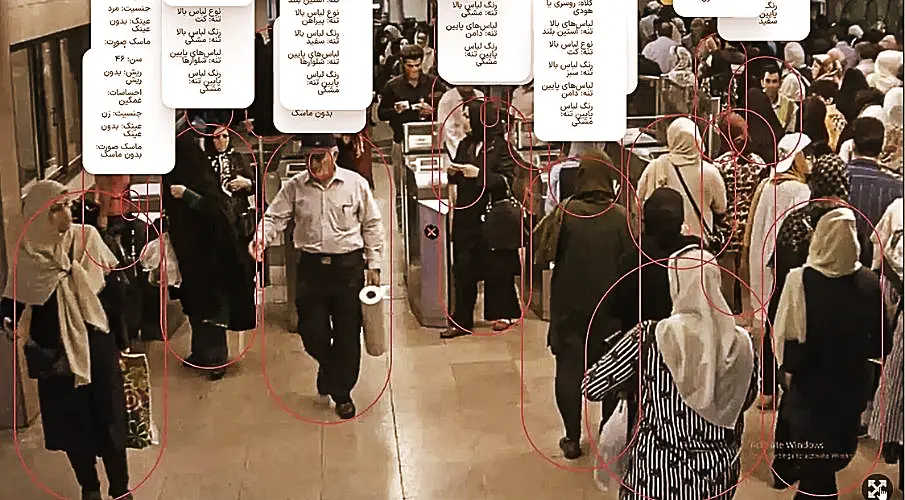
The cameras in the metro circle faces. Green, a color that is supposed to be calming. Next to it appear age, gender, recognized emotion, whether someone is wearing glasses, a mask, a beard. All of it in real time, while people pass through turnstiles and think of nothing except the next train. No one looks up. No one notices it. On the screen next to it, the list keeps running, face after face, second after second, without pause, without limit.

Use of the FindFace software in a metro station in Tehran is shown. The image has been anonymized to protect the privacy of the individuals depicted.
The system is called FindFace. It comes from Russia, was purchased quietly in 2019, through shell companies, without public tender, with tax exemption clauses that were not supposed to leave a trace. It can search a billion faces in seconds, knows no technical limits, no temporal ones. Anyone who has been filmed once is recorded. Anyone who is recorded can be picked up later, when the streets are quiet again, when international attention has shifted, when the resources are available and the lists can be processed. Quietly, methodically, without haste. The regime has time because it has the faces.
Propaganda video showing the use of drone surveillance against demonstrators, published by the Seyyed-al-Shohada Brigade AS in the province of Tehran
A man named Mansur distributed flyers for the movement Woman, Life, Freedom. A bank camera filmed him doing so. The security forces evaluated the footage, found his face, found his daughter. Hasti was thirteen years old when she was taken from school. She survived, but has since suffered neurological damage. The system did not need an informant, no denunciation, no interrogation specialists. It needed only a camera and a database.

Image left: Use of the FindFace software in a metro station in Tehran. The image has been anonymized to protect the privacy of the individuals depicted.
Document right: The document shows that the company NTech LAB LLC in 2019 confirmed an official cooperation with the Iranian company Rasad Intelligent Technologies RASADCO. In the letter, RASADCO is explicitly named as a system integration partner and authorized to further develop technologies from NTech Lab and integrate them into third party applications. Particularly explosive is the fact that NTech Lab is considered a provider of facial recognition software, among others FindFace. The authorization means that an Iranian company had direct access to this technology and was able to actively integrate and expand it within its own systems. This creates a technical foundation that can be used for surveillance, identification and tracking of individuals in public space.

The Iranian Revolutionary Guards warn in an official statement that any form of protest or anti security relevant activity will in the future be punished severely. The background is the current domestic political situation following the death of Ayatollah Khamenei, which is presented by the authorities as a phase of increased threat. In the statement, every street movement, every protest and every form of public unrest is categorically classified as part of a hostile plan. Demonstrators are explicitly described as possible supporters of external enemies. Security authorities make it clear that they consider such activities as direct cooperation with the enemy.
The threat is particularly clear: anyone who takes part in protests must expect severe punishment. The language of the statement leaves no doubt that the state is prepared to act consistently and repressively against its own population with all means.
Reporting in this country means knowing all of this and going in anyway.
Just yesterday, just the day before: ten foreign individuals arrested, under the pretext that they are spies. The pretext does not have to be much here, it only has to be stated, and the rest follows by itself. Anyone who wants to work as a journalist in Iran therefore moves differently than elsewhere. No hotel with registration, if it can be avoided. Instead families, people you know, rooms without registration, without entry, without a trace in the system. You eat at the table of people whose names you do not write down. You sleep in rooms that no one knows except those who live in them. It sounds like caution, but it is simply the baseline.
Large data packages can hardly be uploaded. The network is throttled, controlled, sometimes simply gone, on days when something happens that the authorities do not want to let out. What you film, what you write down, what you witness, you carry out. In your head, on small data carriers, in luggage that no one is supposed to search. You develop a sense for what carries how much weight and how much risk that means, and you make decisions for which there are no rules, only experience and luck and sometimes neither.
And then the question of how information gets out.
The crossings into Turkey, Gürbulak, Bazargan, Kapıköy, Razi, Esendere, Serow, have long been what they are: control points where you stand too long, answer too many questions, have to explain too much about what you wanted in the country and who you met and what is on the phone. The officers there are not stupid. They know what they are looking for, and they have time. The route to Tabriz and further into Iraq was once an option. It is no longer. Too many checkpoints over too many kilometers, too much unpredictability in too many places where you cannot turn back if it goes wrong. What remains is the long route to the northwest. Across the entire country, up through mountain landscapes that are cold and silent in winter, to the border crossing Agarak on the Armenian side, Norduz on the Iranian side. Further, more complicated, more time consuming than anything else. But currently the most reliable option there is, and in this work reliable does not mean comfortable, it only means: the probability of getting through is higher than elsewhere. That is enough to choose this route.
While all of this is happening, FindFace keeps running and running ...

It runs in the Tehran metro, it runs at university entrances, it runs in Mashhad, the holy city with three million inhabitants, where a pro government journalist in 2023 posted a photo of the surveillance monitors and asked what it was for. He did not receive an answer, and the question disappeared, the way questions disappear here. The system also works offline, which in some ways makes it more dangerous than anything else. Videos are stored, data from social networks is downloaded, images are collected, everything is merged into a shared database that has no upper limit and no expiration date. Later, weeks or months after the events, the arrests come. Without announcement, without the person knowing since when they had already been recorded. The system does not sleep, it only waits.

The image shows an automated surveillance system that detects vehicles and labels them with data such as brand and model. Some assignments appear correct, such as the VW Passat or the BMW. At the same time, other vehicles are not detected at all or only described inaccurately. The recognition is therefore not consistently reliable. We verified this. That is exactly where the problem lies: such systems convey the impression of precise control, but operate with errors. Incorrect assignments or incomplete data can lead to uninvolved individuals becoming targets, for example through wrongly identified vehicles or faulty database links.
The technology works, but not without error. And in a surveillance context, that very inaccuracy can become a risk for innocent people.
The brutality of an inhuman regime
Reports from January 2026 speak of up to 30,000 people possibly having been killed within 48 hours - these numbers cannot be independently verified. Machine guns, assault rifles, military weapons against people who had gone into the streets because life had become too expensive and patience had run out. Anyone who wanted to document this had to be invisible. Had to move like someone who does not exist, had to hide the camera and know the way back before taking the way in. Had to know which street was still open and which was no longer. Had to keep in mind what they had seen, because there was no safe place to write it down.

An internal document from 2019 shows that the Russian company NTechLab officially authorized the Iranian company Rasad Intelligent Technologies RASADCO as a system integration partner. RASADCO was thereby allowed to further develop technologies from NTechLab, including facial recognition software, and integrate them into its own applications. The document proves a direct technical cooperation that enabled the use of such systems in Iran.
Narges Mohammadi is in prison. Nobel Peace Prize laureate, arrested in December 2025, seven years and six months. Twelve journalists are in prison, says Reporters Without Borders, and Iran ranks 176 out of 180 in the global press freedom index. The four countries behind it, one hardly wants to say them out loud. Reporting under these conditions is not a question of courage alone, although courage is part of it. It is a question of method, of patience, of contacts, of routes, of knowing whom you can trust and whom you cannot, and of the awareness that this assessment can prove wrong at any time.

It is the art of leaving as little trace as possible in a country that collects traces the way other countries collect tax revenue. You travel north, via Agarak, via Norduz, you carry out what you have seen, and you hope that the cameras did not recognize you while you walked through the metro and thought of nothing except the next train, just like everyone else.
Updates – Kaizen News Brief
All current curated daily updates can be found in the Kaizen News Brief.
To the Kaizen News Brief


