
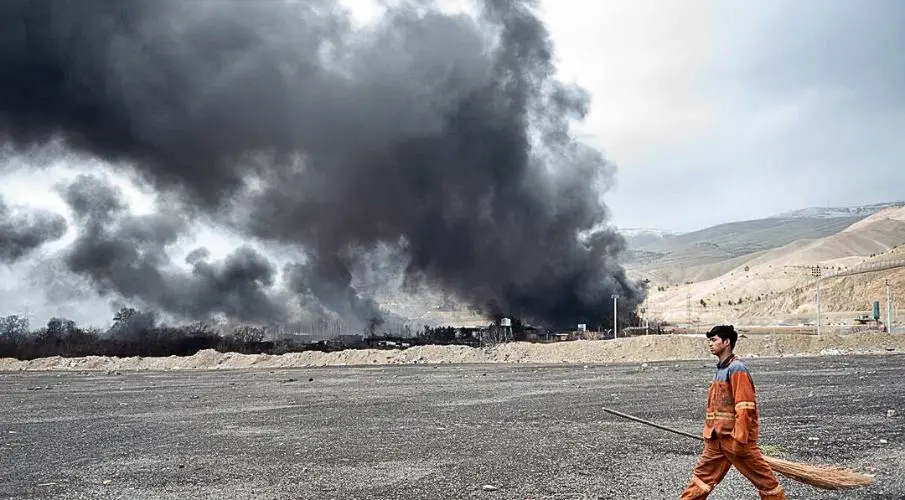
War is not the opposite of peace. It is its condition. Peace is only war resting - holding its breath, counting its shots, searching for its next pretext. We call it stability. We call it normality. We call it everything except what it is: a pause in killing.

Fadi stands in front of the remains of his tent on the beach in Beirut. It is the second time in two days that the storm has destroyed it. Next to him lie new mattresses that he bought after the last storm. They are already soaked again. He says he now only hopes to be able to return home. Only there, he says, can one truly come to rest.

More than 830,000 people are fleeing in Lebanon. One in seven residents of the country. In Haret Hreik, a suburb in the south of Beirut, collapsed concrete slabs, bent steel beams and torn plastic tarps lie on the streets. Smoke rises from rubble. Small fires continue to burn. Since March 2, 826 people have been killed, including 106 children. These figures cannot currently be verified. Death knows no database.


Many right wing parties face a contradiction in the Iran war that they do not want to name. Outwardly: hard rhetoric against Islamist regimes, demonstrative closeness to Israel and the United States, the attitude of strength. Inwardly: the same policies that produce the refugee movements against which they mobilize domestically. Anyone who wants to close the border at the same time does not have two positions. He has one: power without consequence. Escalation without responsibility. One sets the house on fire and complains about the smoke.
The person who flees, for example from Beirut, does not ask about the party line of the one who built the bomb. He flees. And the question that no one asks: who stacked the wood - and who profits from the fact that it burns?

At the same time Iranian rockets strike Tel Aviv. Twenty three impact sites on a single Sunday. In Bnei Brak a residential building was hit, windows torn out, one resident injured by glass fragments. In Ramat Gan paramedics treated a man with blast injuries. Municipal workers shortly afterward cleared an impact site where cluster munitions had detonated - small explosives that can kill days later.
I have always known within myself that human beings fight because they cannot sleep. War is the loudest form of the sleeplessness of civilization.
Bahrain reports 125 intercepted rockets and 211 drones since the beginning of the war. Iranian attacks struck ports, a hotel, a refinery, a desalination plant. The United Arab Emirates report four ballistic missiles and six drones in a single day. The Strait of Hormuz - through which a significant share of the world’s oil flows - is according to Iran’s foreign minister Abbas Araghchi open, but not for the United States and its allies. As long as attacks on Iran continued this restriction would apply.

The language of war does not lie because it is crude. It lies because it is precise. “Take no option off the table” - that is how Mike Waltz, U.S. ambassador to the United Nations, formulates the possibility of further attacks on Iranian energy facilities. It sounds like strategy. It means: people will die, and we have thought about it.


This remains; the grief, no matter which religion one belongs to
The economic consequences are already visible. Aluminium Bahrain, the largest aluminum smelter in the world outside China, is shutting down almost one fifth of its production because exports remain blocked. Such a facility operates at extremely high temperatures - shutting down and restarting takes a long time and can damage machinery. Even if shipping were possible again tomorrow supplies would remain tight for a long time. The construction industry and car manufacturers are already feeling rising prices.

Perhaps the worst thing about war is not the lie. Perhaps it is the habituation. That at some point one stops asking why the numbers rise. That statistics begin to feel like weather - something that comes and goes, something one did not cause, something for which one does not feel responsible.
Almost 32,000 people have fled from Iran to Afghanistan, around 4,000 to Pakistan - although many border crossings are closed. The Iranian Ministry of Culture reports 56 damaged historical sites in two weeks: the Golestan Palace in Tehran, the Shah Abbas Mosque, the Chehel Sotoun Palace in Isfahan. History that does not return. Societies are like ourselves: divided. One part mourns. One part cheers. One part looks away. One part buys flags. All four live in the same city, read the same newspaper, breathe the same air - and none of them lies when they say: I did not want this.
Attacks on Jomhouri Street in the center of Tehran
Pope Leo XIV calls for a ceasefire. Violence can never bring justice or peace. Norway’s prime minister Jonas Gahr Støre warns: wars rarely follow a plan - and precisely in that lies their danger. While they speak more rockets strike. Sirens wail over the Gulf. In Beirut people try to hold their tents against wind and rain. Anyone who truly wants to prevent war must stop believing in peace - and begin believing in the structure that produces both. Egypt’s president Abdel Fattah el Sissi makes phone calls. With the emir of Qatar, the king of Jordan, the president of the Emirates. His foreign minister travels through the Gulf. One calls it diplomacy. It is what states do when they do not know what to do - but must do something so that it appears as if they do.
Iran’s foreign minister Abbas Araghchi says he sees no reason to speak with American negotiators. The talks were still ongoing when the bombs fell. One does not negotiate with someone who fires in the middle of a sentence. Here Araghchi conveniently forgets that Iran is also firing. The Strait of Hormuz: open, he says - but not for everyone. Anyone who wants to pass should ask. Several countries have already done so. Which ones, he does not say. And the nuclear material? It lies under rubble. Iran does not plan to recover it, he says.

That is the uncomfortable thought. Not: war is evil. Everyone knows that. But: war is useful - for whom, for what, under which conditions. Who profits when attention goes elsewhere. Who profits when the line is drawn, and who draws it. The International Energy Agency in Paris opens the reserves. 412 million barrels - more than twice as much as in 2022 when Russia attacked Ukraine. Asia and Oceania immediately, Europe and America from the end of March.
One calls it the largest emergency operation in history. That is probably true. What is not said: that a record of this kind is not a reason for pride. It is a measure of how deep the situation already is. Oil flows so that the world continues to run. Meanwhile the place it comes from burns.
We will continue to document, continue not to look away, continue to broadcast - because a light that no one sees still shines.
(Status of the article: March 15, 16:45 CET)
Updates – Kaizen News Brief
All current curated daily updates can be found in the Kaizen News Brief.
To the Kaizen News Brief In English


Es ist einfach nur furchtbar!
Die Menschen haben den Krieg bicht gewählt.
Nicht das Sterben, Hungern, Vertrieben werden.
Es sind alte Männer, die beschlossrn haben „Krieg zu spielen“.
Für die eigene Macht, für den eigenen Profit.
Menschenleben?
Zählen nicht.
Könnten die Golfstaaten gemeinsam etwas erreichen.
Ohne sich an die USA anzubiedern und Russland zu schmeicheln.
Denn die 2 Länder sind wahrscheinlich die Einzigen und größten Profiteure.
Der Blick ist auch auf diese Staaten gerichtet.
Lassen sie die USA gewähren? In der Hoffnung das unbequeme Mullah Regime zu eliminieren?
Werden sie aufgrund der Angriffe auf ihre Länder selber aktiv?
Bitte passt auf Euch auf!
…. das wird die Frage aller Antworten werden, wie die Golfstaaten auf Dauer das betrachten werden …