
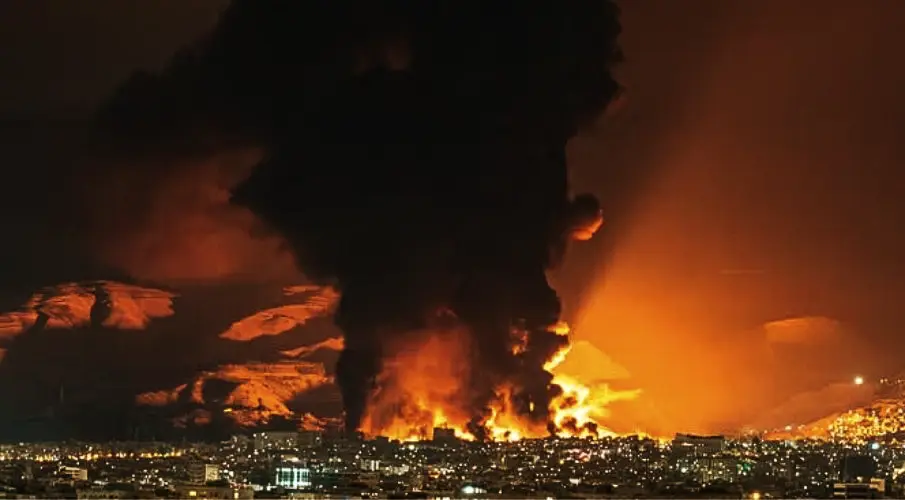
The war in the Middle East is increasingly spiraling out of control. Iran’s supreme leader Mojtaba Khamenei spoke publicly for the first time since the attacks began and made clear that the strikes on states along the Persian Gulf will continue. As the fighting escalates, international organizations are already reporting one of the largest waves of displacement in the region in years. According to the United Nations refugee agency, up to 3.2 million people in Iran have been driven from their homes. Many fled from Tehran and other major cities toward the north or into rural regions.

The military situation is worsening almost by the hour. Israel confirmed new airstrikes on targets in Iran, including once again a facility in Parchin connected to the so called Taleghan-2 complex. The installation had already been destroyed in October 2024, but satellite images had recently shown that Iran had resumed work there. At the same time an airstrike in western Iraq hit a base of the pro Iranian militia Popular Mobilization Forces. At least 14 fighters were killed and 36 others injured. The brigade involved, Ansar Allah al-Awfiya, belongs to those militias that had repeatedly shelled U.S. bases in Iraq in recent days.
Israel is also preparing an expansion of the war. Defense Minister Israel Katz declared after a massive rocket attack by Hezbollah from Lebanon that the military had received orders to widen the operation. If the Lebanese government does not stop Hezbollah’s attacks, Israel will act itself and take control of the area. During the night Hezbollah fired around 200 rockets at northern Israel. Many were intercepted, but sirens wailed for hours. Residents report a night filled with explosions.
Stephen Flynn, leader of the Scottish National Party in the British House of Commons
“Let us make one thing clear: Donald Trump’s war against Iran is illegal. … An American Tomahawk missile strikes an elementary school and kills 110 children. Does he consider that a war crime?”
The conflict is now reaching far beyond Iran. In Dubai two Iranian drones struck. They hit buildings along Sheikh Zayed Road, one of the city’s most important traffic arteries. According to authorities no one was injured. In Kuwait drones hit the international airport and damaged infrastructure. Here as well there were no casualties. At the same time an Italian military base in Erbil in northern Iraq was struck by rockets or drones. Italian soldiers were unharmed, but equipment and buildings were damaged.
The Persian Gulf has now become one of the most dangerous trade routes in the world. At least 19 commercial ships have been damaged since the fighting began. Two ships were hit during the night in the port of Basra, another off the coast of the United Arab Emirates. Footage from Iran’s Revolutionary Guard shows an attack on the cargo ship Safesea Vishnu in which explosions struck the vessel. In the footage a man can be heard shouting that the destruction of an American tanker has been carried out and that he obeys Khamenei.

Traffic through the Strait of Hormuz has practically collapsed. Some captains are trying to protect their ships by presenting themselves as Chinese. Data from MarineTraffic show that several tankers changed their signals and sent messages such as “Chinese owner” or “Chinese crew.” The background is reporting that Iran has so far avoided ships with Chinese connections because China is closely tied economically to Tehran.
The effects are being felt worldwide. The price for Brent crude oil rose again above 100 dollars per barrel after temporarily reaching nearly 120 dollars in recent days. U.S. Energy Secretary Chris Wright spoke of a significant disruption of global oil trade. In the short term the world will experience economic pain, he said on American television. The goal, however, is to secure the long term stability of energy supplies and to disarm Iran militarily.
Europe is already reacting to the economic consequences. Greece introduced emergency measures and limited profit margins for gasoline, diesel, and numerous everyday products. Government spokesman Pavlos Marinakis said the price caps will initially apply until the end of June. At the same time Athens is examining the use of small modular nuclear reactors in order to secure more stable energy prices in the future. Diplomatic pressure is also increasing. Egypt’s foreign minister Badr Abdelatty spoke with colleagues from Qatar, the United Arab Emirates, Bahrain, Oman, and Germany. All agreed that only diplomacy can end the war. Abdelatty also welcomed a resolution by the United Nations Security Council calling on Iran to stop attacks on its neighbors. Egypt warned that further escalation would harm all countries of the region.
Meanwhile global political balances are also shifting. The Kremlin confirmed talks about energy issues between envoys of Vladimir Putin and representatives of Donald Trump in Florida. Putin’s spokesman Dmitry Peskov said cooperation between Russia and the United States could be an important factor in stabilizing oil prices. Whether Washington might in return ease sanctions on Russian oil he left open, but said the subject was being discussed. The war is simultaneously altering other conflicts. Ukrainian President Volodymyr Zelenskyy is trying to conclude an agreement with the United States on the joint production of drones and air defense systems.
The background is the Iranian Shahed drones that are now being used both in the Middle East and in the war against Russia. Zelenskyy hopes that the American government, in light of the new threat in the Middle East, could become more interested in such cooperation. At the same time aid organizations reported new attacks on religious sites in the West Bank. In the village of Duma a mosque was set on fire and covered with graffiti. According to Palestinian authorities 18 Palestinians have already been killed this year in the West Bank by the army or by settlers.
In the Beirut district of Dahiye widespread destruction is occurring, which has been the target of continuous attacks for days. Status: March 12, 2026, 15:00 CET
At the same time Iran itself is intensifying its rhetoric. Parliamentary speaker Mohammad Bagher Qalibaf threatened that the Persian Gulf will be “filled with the blood of the invaders” if Iranian islands are attacked. Responsibility for possible dead American soldiers lies personally with Donald Trump, he declared in a message on the internet. While rockets fly over Israel, Lebanon, Iraq, and the Persian Gulf, large fuel depots are now also burning. In Oman firefighters in the port of Salalah fought a blaze in fuel tanks after Iranian strikes hit the facility. The war has therefore long since reached far beyond military targets. It is cutting deeply into infrastructure, trade, and everyday life across the entire region.
The balance of the first week already shows the scale. According to the Pentagon the war cost the United States around 11.3 billion dollars in only seven days. The figure was presented to the U.S. Congress in a confidential session. The front lines now run from Tehran through Baghdad and Beirut to the Persian Gulf. Attacks on ships, drones over major cities, and rockets over Israel show that this war will not remain locally contained. It is reshaping trade routes, energy prices, and political alliances at the same time. And it is driving millions of people into flight.
Updates – Kaizen News Brief
All current curated daily updates can be found in the Kaizen News Brief.
To the Kaizen News Brief In English


Trump hat die Zündschnur gezündet und nun brennt sie unaufhaltsam.
Diplomatie.
Diplomatie ist immer besser als Krieg. Da sind wir uns wohl einig.
Aber wir dürfen nicht vergessen, wer den Krieg, trotz Termin für Gespräche begonnen hat.
Die Reaktionen in der gesamten Welt war, vor allem in den ersten Tagen der Angriffe seeeehr Verhalten.
Erst seitdem der Iran nicht nur Militärbasen der Amerikaner angreift, wird Kritik lauter.
Der Ölpreis steigt und steigt.
Noch immer ein Motor der Weltwirtschaft.
Das wird schwerer bewertet als der Tod von Menschen … den Mädchen aus der Schule 😞
So lange der Iran als alleiniger Täter hingestellt wird, seine Angriffe (die definitiv völkerrechtswidrig sind, da keines der Länder Iran angegriffen oder ihm den den Krieg erklärt hat), wird sich der Iran (noch) nicht zu Gesprächen bereit erklären.
Voraussetzung ist immer eine Waffenruhe von allen Beteiligten.
Und danach sieht es derzeit nicht aus.
Die Frage ist, wie werden die Golfstaaten in der nächsten Zeit reagieren?
Auch wenn Kritik in diesen Staaten kaum möglich ist, fragen sich die Menschen sicher, hinter virgehaltener Hand, warum nichts für ihre Sicherheit getan wird.
Diese Regime in den Golfstaaten halten ihre Macht aufgrund des Wohlstandes und der busherigen Stabilität.
Wenn das weg fällt, sind die Folgen unabsehbar.
Dazu der Drang Israel’s Teile vom Libanon einzunehmen.
..absolit richtig, entscheidend wird auch sein, wie sich saudi arabien verhält