
Trump says the pain will be short. Reality shows something else. On February 28 the United States and Israel struck Iran for the first time. Nine days later every American who fills up is paying the price. On March 11, 2026, gasoline costs 3.58 dollars per gallon on the national average. That is the eleventh consecutive day of price increases. Before the war began it was below three dollars. In California a gallon now costs 5.34 dollars. In Kansas - the cheapest state - 3.01 dollars. Patrick De Haan, head of petroleum analysis at the price tracking service GasBuddy, calculated what that adds up to: Americans are spending 200 million dollars more per day on gasoline than they were eight days earlier. And that number will continue to rise. Anyone driving a standard passenger vehicle - tank capacity between 12 and 16 gallons (1 gallon = 3.785 liters) - paid about 36 dollars for a full tank before the war. Today it is 43 dollars. Anyone driving an SUV, with up to 21 gallons of capacity, feels the difference even more clearly.
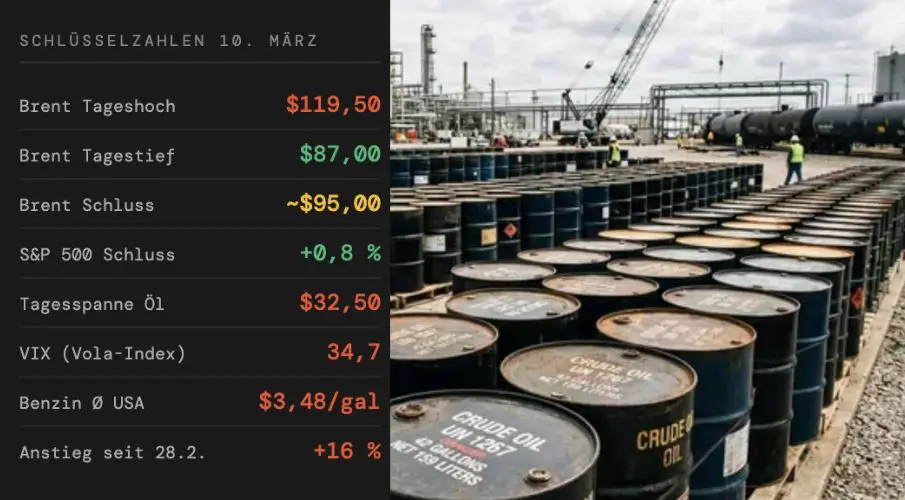
The price of crude oil moved in the first week of the war in a way that left economists searching for words. The global benchmark price temporarily rose to 119.50 dollars per barrel - an increase of 65 percent compared to the level before the war began. That was the highest level since the Covid pandemic. Then Trump stepped in front of the cameras on Monday afternoon and told CBS that the war was “very finished, pretty much.” The S&P 500 jumped by 0.5 percent within seconds and closed the day up 0.8 percent - the best single day in more than a month. Oil fell below 90 dollars. In the evening, at a press conference around 5:30 p.m., Trump corrected himself: the war was not nearly over, it was just on schedule, and they would continue. The oil price rose again.
Kristina Hooper, chief market strategist at Man Group, one of the largest investment managers in the world, put it this way: Trump cares about the markets, especially the stock market, that makes sense, he wants to calm fears. But, Hooper said, even if Trump declares the war over, Iran could continue fighting. We will leave that statement uncommented for now. What Trump has ethically never understood or wanted to understand: “The stock market does not solve consumers’ problems. It does not solve many of the banks’ problems.” - “But it makes individuals rich.”

What March 10 Revealed in the Markets
Brent loses 30 dollars in three hours. The S&P reverses direction twice. And the decisive moves happen precisely when the fewest people are watching.
At 02:00 p.m. ET on March 10, 2026, Brent Crude was trading between 115 and 119 dollars. What followed was the strongest single move of the day - triggered not during the hours when analysts and journalists are watching, but in a window of thin liquidity in which any larger position drives the price. By 05:00 p.m. ET Brent had fallen to 87 to 90 dollars. Thirty dollars in three hours. That is not normal market behavior.
Anyone who was short during that phase held one of the most profitable positions of the entire Iran war. The question that follows is not speculative but technical: When were those positions built, and by whom? Options market data show open interest, expiration dates, and strike prices. Anyone who matches trade time stamps with the overnight news flow will get a picture. That picture is not yet available. But it will emerge.
As the day progressed oil stabilized. In U.S. pre market trading between 12:00 and 14:30 p.m. ET the S&P future turned positive and Brent settled between 88 and 92 dollars. The market read political communication from Washington as a signal of possible de escalation. With the opening of U.S. exchanges at 04:30 p.m. ET the recovery continued. Energy stocks came under pressure, airlines and consumer stocks rose. Between 05:30 and 06:00 p.m. ET the S&P 500 gained around 0.5 percent intraday - accompanied by a noticeable rotation out of the energy sector into higher growth names. Anyone who was long oil puts at the 87 dollar low while simultaneously betting on consumer stocks had a very good afternoon.
At around 5:30 p.m. ET Trump changed his public statement. The war was not almost over, he said, it was merely on schedule and would continue. Brent immediately rose to 95 to 98 dollars. The S&P gave back part of its gains but still closed up 0.8 percent. From a trading perspective what remains is a day that reversed direction three times - and in which each reversal was closely tied to public statements by a single man.
That is precisely the point. When market moves of this magnitude are not triggered by fundamentals but by sentences in press conferences, the relevant question shifts. It is no longer: What moved the market? It becomes: Who knew in advance what was going to be said? In the time windows immediately preceding the public statements there were unusual call and put positions. That is no longer the question. The question is who was behind them. Such constellations are not automatically proof of unlawful behavior - but they mark the point at which a volatile trading day becomes a case.
Investigations are underway. A reliable evaluation takes weeks, not days. Trade time stamps, volume spikes, open interest, and unusual options chains must be carefully matched with the political and military news flow. Only then can it be determined whether March 10 was merely a day of extreme nervousness - or whether certain market segments show more than the official statements do. The Fed is in a bind. Not for the first time in this administration - but now in a new dimension.
Before the war the central bank had already lowered rates to a range of 3.5 to 3.75 percent after a series of cuts in the fall of 2024. Since January 2026 it has paused. No one expects a change at next week’s meeting. The real question is what comes after. Before the war markets expected the next rate cut in July. Now they are betting on September. That is the friendly version. The less friendly one is: perhaps not at all.
Alan Detmeister, formerly a Fed economist and now at UBS, formulates the fundamental problem: A supply shock forces the central bank in two directions at once. Rising prices argue for rate hikes. Falling output and rising unemployment argue for rate cuts. The Fed cannot serve both simultaneously. It waits. And waiting has its own price. Austan Goolsbee, president of the Federal Reserve Bank of Chicago, put it this way in an interview on Friday: “If the labor market gets worse and inflation gets worse at the same time, it is not clear to me what the immediate response should be.”
The labor market does in fact give cause for concern. In February 92,000 people lost their jobs. The unemployment rate rose to 4.4 percent. These are not yet dramatic numbers - but they show a direction. The consumer price index to be released on Wednesday still covers February and ends on the last day of the month - the day the attacks began. It therefore shows a snapshot from before the oil shock. Year over year inflation stood at 2.4 percent, core inflation - excluding energy and food - at 2.5 percent. Subdued, as economists say. What follows will look different.
It is estimated that every ten dollar increase per barrel of oil, if sustained, raises core inflation by about 0.05 percentage points. That sounds small. But oil has risen 30 dollars in the past month, and no one knows how long that will last. The Fed’s preferred inflation gauge, the Personal Consumption Expenditures Price Index, stood at 2.9 percent in January - well above the 2 percent target. For five years inflation has not fallen below that target a single time, as Riccardo Trezzi, former Fed economist and head of the research firm Underlying Inflation, notes. “At some point you start to ask: Are we really returning to target?”
Gregory Daco, chief economist at EY Parthenon, has run the scenarios. In the event of a sustained conflict lasting many months, global inflation could rise two percentage points faster than originally expected. In the United States that would mean inflation above four percent this year. Economic growth would shrink to 1.6 percent compared to the originally projected 2.4 percent. Tim Mahedy, chief economist at Access Macro and a former Fed economist, goes further: “I am very concerned that this could push us into a recession if it persists.” Consumption accounts for about 70 percent of U.S. economic output. Household savings are largely depleted. The oil price shock, Mahedy says, “is hitting at a really bad time.” And it is not coming alone - it comes after the tariffs, after the immigration policy. Mahedy sums it up: “This administration is a sequence of supply shocks.”
Bernard Yaros, lead U.S. economist at Oxford Economics, points out who bears the burden specifically: low income households, because energy makes up a disproportionately large share of their monthly expenses. Trump sees all of this, and he steers on anyway. Not because he does not know the numbers - he knows them. But because his benchmark is different. He does not have one.
In his address to Congress in February he had proudly declared that gasoline was below 2.30 dollars in most states, at some places 1.99 dollars, and in Iowa he had even seen 1.85 dollars per gallon. Gas prices as proof of economic strength - that was his favorite data point. Today he no longer mentions it. At his meeting with Republicans in Doral, Florida, earlier this week he left the point out and spoke instead about the stock market: “It is going to go much higher.” He added, regarding the war: “Once we get this behind us, which we really had no other choice.”
Senator John Thune of South Dakota, the Republican majority leader, told reporters that gasoline prices are “always kind of a benchmark.” He added that he is “always concerned about oil and gas prices.” That is the restrained formulation for something that worries Republican strategists far more than they publicly admit - namely that the war could destroy the party’s economic message for the midterms in November.
Before the war Trump’s staff had insisted at a strategy meeting at the Capitol Hill Club that lowering the cost of living had to be at the center of the midterm campaign. Sarah Bianchi, former trade official under Biden and now at Evercore ISI, put the criticism this way: “It is surprising that they approached this without a more developed plan. They seem to be improvising on this issue, and it can be hard to move the needle.” Patrick De Haan of GasBuddy said he was surprised by the administration’s apparent lack of planning on gasoline prices. Previous administrations - of both parties - actively engaged analysts and experts or at least informed them of their steps. “There is a pretty intense sense of alarm among Americans about the pace of price increases,” he said.
That captures the moment precisely. The stock market rallies when Trump hints at peace. It dips slightly when he escalates further. But the woman in Kansas paying 3.01 dollars, or the man in California paying 5.34 dollars - they play no independent role in this calculation. They are the aggregate.
Henrietta Treyz, head of economic policy at Veda Partners, says Trump’s real priorities remain tax cuts, deregulation, and deploying his political influence for corporate deals. “The American public is concerned about affordability, housing, high electricity prices, and high grocery prices.” That gap between what the administration has in mind and what households feel in their wallets existed before the war. The war has only widened it. At some point, if oil prices remain high long enough, this will no longer be an abstract economic debate. It will add up - at the gas pump, at the supermarket, on the credit card statement. And then Trump will need a new data point to distract from it.
Updates – Kaizen News Brief
All current curated daily updates can be found in the Kaizen News Brief.
To the Kaizen News Brief In English


Danke für diesen hervorragenden Bericht.
Was mich erschreckt, dass die Märkte auf jedes Räuspern von Trump reagieten.
Und zwar alle Märkte.
Und jetzt auch noch die Ölpreise.
Ich erinnere mich noch an einen Artikel von Euch. Vom Anfang Trumps Amtszeit. Wo noch das Mikrophon an war und Trump mit einigen Ministern/Abgeordneten genau etwas in die Richtung besprach.
Wenn man weiß, dass die Märkte derart auf Trump reagieren, ist es einfach Gewinne zu machen.
Vorausgesetzt, man weiß, was er wann sagt.
Ich bin gespannt, was Eure weiteren Recherchen ans Licht bringen.
ich danke dir, es wird monate dauern, das auszuwerten, dazu haben wir noch ICE und die epstein recherchen + aktuelles und iran krieg – aber die recherche wird gemacht, ist aber mit vielen unterlagen, belegen und zahlen verbunden
Wie sieht denn der Aktienmarkt im erneuerbaren Energien Bereich aus?
der Aktienmarkt für erneuerbare Energien hat sich in den letzten zwei tagen weitgehend stabil gezeigt. Der internationale Branchenindex RENIXX bewegte sich leicht im Plus und deutet eher auf eine vorsichtige Erholung als auf größere Turbulenzen hin.