
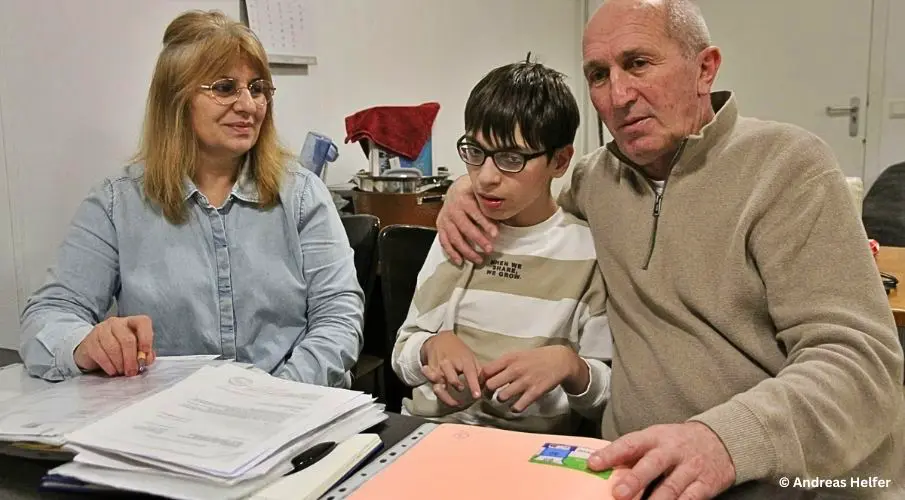
It is news many people have been waiting for months to hear. The family of 14 year old Bagrat has been granted the right to remain in Germany. For his mother Nani Ninua it is more than a decision by authorities. It is the certainty that her son can continue living without the constant fear of deportation. "For Bagrat we will overcome and endure every obstacle, every challenge and every suffering," she writes. She adds a sentence that means a great deal to her: "Give a person a goal worth living for and he will endure any suffering." A thought by Johann Wolfgang von Goethe that she has made her own.
The boy's name means "gift from God." For many people who followed his story this meaning now seems almost like a quiet explanation for what has happened. Just a few days ago his future was uncertain. Bagrat lives with severe medical conditions. After a brain hemorrhage during premature birth he developed encephalopathy, spastic cerebral palsy, a combined developmental disorder, epilepsy and blindness. In addition he suffers from a life threatening bladder disorder. His brain does not properly control bladder emptying. At the Clinic and Polyclinic for Urology and Pediatric Urology at the University Hospital Bonn he therefore receives specialized treatment through a catheter. This method stabilizes his condition. Without it kidney failure is likely. The full story can be found here.
The family came to Germany from Georgia three years ago because comparable treatment for the boy was not available there. Bagrat now attends the LVR special education school at Königsforst in Rösrath. There he receives support in physical and motor development. He has learned German. And he sings. Anyone who hears him quickly understands why his mother speaks of an exceptional talent. His voice is clear, calm and remarkably confident. At the music school he is being specifically encouraged. He will perform at the school's Christmas celebration. For many people this is a moving moment because the boy is not seen there as a patient but as someone who can do something.
In the family his disability is not hidden. It is openly shown. That is unusual because many families in similar situations try to keep such illnesses out of the public eye. Nani Ninua takes a different path. Her son belongs to her exactly as he is. For months, however, the possibility of deportation loomed. The immigration authority of the Rhein Sieg district demanded that the family leave the country. An emergency application to the Administrative Court of Cologne failed. The judges argued that treatment in Georgia would be possible even if it looked different. Instead of the catheter method tablets and a syrup could be used. Private clinics were also available. The family saw it differently. Doctors at the University Hospital Bonn warned that incorrect therapy could lead to severe infections, including urosepsis and death. For Nani Ninua this was not an abstract medical discussion. It was fear for the life of her child.
Support came from the refugee initiative Lohmar Siegburg represented by Christa Feld. She advocated intensively for the family. The refugee initiative Lohmar Siegburg has existed since 1992 and was originally formed during the Balkan war in Lohmar and Siegburg before both groups merged in 1999. The association supports refugees in settling in Germany, learning the language, attending school, training and employment, as well as dealing with authorities in everyday life. Around 50 members are involved in the initiative, about ten of them actively working with refugees. In addition, German courses, tutoring and legal training sessions are organized in cooperation with lawyers.
A deportation would also have been inadmissible if adequate medical care cannot be guaranteed in the country of origin or if an existential emergency situation is likely. The legal basis for this is the European Convention on Human Rights. The family also found support in local politics. The former mayor of Lohmar, Claudia Wieja of the Greens, publicly supported granting the family the right to remain and said that this was not only about legal paragraphs but about humanity. Her successor Matthias Schmitz of the CDU announced talks with the immigration authority.
Despite this the situation remained unresolved for a long time. Georgia is considered a safe country of origin, so political asylum was excluded from the beginning. Even the hardship commission of the state of North Rhine Westphalia initially could not reach a solution. Nani Ninua prepared in parallel for a German language exam. She signed an employment contract with a cleaning company. Her husband Merab Sharia, a trained electrician of retirement age, offered voluntary work.
Now the situation has turned. The family may stay. For Christa Feld, who closely followed the developments, the news is a moment of relief. This was also reflected in her email through which the honest and heartfelt message reached us. The family has achieved a goal for which they fought for a long time. Bagrat can continue going to school. He can continue receiving treatment. And he can continue singing. Perhaps that is exactly why this story has moved so many people. It shows how different politics and reality can sometimes be. On one side there are files, deadlines and administrative responsibilities. On the other side there is a boy who, despite severe illnesses, has a voice that can fill a room.
Now Bagrat may stay. For his mother this is not a political story. It is a decision about life and future. In the end, a German-American-English joint effort has brought about a good outcome. The Seebrücke - "Siegburg zeigt Haltung" and former mayor Claudia Wieja also helped make this possible. And perhaps the simple hope remains that one day her son will stand on a stage, raise his voice, and sing.
Updates – Kaizen News Brief
All current curated daily updates can be found in the Kaizen News Brief.
To the Kaizen News Brief In English


Eine gute Nachricht für Bagrat und seine Familie.
das hat uns auch sehr gefreut und zeigt, man kann über länder- und kontinentgrenzen trotzdem miteinander arbeiten
Ich wünsche der Familie viel Glück! Und ich bin auch erleichtert, dass es doch noch ein gutes Ende genommen hat!!!!
wir haben uns auch sehr gefreut